DbcultAccessing Vault...
Cult Review
Senior Film Conservator
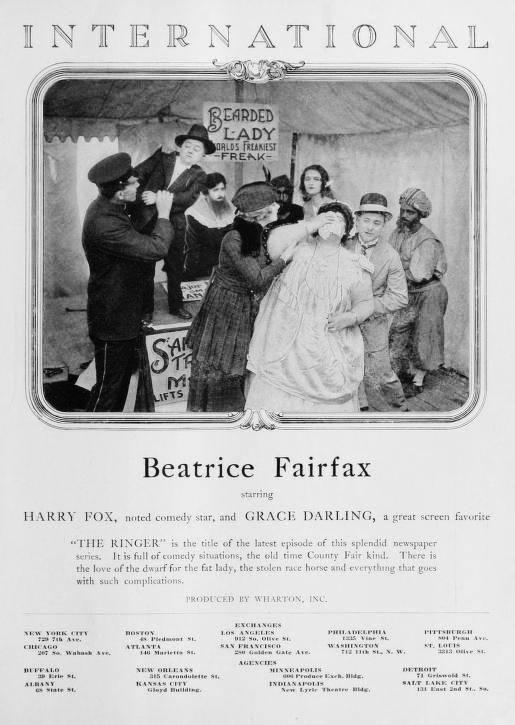
In the annals of early cinema, few serials captured the public imagination quite like Beatrice Fairfax, a weekly dose of thrilling mystery and daring escapades. Episode 13, aptly titled 'The Ringer,' stands as a particularly compelling installment, a testament to the ingenuity of silent film storytelling. This chapter plunges us into a world where high-stakes horse racing intersects with the shadowy underbelly of a country fair, weaving a narrative tapestry rich with deception, quick thinking, and the relentless pursuit of justice. It's a fascinating glimpse into the moral ambiguities and the clear-cut heroism that defined the era's popular entertainment.
The narrative commences with a classic setup: a seemingly impossible crime. Whitestocking, a thoroughbred of considerable renown, has vanished from its supposedly impregnable stall. The owner, Bitney, relays the perplexing details to Jimmy Barton: a diligent stable boy, utterly reliable, had been found in a drugged stupor, the stall door locked from the inside, its key still clutched in his pocket. The only other aperture, a small opening above the manger, was far too diminutive to admit an adult. This initial enigma immediately hooks the viewer, establishing a formidable challenge for our intrepid investigators. The film masterfully builds suspense, presenting an almost supernatural feat of thievery, compelling the audience to ponder the 'how' before even considering the 'who' or 'why.' It's a testament to the writers' ability to craft a compelling puzzle, reminiscent of the intricate plots found in contemporary detective literature.
While Jimmy grapples with the baffling horse theft, Beatrice Fairfax, the sage purveyor of advice, receives an equally peculiar missive. Cutie, the jovial 'fat lady' of a country fair sideshow, writes with distress, her dwarf sweetheart having been absent for three days without explanation. The intuitive Beatrice, with her keen understanding of human nature, immediately senses a connection, however tenuous, between these two seemingly disparate events. This is where the strength of the serial's premise truly shines: Beatrice's intellectual prowess and Jimmy's pragmatic, action-oriented approach create a complementary investigative synergy. Their decision to venture into the vibrant, often shadowy, world of the country fair is a pivotal narrative turn, drawing the audience into a realm brimming with eccentric characters and hidden agendas. The contrast between the genteel world of Beatrice's advice column and the gritty reality of the fairgrounds provides a rich backdrop for their unfolding adventure.
Upon entering the 'freak tent,' Beatrice engages Cutie, who points out the elusive dwarf. It's here that the pieces begin to fall into place with a swiftness characteristic of the serial format. Jimmy, ever the astute observer, witnesses a clandestine exchange: Wilder, a bookmaker with an air of ill-repute, slips a note to the dwarf. The contents, "Sam arrested for shell game. We divvy after race," confirm their suspicions – the dwarf is entangled in a criminal enterprise. The dwarf's gleeful reaction and subsequent tucking of the note into his belt provide Jimmy with a golden opportunity. In a moment of audacious cunning, Jimmy, under the pretense of whispering a jest, physically lifts the dwarf and deftly pilfers the incriminating note. This scene is a masterclass in silent film action, relying on clear visual cues and the audience's ability to infer the quick, surreptitious act. The film's depiction of the fairground, while a common setting for early cinema, is imbued with a sense of underlying menace, a stark contrast to the outward merriment, effectively setting the stage for the unfolding drama.
With the note secured, Jimmy embarks on a truly daring plan. Disguising himself as a fakir, he sets up a shell game on the main avenue of the fairgrounds, deliberately inviting arrest. This calculated risk pays off; he is apprehended and, in a stroke of narrative convenience, locked into a cell adjacent to Sam, the very accomplice mentioned in the note. The tension escalates as Jimmy, with remarkable dexterity, manages to purloin the jailer's keys during his incarceration. This sequence highlights Jimmy's resourcefulness and physical prowess, embodying the archetypal silent film hero who relies on wit and daring to overcome obstacles. His subsequent interrogation of Sam, inducing him to confess, is a crucial turning point. The revelation that the dwarf, due to his diminutive size, was the one who slipped through the manger opening to drug the stable boy provides the ingenious solution to the 'impossible' theft. This twist is both satisfying and cleverly executed, leveraging the unique physical attributes of one of its characters to resolve the central mystery. The depiction of the jail, though brief, effectively conveys the urgency of Jimmy's mission, echoing the confined spaces and desperate plights seen in crime dramas like The Lyons Mail.
While Jimmy is enacting his elaborate jailbreak, Beatrice, driven by Cutie's anxieties and her own burgeoning suspicions, continues her investigation. Her direct questioning of the dwarf about his three-day absence elicits a palpable fear, sending him scurrying to warn Wilder. This moment underscores Beatrice's independent agency and her crucial role in advancing the plot, even when separated from Jimmy. The dwarf finds Wilder in another box stall, meticulously overseeing the blacking of Whitestocking's legs, transforming him into 'Black Joe' – the ringer. The sign on the door, explicitly stating 'Black Joe,' serves as a clear visual confirmation of the nefarious plot. Wilder, ever the villain, dispatches the dwarf back to Beatrice with a deceptive invitation: "If you'll come with me, I'll tell you." Beatrice, perhaps a touch too trusting in her pursuit of truth, follows, only to be seized and bound by Wilder and his stable boy. This classic damsel-in-distress scenario, while a common trope of the era, is executed with genuine tension as the ringer is led out to the race, leaving Beatrice in dire straits. The escalating danger for Beatrice effectively raises the stakes, propelling the narrative towards its thrilling climax. The vulnerability of even intelligent characters in the face of criminal cunning is a recurring theme, sometimes explored with tragic depth in films like The Weakness of Man.
Jimmy, having ascertained Beatrice's whereabouts from a frantic Cutie, rushes to the stable. His recognition by the constable who arrested him adds a layer of comedic urgency, as he is pursued by a growing crowd. With a dramatic flourish, he breaks down the stable door, overpowering the guard and heroically rescuing Beatrice. His rapid explanation to the constable, delivered with the urgency of a man against the clock, sets the final act in motion. However, despite his frantic dash to the racetrack, it is 'too late' – the "Free-for-All" race has begun, with 'Black Joe,' the ringer, already in the lead. This moment of near-failure is a powerful narrative device, heightening the tension before the ultimate triumph. Wilder and his confederates, who had wagered immense sums on the ringer at staggering odds, are promptly arrested, their hubris leading to their downfall. The visual spectacle of the race, even in its silent depiction, conveys the excitement and the high stakes involved. The subsequent confrontation at the judges' stand is the narrative's crescendo. Jimmy, with a flourish, protests the race and dramatically proves his charge by washing the stain from Whitestocking's ankles, revealing the true identity of the horse beneath the disguise. The crowd's applause is the satisfying culmination of the episode's intricate plot, a public vindication of justice. Meanwhile, Beatrice, ever the empathetic soul, attempts to console the distraught Cutie as detectives lead away the struggling dwarf, a poignant end for a character caught between affection and criminality.
The performances, while adhering to the expressive style of silent cinema, effectively convey the motivations and emotions of the characters. Grace Darling as Beatrice Fairfax brings a refined intelligence and unwavering resolve to her role, balancing her vulnerability with a keen sense of justice. George Connor, as Jimmy Barton, embodies the quintessential dashing hero, his physical dynamism and quick wit driving much of the episode's action. His portrayal is a compelling blend of courage and cunning, making him an engaging protagonist. Elsie Baker's Cutie elicits sympathy, her concern for the dwarf providing a human element to the criminal machinations. Harry Fox's dwarf, a character both pitiable and complicit, is particularly memorable, his unique physicality being central to the plot's ingenious solution. His final, struggling apprehension adds a touch of pathos to the otherwise triumphant conclusion. The film subtly explores themes of deception and revelation, the contrast between outward appearances and hidden truths. The country fair itself serves as a microcosm of society, where innocence and exploitation, spectacle and subterfuge, coexist. The immense sums wagered on the ringer highlight the intoxicating, often corrupting, allure of gambling, a vice frequently scrutinized in early cinema. The narrative champions the triumph of intellect and bravery over criminal cunning, a timeless message resonating with audiences then and now.
As a product of its era, 'The Ringer' showcases the distinct cinematic language of silent films. The pacing is brisk, propelling the audience through a series of escalating events without ever feeling rushed. The use of intertitles is judicious, providing essential dialogue and exposition without bogging down the visual flow. The expressive acting, often characterized by exaggerated gestures and facial expressions, was crucial for conveying emotion and intent without spoken words. The director skillfully employs visual storytelling, from the close-up on the incriminating note to the dramatic reveal of Whitestocking's true identity, leveraging the medium's strengths. The serial format, with its episodic structure, allowed for self-contained mysteries that also contributed to the overarching appeal of the Beatrice Fairfax character. Each episode had to deliver a compelling narrative arc while maintaining continuity, a challenge 'The Ringer' meets with aplomb. The film's aesthetic, while simple by modern standards, effectively creates an atmosphere of mystery and adventure, drawing the viewer into its world. The construction of the plot, relying on physical attributes and clever misdirection, is a hallmark of the era's ingenuity, echoing the intricate narrative puzzles found in films like The Man Who Found Himself where identity and disguise play central roles. The dramatic tension is built not through dialogue, but through the rapid succession of events and the visual representation of peril, a technique perfected in early action and mystery serials.
Even decades removed from its original release, 'Beatrice Fairfax Episode 13: The Ringer' retains a certain charm and effectiveness. It serves as a captivating example of silent-era detective serials, demonstrating how compelling narratives could be crafted with limited technological means but boundless creative energy. The episode's intricate plot, memorable characters, and satisfying resolution make it a standout entry in the series. It’s a reminder of the foundational storytelling principles that continue to inform cinema today: a strong mystery, resourceful heroes, and a clear moral compass guiding the narrative. While it might lack the psychological depth of later, more complex dramas like Les misérables, its strength lies in its unpretentious commitment to thrilling entertainment. The episode's enduring appeal lies in its ability to transport us to a simpler yet equally captivating cinematic past, where a stolen horse, a determined duo, and a clever dwarf could orchestrate an unforgettable tale of crime and justice. It’s a delightful piece of film history, well worth rediscovering for anyone interested in the origins of cinematic suspense and the timeless art of the mystery story.
Community
Log in to comment.