DbcultAccessing Vault...
6/10
Senior Film Conservator
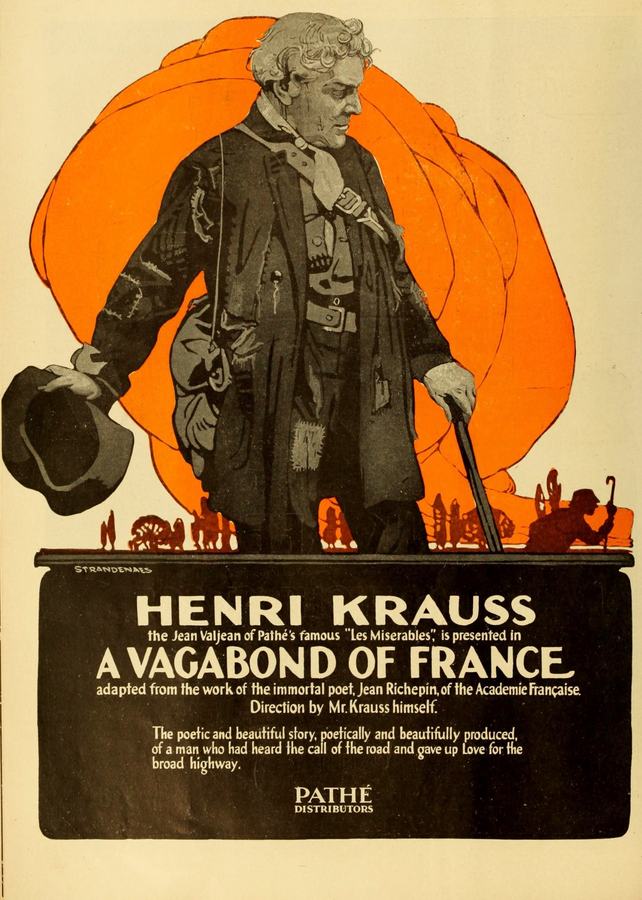
A definitive 6/10 rating for a film that redefined the boundaries of cult cinema. Le chemineau remains a cornerstone of transgressive art.
The first time I saw Le Chemineau I was drunk on winter light, the sort that slants through attic windows and makes dust motes look like cosmic ash. The print was bruised, flickering, its nitrate bruises bleeding into the emulsion until the vagabond’s silhouette became a rip in reality. Silent cinema at its most feral does not merely depict myth; it exhales it. Jean Richepin’s 1905 one-reel fever dream—shot when Méliès was still conjuring moons and Griffith was a stock-company ham—feels older than celluloid, as though the Lumières had filmed a parable that already existed in the marrow of peasants who could neither read nor write but knew the taste of rue.
Plot synopses flatten this film into a triangle: wanderer, girl, road. Yet the true protagonist is departure—the moment when boots pivot on gravel and lungs swell with the narcotic of elsewhere. Henry Krauss, gaunt as a Caravaggio saint, moves through the frame like a delayed echo; every footstep seems to arrive a second after it should, lending the world a faint vertigo. The village, unnamed, is a handful of stone teeth set in a jaw of frostbitten fields; the plague that gnaws Pierre’s sheep is less veterinary than eschatological, a greenish mist that recalls the Mark of Cain and the punitive murrains of Exodus. When the stranger kneels, pressing a poultice of bruised herbs into the fleece, the gesture carries the weight of pagan liturgy; the camera, immobile, watches like a priest who has forgotten the words.
Toinon—played by Charlotte Barbier-Krauss with the stunned radiance of a girl who has never seen herself in glass—does not fall in love so much as collide with it. Their courtship is a single dusk: she offers cider, he offers stories of coastlines that taste of almond and shipwreck. Close-ups were still three years away, so intimacy must be inferred from the way her apron trembles in mid-distance when he speaks. The night they share is edited with the austerity of a wound; a fade to black, and dawn finds the bed empty, sheets folded as if to deny that a body ever warmed them. The road, that ancient dominatrix, reclaims her paramour with the indifference of a tide.
What follows is a rural leçon des choses: marriage as ploughshare, grief as crop rotation. François, solid as an oak beam, marries Toinon while the village bells crack their bronze voices across the furrows. The film leaps years in a single cut, a brazen ellipsis that feels like a slammed gate; suddenly a boy hurls himself across the frame, all elbows and mischief—Toinet, the cuckoo’s child whose face is a haunting negative of the man who fled. Childhood is rendered in two shots: the boy stealing apples, the boy reciting catechism while staring at the rafters where swallows nest. Desire ignites when he pursues Pierre’s daughter, a slip of a thing with the eyes of a startled doe. Pierre, gnarled as olive bark, bars the union with the grim authority of a patriarch who has seen bastard blood warp like green wood. The secret he hoards—that Toinet’s father was the itinerant sorcerer—becomes a stone in the family’s throat.
Enter again the wanderer, hair now a shock of salt, coat patched by every weather of the continent. He arrives during a thunderstorm that turns the village into a chiaroscuro etching; lightning reveals him standing beside the sheepfold, as though the years between were a mere hiccup in the spool of fate. In a sequence that feels like recovered memory, he presses palm to Toinet’s brow and the boy’s fever—literal and dynastic—breaks. Pierre, witnessing, lowers his cane; bloodlines unknot, grudges dissolve like sugar in rain. One expects catharsis, reconciliation, the prodigal embracing his progeny. Instead the vagabond turns on his heel, coat flaring like a crow’s wing, and walks into the horizon that has always tugged at his ribcage. The final shot is not of departure but of absence: an empty lane, clouds passing overhead like pages torn from a calendar.
Formally, the film is primitive yet uncannily sophisticated. Depth is achieved not through focus but through superimposition: a double-exposed sky bruised with storm clouds hovers above the miniature village like a divine afterthought. The aspect ratio, boxy as a locket, squeezes bodies until they become vertical urges—everyone strains toward escape. Intertitles, sparse as haiku, appear only to name grief (“Il partit à l’aube”) or to invoke the road (“L’appel du chemin”). Tinting alternates between arsenic green for the plague sequences and a bruised amber for interiors, as though the world itself were diseased or nostalgic by turns. The camera never moves; instead, the world tilts into it, a strategy that makes every arrival feel fated and every exit postlapsarian.
Compare this austerity with the florid pathos of Life Without Soul or the Gothic histrionics of The House of Tears, both from the same annus mirabilis of 1905. Where those films clutch at melodrama like a lifebuoy, Le Chemineau practices renunciation with monastic rigor. Its nearest spiritual cousin among surviving silents might be Rip Van Winkle, yet where Rip’s exile is punitive, the wanderer’s is elective—an addiction more than a sentence. The film anticipates the transcendental homelessness that would haunt later road movies from Easy Rider to Paris, Texas, but locates the malady in pre-industrial Europe, suggesting that modernity did not invent the disease merely commodified the symptoms.
Performance styles oscillate between the tableau vivant and the incipiently naturalistic. Krauss keeps his face a mask of courteous fatigue, eyes glazed with visions no villager could parse; when he smiles, it is as if the decision pains him. Barbier-Krauss, his real-life spouse, performs Toinon’s despair by letting her shoulders sag a millimetre per reel; the cumulative effect is a woman eroding in real time. The child actor—credited only as Jacques Colsy—has the unselfconscious physicality of the unfilmed; he runs as though the camera were merely another tree. Their collective understatement creates a vacuum into which the viewer’s own memories of abandonment rush like cold air.
Thematically, the film is a palimpsest of biblical cadences. The stranger is both healer and Paraclete, yet his refusal to remain renders him an anti-Christ: salvation without stewardship. Toinon’s marriage to François evokes Ruth and Boaz, but the absent Naomi is a man who chooses orphanhood. Toinet’s forbidden love replays the Jacob-Rachel-Laban triangle, though here the obstacle is not labor but the shame of illegitimacy. When the wanderer finally liberates the lovers by revealing—without words—the boy’s patrimony, he enacts a reverse Abraham: instead of demanding the sacrifice of the son, he sacrifices the father’s claim. Yet the price is himself; he becomes the scapegoat laden with the village’s unspoken sins and driven into the desert of endless mileage.
Contemporary critics, those few who bothered, dismissed the picture as “a peasant conte moraux, agreeably pictorial but slight.” Slight! The word now clangs like a cracked bell. In an era when cinema was busy birthing detectives, fire-breathing locomotives, and moon-dwelling astronomers, Le Chemineau dared to dramatise the invisible: the moment when blood memory overrides social contract, when the desire for motion eclipses the narcotic of hearth. It is a film that trusts the audience to intuit trauma from a slammed gate, to read eternity in a man’s refusal to turn around.
Restoration has been mercifully kind. The Cinémathèque de Bretagne’s 4K scan preserves the flicker that makes torchlight shiver; the ear-worm clatter of the automatic shutter remains, reminding us that what we see is not life but its phosphorescent afterimage. Orchestral scores have been grafted by well-meaning musicians, yet I prefer the version projected in monkish silence, broken only by the wheeze of the carbon arc and the collective inhale of spectators recognising their own departures—those they fled, those they still court.
Viewing it today, in an age when every mile is mapped and every impulse instagrammed, the vagabond’s anonymity feels utopian. He carries no papers, leaves no digital spoor; even his name is a rumor. His curse is not poverty but amplitude—too much world, too little time. We, tethered to algorithms that quantify our every twitch, watch him vanish with the envious sigh of prisoners who hear a train whistle at night. The road calls, yes, but it no longer answers; asphalt has replaced dirt, and GPS satellites track the erstwhile freedom of gravel.
Still, the film refuses nostalgia. It does not lament a lost pastoral; it anatomises the universal gland that secretes restlessness. Toinet, product of betrayal and nurture, will perhaps repeat the cycle, bedding a village girl and bolting when the wheat sprouts. The final image—empty lane, indifferent sky—suggests not closure but a wheel perpetually about to turn. One thinks of Umirayushchiy Lebed, where swan-maiden and mortal lover part in similar silence, or of Where the Trail Divides, where the fork itself becomes destiny. Yet Le Chemineau offers no bifurcation, only a straight path that devours its own horizon.
So I return to it, year after year, as one returns to a scar, tracing its ridges for meaning that mutates with age. In adolescence I saw the wanderer as hero, his coat a flag of rebellion. In middle age I see the cost: Toinon’s face collapsing like a failed soufflé, Toinet’s childhood scarred by the ghost of choice. The film teaches that freedom and abandonment share a border thin as a spider’s thread; cross once, and you are forever the contagion in someone else’s blood. To leave is to become legend; to stay, compost. The genius of Le Chemineau is to render both fates intolerable, then to walk away whistling.
There are no extras, no making-of, no audio commentary in which academics parse the semiotics of barns. The film survives as a single, scorched negative, a relic from the era when cinema was still a fairground curiosity. Perhaps that is fitting. Explanations would cauterise the wound; essays would tame the beast. Better to let it haunt the periphery of film history, a rogue planet that wanders into our orbit every few years, reminding us that stories need not end in marriage or death—sometimes they end in distance, in the faint crunch of boots on a road that swallows names faster than lovers can invent them.
If you watch one silent film this year, let it be this whispered confession of incurable drift. But beware: the road will seem wider afterward, the night air scented with camphor and escape. And when you close your laptop, you may hear—impossible, yet certain—the receding echo of a man who has learned that the only sin is arrival, the only sacrament departure. He is already beyond the next hill, coat flapping like a torn map, while behind him the village bells count the hours for people who still believe that time is a circle rather than a straight line receding into fog.
IMDb —
1917
Community
Log in to comment.