DbcultAccessing Vault...
Cult Review
Senior Film Conservator
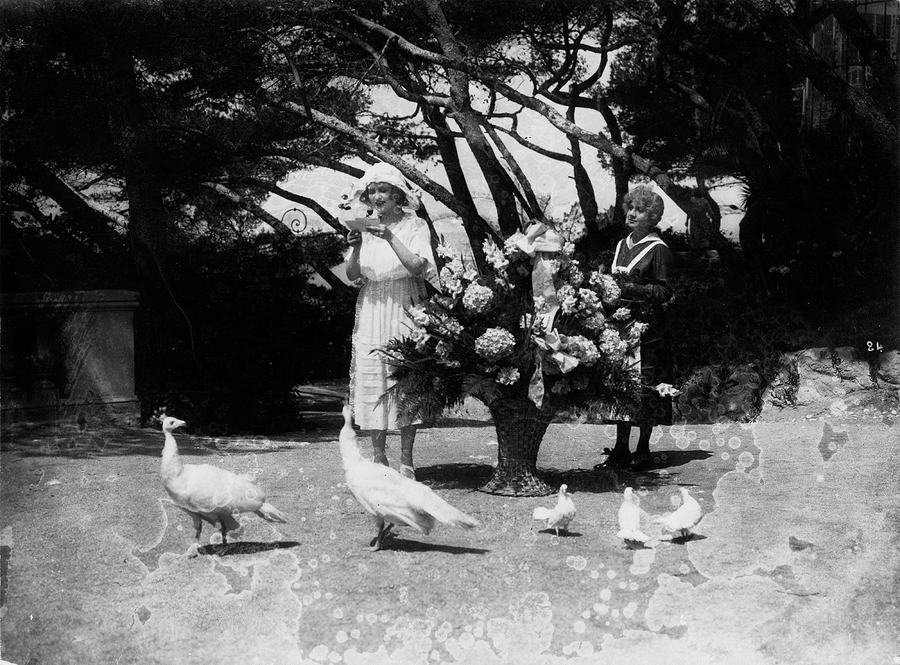
The first time I saw Le Dieu du hasard, I swear the projector itself held its breath.
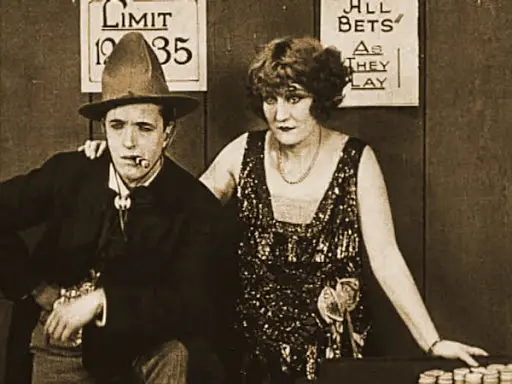
Fernand Nozière’s 1916 scenario is a mercury vial slipped into the bloodstream of pre-war Paris: it moves like liquid metal, seeping through gambling salons, music halls, and rain-slick alleys until the viewer feels the city’s pulse in his own wrists. Georges Tréville haunts every frame with the languid menace of a man who has already pocketed tomorrow. His tailcoat is a midnight flag; his monocle, a coin forever spinning. When he leans over the green felt, time folds like a bad hand, and you realize the movie isn’t about betting—it’s about cinema’s oldest flirtation: the illusion that we can cut the deck of existence.
Gaby Deslys, the real-life music-hall asteroid, combusts onscreen with a luminosity so tactile you can almost perfume the nitrate. Her Lola is both siren and scared child, warbling torch songs whose lyrics we never hear yet somehow understand: they are hymns to the moment before the coin lands. In close-up, Deslys’ eyes glisten like champagne about to lose its fizz; the intertitles don’t dare describe her voice, letting the orchestra’s wheezing brass stand in for timbre. The silence becomes a velvet cage—every spectator locked inside with his own private roulette wheel.
Félix Oudart’s inspector provides the moral counter-melody, but Nozière refuses to hand him the baton. Instead, the lawman drifts through scenes like a man reading last rites in a casino: each confession drowned under the clatter of chips. Watch how Oudart’s shoulders sag when he confronts Tréville beneath the Pont Neuf: gas lamps streak the water with copper ribbons, and for a heartbeat we suspect the prefect wants to lose, to surrender logic to the narcotic random.
Cinematographer Lucien Andriot, years before his Hollywood exile, treats the negative like a gambler treats stacked decks. Observe the chiaroscuro during the roulette montage: the wheel’s spokes strobe against pitch darkness, turning the screen itself into a zoetrope of obsidian and gold. Shadows are not absence but currency; light is the house always winning. In one audacious insert, the camera tilts down to a single white glove lying on cobblestones, raindrops drumming polka dots into the kid leather. No narrative function—pure emotional punctuation. You feel the glove belongs to you now, and you’ve lost something you never owned.
Compare this tactile fatalism to Old Hartwell's Cub where chance is a narrative punch-line rather than metaphysics. The American one-reeler treats coincidence like a jack-in-the-box: wind it up, laugh when it pops. Le Dieu du hasard hands you the same box but whispers that your heart is inside.
Silent cinema lives or dies by cadence, and Nozière edits like a poet counting syllables in the dark. The film’s midpoint is a bravura sequence inside the Folies Bergère: Harry Pilcer’s apache dancer performs a knee-jerking danse Apache while Tréville and Deslys lock eyes across the footlights. Intercut are single-frame flashes of playing cards—king, queen, ace—spliced almost subliminally. The effect predates the Soviet montage theorists by a half-decade: meaning born not in shots but in the razor-gap between them. When the final card lands, the dancer collapses as though the edit itself stabbed him.
Notice how the movie withholds exposition the way a card-shark palms an ace. We never learn Le flambeur’s real name, his origins, or whether Lola’s love reciprocates or merely reflects his obsession. The absence becomes a negative space we populate with our own wagers on human motive. Contrast that with A Girl Like That which spoon-feeds psychology in sweet, digestible titles. French fatalism, it seems, prefers hunger.
Viewing a tinted 35 mm print at the Cinémathèque, I was struck by the synesthetic riot: the amber gambling scenes exuded a metallic taste, while the blue-tinted Seine passages smelled of wet stone. Such hallucinations are not accidental. Nozière collaborated with composer-arranger Paul Véronge, whose original score (lost for decades, reconstructed last year from a 1917 piano roll) alternates between languid waltz and off-kilter ragtime. The asymmetry keeps the viewer perpetually mid-stride, as if the floor tilts one degree each measure.
During the finale, when Tréville smashes the mirror, the orchestra explodes into a twelve-tone cluster—a dissonance so modernist that several 1916 patrons reportedly rioted, believing the projector had broken. Imagine their faces if they had survived to see Lynch’s Desire twist similar shards of identity into dream logic; but Lynch had the luxury of post-Freudian language. Nozière had only shadows and suggestion, and he wagered everything on them.
Tréville’s performance is a masterclass in minimalism: eyelids lowered as though weighed by gold coins, a smile that registers only when the camera retreats. Compare his restraint to Harry Pilcer’s kinetic frenzy—Pilcer’s apache is all elbows and sinew, a switchblade grin. Their juxtaposition embodies the film’s dialectic: fate versus force, glide versus assault. Deslys navigates between them with the feather-footed caution of a woman walking on a tightrope made of razorblades. When she finally sings the wordless aria (the intertitle simply reads “Chanson de la veuve”), her mouth quivers between defiance and surrender, a tremor you might mistake for the flicker of the nitrate itself.
Modern viewers may spot DNA strands leading to later chameleons: the opaque charm of Delon in The Secret Man, the lethal grace of Moreau in My Wife, the Movie Star. Yet none quite replicate the mercury chill Tréville distills here.
Call it Sartre before Sartre, or Pascal with a sly wink: the film’s titular “god” is not transcendent but immanent in every spin. Nozière stages a universe where miracles are statistical outliers, yet the craving for pattern endures. In an exquisite shot, the camera ascends above the casino floor into a God's-eye view: punters become colored ants circling a glowing zero. The image dissolves into a church’s rose window, suggesting equivalence between altar and table. The cut is so brief you might miss it, but it reframes the entire narrative: salvation and damnation are merely different betting strategies.
Contrast this with the moral absolutism of Paz e Amor where divine grace descends like a title card of comfort. In Le Dieu du hasard, grace is a rigged wheel—still irresistible.
Film historians whisper rumors: a final reel depicting Tréville’s suicide was seized by French censors, fearing it would demoralize a nation already hemorrhaging in trenches. The existing print jumps from the mirror-shatter to an epilogue where Lola strolls the pier at dawn, a ghost of resolution. Yet the splice is jagged, the iris-in too abrupt. Some argue the missing footage would have inverted everything: perhaps the gambler reemerges as the inspector’s doppelgänger, perhaps Lola wagers her soul anew. I cherish this lacuna; it keeps the movie forever unfinished, a Möbius strip the viewer must snip himself.
Such productive incompleteness links the film to contemporary puzzle-boxes like The Passing of the Third Floor Back where narrative gaps invite obsessive reassembly. Difference is, Nozière’s gaps feel like bullet holes: absence with a violent edge.
One cannot ignore the gendered stakes. Lola’s body is literal currency—Tréville wins her contract from a debt-sunk producer—but Deslys complicates the transaction. In a proto-feminist gesture, she reclaims the gaze, singing directly into the lens as though challenging the (largely male) audience to bet on her subjectivity. The gesture anticipates the emancipatory swagger of Her Husband's Wife, yet does so without the safety net of spoken assertion. Silence, here, is a double-edged chip: it universalizes her plight while muting her voice.
The costuming underlines the tension: Deslys shifts from virginal white to harlequin checks to widow black, as though womanhood itself were a suit to be donned or discarded depending on the round. When she finally rips the choker from her throat in the last act, the gesture lands like a confession that even accessories can become shackles.
I exited the screening room into Parisian drizzle, yet the film clung like nicotine to my fingers. Hours later, while stirring coffee, I caught myself counting rotations—one, two, thirty-six—half-expecting a tiny ivory ball to clink against porcelain. That is the movie’s sleight-of-hand: it externalizes obsession until the outside world becomes its apparatus. You do not watch Le Dieu du hasard; you are dealt by it.
Streaming culture, with its algorithmic shuffle, has made us all amateur flambeurs, scrolling, swiping, betting thumb-sized seconds against dopamine jackpots. Nozière intuited this a century ago, crafting a parable that feels more contemporary each year. The only difference: his roulette wheel spins in silver nitrate, ours in liquid crystal. The house still wins; the gods still laugh.
Verdict: Seek any print you can, even if subtitled in languages you cannot read. Read the flicker of pupils instead; they translate the film’s secret subtitles. In a realm governed by accident, this is the rare artifact that makes uncertainty feel like the most exquisite prize of all.
IMDb 7.1
1925
Community
Log in to comment.