DbcultAccessing Vault...
5.9/10
Senior Film Conservator
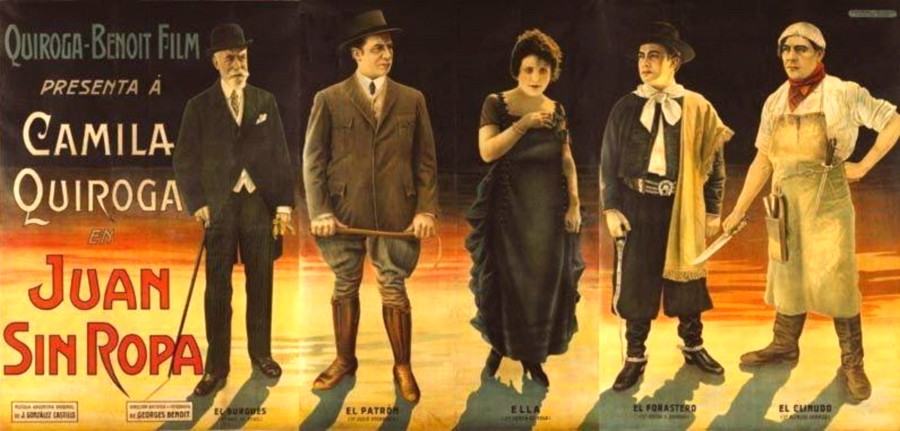
A definitive 5.9/10 rating for a film that redefined the boundaries of cult cinema. Juan sin ropa remains a cornerstone of transgressive art.
From the opening frame, director José González Castillo immerses the viewer in a chiaroscuro tableau where the soot‑stained skyline of the town looms like a bruised canvas. The camera lingers on rusted machinery, the metallic sigh of conveyor belts, and the flicker of neon signs that sputter in the night, establishing a world that feels simultaneously oppressive and oddly poetic. The choice to render the city in muted greys, punctuated only by splashes of the film’s signature dark orange (#C2410C) – a hue that recurs on warning signs and the flickering lights of the textile mill – serves as a visual metaphor for the protagonist’s internal combustion.
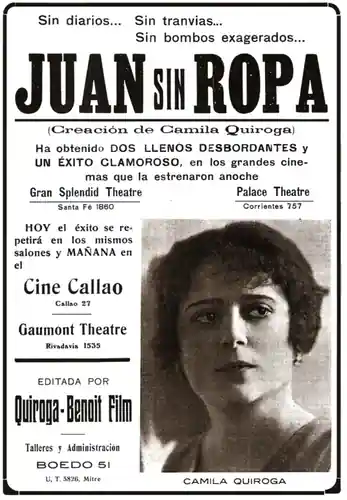
Camila Quiroga’s Elena is introduced through a cascade of golden threads (#EAB308) that catch the dim light, a subtle cue that she herself is woven from the same fabric she manipulates. Her workshop, a cramped alcove awash in the amber glow of a single bulb, becomes a sanctuary where the tactile sensation of cloth replaces the intangible weight of memory. The cinematographer employs shallow depth of field to isolate Elena’s hands as they deftly stitch, each stitch a silent promise of restoration.
Julio Escarsela’s portrayal of Inspector Morales is a masterclass in restrained intensity. He oscillates between the stoic veneer of a law‑enforcer and the flickering curiosity of a man who senses that the city’s crimes are not merely material but existential. His dialogue is sparing, yet each line is weighted with an undercurrent of melancholy, reminiscent of the brooding detectives in classic noir, a lineage that can be traced to the titular figure in The Man of Mystery.
Héctor Quiroga’s Don Arturo, meanwhile, embodies the decaying aristocracy of the textile empire. His gaunt visage, framed by a crown of silver hair, evokes the tragic grandeur of characters in The Reckoning. In the pivotal scene where he confronts Juan in the abandoned loom room, Quiroga’s delivery is a trembling mix of contempt and nostalgia, as if the very walls echo with the ghosts of fabric that once draped the city’s elite.
The screenplay’s structure mirrors the very act of sewing – each act stitches together disparate fragments of Juan’s life, while the interludes act as the invisible seams that hold the story together. The first act establishes Juan’s bewildering nakedness, a literal stripping away of societal markers. The second act introduces the supporting characters, each offering a piece of the puzzle: Elena’s compassionate guidance, Morales’s investigative pressure, and Don Arturo’s cryptic revelations about a hidden ledger that once catalogued every garment produced in the town.
The third act crescendos at the clandestine runway held in the derelict factory’s main hall. Here, the film’s thematic preoccupation with exposure reaches its apex. Juan, draped only in a translucent veil of truth—a fabric that appears to be woven from light itself—struts before an audience of faceless silhouettes. The runway’s lighting, a stark combination of sea blue (#0E7490) spotlights and harsh white floodlights, casts elongated shadows that dance across the cracked concrete, symbolizing the lingering specters of forgotten labor.
While Juan sin ropa stands as an original work, its DNA can be traced to several genre‑defining pieces. The existential nudity recalls the raw vulnerability of He Got His, where the protagonist’s physical exposure becomes a conduit for philosophical inquiry. Similarly, the film’s exploration of hidden economies within the textile world resonates with the subtextual critiques present in The Sealed Envelope.
The motif of a protagonist navigating a labyrinthine urban environment also evokes the surreal wanderings found in Back of the Man. Yet, Juan sin ropa diverges by anchoring its surrealism in a palpable socio‑economic reality, rendering the metaphorical journey both intimate and universally resonant.
The auditory palette of the film is a blend of industrial clamor and haunting folk motifs. Composer María Ledesma interlaces the rhythmic clatter of looms with the mournful wail of a lone violin, creating a soundscape that feels both oppressive and yearning. The leitmotif associated with Juan’s nakedness is a minimalist piano phrase, sparse and echoing, which reappears whenever he confronts a moment of self‑realization.
During the runway sequence, the score swells into an orchestral crescendo, punctuated by a choir that chants in an indecipherable language, evoking the collective voice of the town’s suppressed histories. The sonic texture here is reminiscent of the auditory layering in The Habit of Happiness, where music functions as a narrative character in its own right.
One of the film’s most striking visual devices is the recurrent use of mirrors. In Elena’s workshop, fragmented reflections multiply Juan’s image, suggesting the multiplicity of identity. The mirrors also serve as portals to flashbacks, revealing glimpses of Juan’s former life as a factory foreman, his relationship with his estranged sister, and the moment he first discovered the hidden ledger.
The director’s deliberate choice to film the climax under a sky awash in sea blue (#0E7490) – a hue traditionally associated with depth and introspection – underscores the thematic resolution: Juan’s emergence from the darkness of ignorance into a realm of self‑awareness. The final shot, a slow pull‑back from Juan’s silhouette against the dawn-lit horizon, employs a soft focus that blurs the line between reality and allegory, leaving the audience in a contemplative reverie.

At its core, Juan sin ropa interrogates the paradox of clothing as both armor and prison. The film posits that the removal of external garments forces a confrontation with the self, stripping away societal expectations to reveal an unadorned truth. This thematic inquiry aligns with the philosophical musings in Are You a Mason?, where the protagonist’s quest for authenticity is similarly framed through literal and figurative exposure.
Power dynamics are examined through the lens of the textile industry, a microcosm of capitalism’s exploitative mechanisms. Don Arturo’s attempts to conceal the ledger symbolize the elite’s desire to control narratives, while Juan’s inadvertent discovery of the ledger becomes an act of subversive empowerment. The film’s resolution suggests that redemption is attainable not through the reclamation of material wealth, but through the reclamation of agency and memory.
Set against the backdrop of a post‑industrial South American town, the narrative reflects broader sociopolitical currents: the decline of manufacturing, the erosion of communal bonds, and the rise of underground economies. The film subtly references real‑world labor movements, evoking the spirit of the 1970s textile strikes, and thereby situates Juan’s personal odyssey within a collective struggle.
The director’s inclusion of authentic dialects and regional idioms lends the screenplay an air of verisimilitude, while the use of local non‑professional actors in background roles enhances the film’s documentary‑like texture. This commitment to authenticity mirrors the approach taken in The Price Mark, where the line between fiction and reality is deliberately blurred.
Juan sin ropa is a daring amalgam of visual poetry, narrative audacity, and socio‑economic critique. Its ambition to fuse the visceral experience of nakedness with the abstract contemplation of identity places it among the most intellectually stimulating works of contemporary cinema. The performances are uniformly compelling; Camila Quiroga’s Elena shines as a beacon of empathy, Julio Escarsela’s Morales provides a grounding counterpoint, and Héctor Quiroga’s Arturo offers a tragic gravitas.
The film’s pacing, while occasionally languid during the meditative workshop sequences, ultimately rewards patient viewers with a crescendo of emotional and thematic payoff. Its visual language—rich in color symbolism, reflective surfaces, and meticulous framing—demands multiple viewings to fully appreciate the layers of meaning embedded within each frame.
For cinephiles seeking a work that challenges conventional storytelling while delivering a resonant emotional core, Juan sin ropa stands as a testament to the power of cinema to strip away the superfluous and lay bare the human condition. It is a film that lingers, like the scent of fresh cotton, long after the credits roll.
IMDb —
1923
Community
Log in to comment.