DbcultAccessing Vault...
Cult Review
Senior Film Conservator
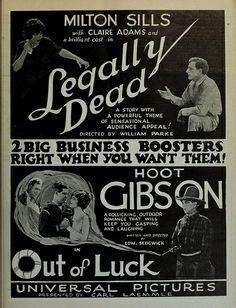
In the annals of early cinema, certain films emerge not merely as entertainment, but as audacious statements, challenging societal norms and probing the very essence of human experience. Legally Dead, a cinematic artifact from 1923, stands as one such profound declaration. Directed with a keen eye for dramatic tension and featuring the compelling presence of Milton Sills, this silent-era gem transcends its seemingly sensational premise to deliver a surprisingly nuanced critique of justice, identity, and the fragile line between life and oblivion. Far from a mere melodrama, it’s a philosophical inquiry wrapped in a gripping narrative, penned by the insightful Harvey Gates and Charles Furthman, whose collective vision birthed a story that resonates with a timeless, unsettling power.
The film introduces us to Will Campbell, portrayed with a compelling blend of idealism and dogged determination by Milton Sills. Campbell is no ordinary newspaperman; he is a man consumed by a singular, audacious conviction: that the state's ultimate penalty, capital punishment, is often meted out to the innocent. To validate this theory, he embarks on a radical, almost suicidal, journalistic endeavor: he deliberately gets himself arrested and imprisoned. This isn't merely an undercover assignment; it's a deep dive into the abyss of institutional injustice, a self-imposed crucible designed to forge truth from the raw, often brutal, realities of incarceration. Sills’ performance here is critical; he conveys not just a reporter's curiosity, but a profound, almost spiritual, burden to expose a horrifying truth. His journey through the prison system, though depicted without the explicit realism of later eras, hints at the dehumanizing conditions and the despair that can crush the human spirit, setting the stage for the film's later, more devastating turns.
Following his parole, a period of societal reintegration begins, aided by the kind-hearted Minnie O'Reilly, a character who embodies unwavering loyalty and compassion amidst the cynicism that often pervades the film's world. Minnie, brought to life by Claire Adams, offers a quiet counterpoint to the dramatic turmoil surrounding Campbell. He finds work in a bank, a semblance of normalcy, but destiny, or perhaps the cruel hand of narrative irony, intervenes. An attempted robbery shatters this fragile peace. In a moment of reflexive heroism, Campbell seizes the opportunity to pursue the fleeing killer, grabbing the weapon left behind. This seemingly righteous act, however, becomes the very instrument of his undoing. He is arrested, not as a hero, but as the prime suspect in the shooting of a detective during the melee. The swiftness of his subsequent conviction and death sentence is chilling, a stark illustration of the very systemic flaws he sought to expose. The legal process, once a tool for justice, becomes a relentless, unforgiving machine, grinding down the innocent with the same efficiency it applies to the guilty. This segment of the film is a masterclass in building tension and conveying the profound horror of a man trapped in a Kafkaesque nightmare, a theme explored in different contexts in films like The Snarl, which similarly delves into the psychological entrapment of its protagonists.
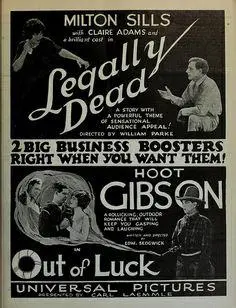
The execution scene in Legally Dead is undoubtedly one of the film's most potent and emotionally devastating sequences. Campbell, a victim of a monstrous miscarriage of justice, is led to the gallows. The silent film medium, paradoxically, amplifies the horror, allowing the viewer's imagination to fill in the grim sounds. The tension is almost unbearable, punctuated by the agonizing knowledge that an innocent man is about to die. The dramatic irony is exquisitely painful: a stay of execution arrives mere seconds too late, a cruel cosmic joke played at the expense of human life. This moment of ultimate despair is then followed by a breathtaking, almost fantastical, turn. The prison warden, played with palpable anguish and moral conviction by Robert Homans, is so profoundly shaken by the injustice that he sanctions an extraordinary, unprecedented experiment. A doctor, sensing an opportunity for medical pioneering, administers adrenaline to Campbell's lifeless body, performing a macabre resurrection. This pivotal plot device, while stretching the bounds of realism, serves a crucial thematic purpose. It elevates the film beyond a simple tale of wrongful conviction, venturing into questions of mortality, second chances, and the very definition of life itself. The film posits a world where death, even at the hands of the state, is not necessarily the final word, opening up a Pandora's Box of existential quandaries.
Campbell's return to the world of the living is not a triumphant one. He is, in essence, a ghost among the living, a man who has traversed the ultimate threshold and returned. The film brilliantly explores the psychological and social ramifications of such an experience. His nagging wife, a character often used in early cinema to symbolize domestic discontent, has seized the opportunity of his 'death' to secure a divorce, an act that underscores the superficiality of their bond and highlights the profound isolation Campbell now faces. This personal betrayal, coupled with the trauma of his ordeal, leaves him adrift, grappling with a fragmented identity. He is 'legally dead' in more ways than one, a man who no longer fits neatly into the societal boxes. It is here that Minnie O'Reilly's unwavering presence becomes even more significant. Her acceptance of his bizarre fate, her unconditional support, offers a glimmer of hope and a chance at rebuilding a life shattered by an unjust system. The reunion with Minnie is not a simplistic romantic resolution but a profound acknowledgment of genuine connection and human resilience. This exploration of personal aftermath and the search for meaning after profound trauma gives the film a depth that distinguishes it from many of its contemporaries, echoing the complex human struggles often found in European dramas of the era, such as Livets Gøglespil, which delves into life's various trials.
Milton Sills, as Will Campbell, delivers a performance of remarkable intensity and pathos. His ability to convey complex emotions through subtle gestures and facial expressions, a hallmark of silent acting, is on full display. He carries the weight of the film's dramatic arc, from idealistic reporter to condemned man to resurrected outcast, with compelling authenticity. Claire Adams, as Minnie O'Reilly, provides a necessary anchor of warmth and sincerity, her quiet strength a vital counterpoint to Sills' anguished portrayal. The supporting cast, including Robert Homans as the conscience-stricken warden, Charles Wellesley, Joseph W. Girard, Eddie Sturgis, Faye O'Neill, Albert Prisco, Charles A. Stevenson, Brandon Hurst, Margaret Campbell, and Herbert Fortier, all contribute to the film's rich tapestry, each adding a layer of credibility and emotional resonance to their respective roles. Even in smaller parts, the ensemble creates a believable world, enhancing the film's dramatic impact and ensuring that the audience remains invested in Campbell's harrowing journey.
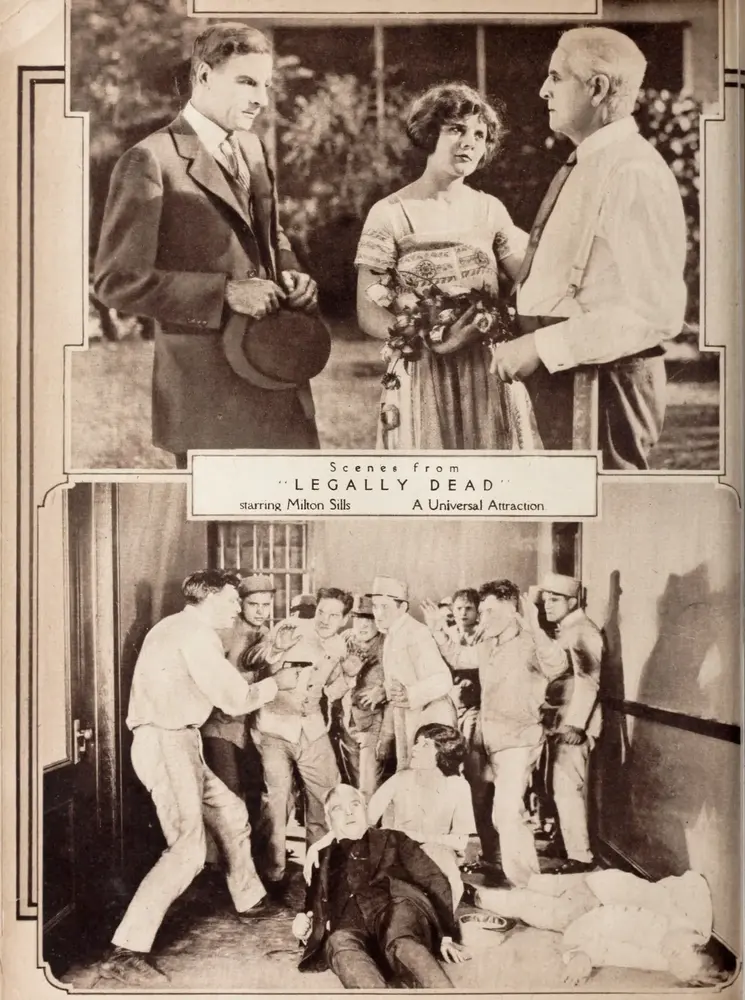
The direction of Legally Dead, while typical of its era in terms of pacing and visual grammar, effectively builds suspense and elicits strong emotional responses. The filmmakers understood the power of visual storytelling in the silent medium, employing dramatic close-ups and carefully composed shots to convey the inner turmoil of the characters and the gravity of their circumstances. The screenplay by Harvey Gates and Charles Furthman is particularly noteworthy for its bold narrative choices. They weren't afraid to push boundaries, introducing elements that border on the fantastical (the resurrection) to serve a deeper, more profound narrative purpose. The script navigates complex themes—judicial error, the arbitrary nature of fate, the psychological toll of trauma, and the enduring power of human connection—with a surprising degree of sophistication for its time. Their ability to weave together a journalistic expose, a courtroom drama, a death row narrative, and a fantastical rebirth into a cohesive and compelling whole is a testament to their skill as storytellers. This intricate plotting and thematic ambition distinguish Legally Dead from more straightforward narratives of the period, inviting comparisons to other films that explored complex moral quandaries or intricate narrative twists, such as Four Around the Woman, albeit with very different stylistic approaches.
Decades after its initial release, Legally Dead retains a startling relevance. Its central theme—the fallibility of the justice system and the tragic consequences of wrongful conviction—remains a pressing issue in contemporary society. The film serves as a stark reminder of the importance of due process, the dangers of circumstantial evidence, and the irreversible nature of capital punishment. Beyond its social commentary, the film also explores universal questions about identity, the meaning of life after a brush with death, and the search for belonging. Campbell's journey from an investigative journalist to a man literally brought back from the dead, only to find himself a stranger in his own life, is a powerful metaphor for alienation and the struggle to redefine oneself in the face of overwhelming adversity. The film's unique blend of social realism, courtroom drama, and a touch of the fantastical makes it a fascinating historical document and a compelling piece of cinematic art. It challenges viewers to consider the profound implications of its title—what does it mean to be 'legally dead' when one is still very much alive, and what obligations does society have to those it has wronged?
In conclusion, Legally Dead is more than just a silent film curiosity; it is a powerful, thought-provoking drama that asks difficult questions and offers no easy answers. It showcases Milton Sills at the height of his powers, supported by a talented cast and a daring screenplay. For enthusiasts of classic cinema and anyone interested in the enduring themes of justice, redemption, and the human spirit's indomitable will, this film offers a rich and rewarding viewing experience. Its enduring legacy lies not just in its dramatic twists, but in its unwavering commitment to exploring the darker corners of human experience and the persistent hope for rectifying profound wrongs. It stands as a testament to the power of early cinema to engage with complex social issues and deliver narratives that continue to resonate with a modern audience, a truly remarkable achievement for a film celebrating its centennial.
Review by a dedicated film enthusiast and critic.
IMDb —
1933
Community
Log in to comment.