DbcultAccessing Vault...
Cult Review
Senior Film Conservator
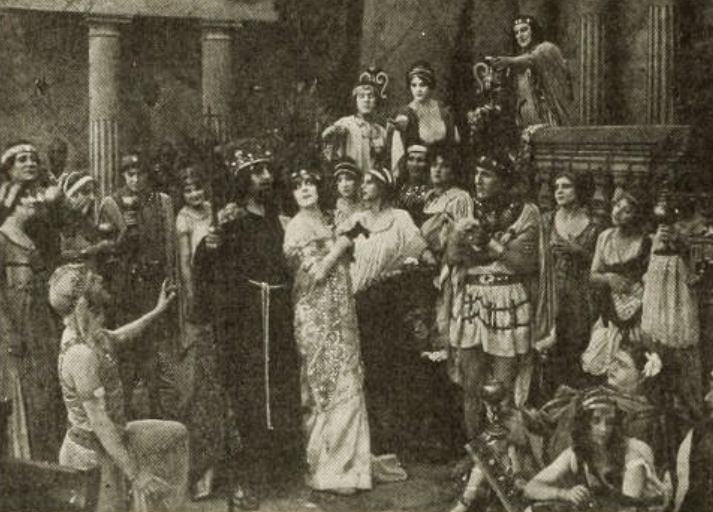
In the flicker of nitrate and candle, Thais (1914) arrives like a fever dream transmitted through stained glass, a film whose very silences seem perfumed with myrrh and musk. Adapted from Anatole France’s scandalous 1890 novel and shepherded by Arthur Maude—who writes, directs, and co-stars as the tormented Paphnuce—the picture positions itself at the crossroads of piety and pagan opulence, daring audiences to look, and keep looking, as virtue and vice perform their endless tug-of-war across the courtyards of Alexandria.
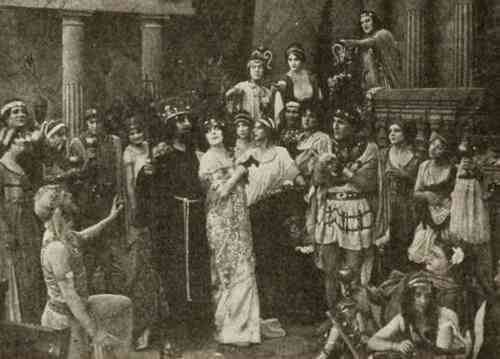
The production design—extravagant even by early feature-length standards—conjures a metropolis drunk on its own contradictions: white marble sphinxes leer beside altars to Isis; processions of flagellants thread through bazaars reeking of cumin and cumin-scented flesh. Cinematographer George Barnes (often uncredited) sculpts chiaroscuro worthy of Caravaggio—faces slip from radiant to cadaverous within the same take, as if the film itself doubts the soul’s itinerary. Intertitles, lettered in curling art-nouveau glyphs, speak of "the honeyed poison of beauty" and "the razor of repentance," each card a miniature sermon that nevertheless tempts us toward the very sins it decries.
Constance Crawley’s Thais commands the screen with the volatile poise of a solar eclipse—at once blinding and eerily cold. She is introduced via a sustained close-up rare for 1914: veil lifted by an unseen breeze, pupils dilated as if perpetually surprised by the world’s willingness to prostrate itself. Crawley’s acting style oscillates between the statuesque tableaux of early cinema and startling bursts of modern naturalism: a tremor along the jawline when a patron oversteps, a half-swallowed gasp when she spies Paphnuce glowering from the colonnade. Rather than the vamp archetype later codified by Traffic in Souls or The World, the Flesh and the Devil, Thais is a merchant of emotional vertigo—she sells the idea
Arthur Maude’s Paphnuce charts a pilgrimage from decadence to desert sanctity and back to a ruin more harrowing than any orgiastic prelude. In the opening reels he wears Roman toga like a man hugging a ghost of empire—shoulders squared, yet fingers fidgeting along the hem as if measuring the distance between silk and sackcloth. His conversion occurs off-screen, relayed through a whirlwind montage: dice clattering onto marble, wine sloshing from overturned cup, a crucifix clenched in a blood-slick hand. Maude the director allows the actor nearly thirty seconds of silent, tear-streaked prayer—an eternity in nickelodeon pacing—before cutting to the desert where the newly minted hermit pounds his chest with such fervor the sound (suggested by intertitle) seems to echo across the dunes.
The ellipsis that swallows five narrative years is conveyed through a single fade-to-white, followed by a reverse fade revealing Paphnuce sun-scorched, beard matted, eyes now aglow with the unhinged certainty of one who has conversed with jackals and taken their silence for scripture. It is here the film’s moral fulcrum tilts: the monk who once trembled before Thais’s carnal throne now strides into Alexandria clutching a staff carved with chi-rho, determined to "pluck the rose from the dung-heap" (intertitle). Yet Maude seeds irony into every gesture—Paphnuce’s fingers white-knuckle the staff whenever a painted courtesan smiles, betraying the war still seething beneath his cassock of conviction.
Critical to the film’s emotional detonation is the scene of Thais’s conversion, staged not as thunderbolt but as negotiation. Inside a courtyard ringed by ibis statues and censer smoke, Paphnuce confronts her with a wooden crucifix held like a sword. The camera alternates between medium two-shots and invasive close-ups: Thais’s pupils shimmering with defiance, Paphnuce’s irises reflecting torchlight like oil on water. When she finally kneels, the film withholds triumph; instead, Crawley lets a solitary tear crawl down powdered cheek, the precise moment when commerce in desire yields to commerce in salvation. The tear’s trajectory—caught in luminous side-lighting—suggests both penitence and bereavement, as though Thais intuits that to embrace eternity she must abdicate the only sovereignty she has ever known.
The convent to which Thais retreats is rendered in spare, almost expressionistic strokes: alabaster walls, black veils, and perpetual twilight. Here Maude nods toward Scandinavian austerity reminiscent of Den tredie magt or Northern Lights, using negative space to evoke spiritual asphyxiation. Thais’s cell contains only a cot, a ewer, and a window shaped like a keyhole—through it she glimpses the same moon that once silvered her revels, now reduced to a sterile disk. The nuns move in synchronized tableaux, their synchronized gestures evoking clockwork piety; the film subtly equates religious regimentation with the earlier regimentation of desire in Thais’s courtesan court, suggesting that both are performances for unseen patrons—whether clientele or deity.
While Thais wastes within cloister walls, Paphnuce prowls Alexandria’s markets, each sensory assault—saffron, tambourine, the flash of female ankle—unmooring his hard-won equilibrium. Maude inserts a bravura sequence wherein the monk hallucinates Thais’s face superimposed over loaves of bread, over the gaping mouth of a beggar, even over the disc of the sun. These double exposures, achieved in-camera, prefigure the more baroque effects of Fantasma yet serve a psychological rather than spectacular function: they visualize the way obsession colonizes perception. Unable to endure the siege, Paphnuce rushes to the convent, barges past startled novices, and finds Thais on the verge of death—her beauty now lunar, chalky, the courtesan’s radiance inverted to mortis pallor.
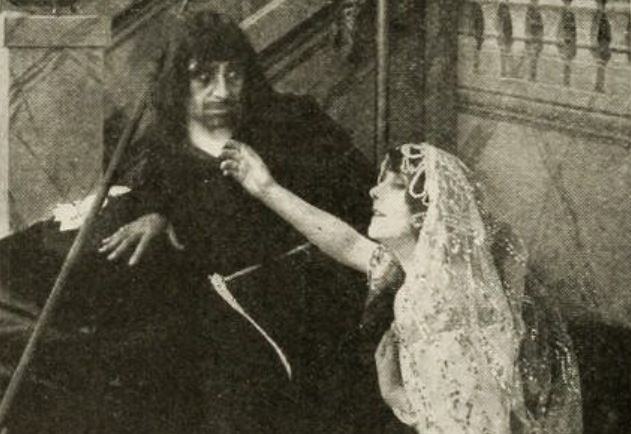
The closing tableau is a masterclass in chiaroscuro tragedy. Thais, propped on rough linen, whispers (via intertitle) "I loved the world—now I love only thee," a line that conflates earthly and divine affection, collapsing object of desire into object of devotion. Paphnuce gathers her with the frantic tenderness of one who has bargained away eternity for a fingertip’s brush; her head lolls, the veil slips, and the camera lingers on two profiles fused against guttering candle. Fade-out. No heavenly ascension, no chorus of angels—only the black screen that swallows all transactions of flesh and faith alike. The audience is abandoned to contemplate whether redemption occurred or merely a peripatetic exchange of shackles.
Beyond the leads, George Gebhardt as Nicias—a sybaritic poet who serves as Thais’s confidant and occasional pimp—imbues his role with flamboyant melancholy. His gestures quote both Roman oratory and modern ballet, a hybrid that underscores the film’s obsession with masks theatrical and spiritual. In one memorable aside, Nicias mocks Paphnuce’s desert rigor while dabbing perfume behind his ear with the same finger that inscribes verses to Isis; the gesture epitomizes Alexandria’s moral promiscuity, where piety and profanity share a single circulatory system.
Though photographed in monochrome, the film’s lighting design smuggles in chromatic suggestion: scenes of carnal revelry are awash in amber gels that evoke dark orange hedonism, while sequences of penance adopt bluish tungsten reminiscent of sea-blue asceticism. The yellow flare of candlelight recurs at moments of epiphany—Thais’s conversion, Paphnuce’s desert hallucinations—hinting at a liminal spirituality that is neither white grace nor crimson sin but the sulfurous hinterland in between.
Contemporary exhibitors were provided with a cue sheet that oscillates between Saint-Saëns’s Danse Macabre for Thais’s bacchanals and Gregorian chant for Paphnuce’s hermitage. Archive accounts describe certain urban screenings where orchestra plunged into silence the moment Thais expires, four full measures of auditory void before a subdued reprise of Ave Verum. This calculated absence weaponizes silence as emotional punctuation, an effect later imitated by The Wrath of the Gods but never with such liturgical precision.
Upon release, the film skirted condemnation by the National Board of Review only after producers agreed to trim a 20-second segment depicting Thais’s bare back during an oil-anointment ritual. Even so, clergy leafleted parishioners denouncing the picture as "a painted harlot masquerading as morality tale," while secular critics praised its "unflinching anatomy of the war between gland and gospel" (Chicago Herald). Box-office returns, buoyed by notoriety, rivaled those of Traffic in Souls, proving once again that prohibition is the most potent publicity.
Elements of Thais resurface in Carl Theodor Dreyer’s The Passion of Joan of Arc (the fetishized tear-track), in Rossellini’s Europe ‘51 (saintly self-negation), even in the toxic erotic symbiosis of Denn die Elemente hassen. Its DNA can be glimpsed whenever cinema stages the body as battleground between libido and liturgy, from Black Narcissus to The Devils. Yet few descendants match the original’s vertiginous equipoise—its refusal to grant the audience the comfort of either damnation or absolution.
Long after the final iris closes, what haunts is not the grand theological dialectic but minutiae: the way Thais’s fingers, bereft of rings post-conversion, keep twitching as though memory of jewelry persists in muscle; how Paphnuce, in extremis, kisses not her mouth but the hollow above collarbone, that fragile notch where pulse once drummed. Such granular honesty elevates Thais above moral melodrama into the rarer realm of sensual metaphysics—a celluloid relic that, when held to light, projects our own divided hungers on the wall of some inner catacomb.
Contemporary discourse around sexuality, power, and institutional hypocrisy finds uncanny antecedent here. Thais’s commodification of beauty rhymes with influencer culture; Paphnuce’s zeal mirrors any zealot who would save others to evade himself. Their mutual unraveling cautions that attempts to police desire often inflame it, a lesson societies still rehearse in endless loop. Streaming in restored 2K from several boutique labels, the film invites rediscovery by viewers fatigued with CGI spectacle and hungry for the slower burn of existential erotica.
Is Thais a pious sermon wrapped in licentious silk, or a libertine manifesto masquerading as penitential tract? It is both and neither—a paradox etched in silver halide, as enduring and fragile as the human heart itself. Approach it not as antique curiosity but as open wound: press your thumb into its spectacle, and it will press back with the ache of recognition. For anyone tracing cinema’s long obsession with saint and sinner locked in erotic combat, this artifact remains essential—an opulent, scorching reminder that the line between salvation and ruin is drawn not in sand but in the bloodstream.

IMDb 6.2
1934
Community
Log in to comment.