DbcultAccessing Vault...
Cult Review
Senior Film Conservator
A gorge devours its own echo.
Ink-dark basalt walls rise like jury members who have already reached a verdict. Between them, a draper’s maid—bib apron still smelling of camphor and folded broadcloth—walks the gauntlet of a village that sells piety by the yard yet buys silence wholesale. The watch committee, those grim custodians of paraffin lamps and paranoid ledger-books, decree expulsion for a trespass nobody will articulate. She counters not with pleas but with contract: an exchange of vows with the poacher’s son, a youth whose cradle was a rabbit-skin muffler and whose theology is taught by rusted gin traps. Marriage here is neither sacrament nor strategy; it is a dare hurled at geography itself.
George Dewhurst, writing and directing, refuses to let melodrama ossify into cliché. His 1919 one-reeler—often misfiled as a pastoral curio—sprays vinegar on the sugar of Edwardian domestic cinema. Compare it to The Carter Case of the same year, where narrative pivots on a detective’s swaggering deduction. Dewhurst instead weaponizes negative space: the valley’s gullet becomes protagonist, antagonist, and Greek chorus, swallowing dialogue whole so the film’s intertitles shrink to haiku. A single card reads, “The river remembers.” That is the entire exposition for a flash-forward that never arrives, because memory and future have fused inside a crack in the limestone.
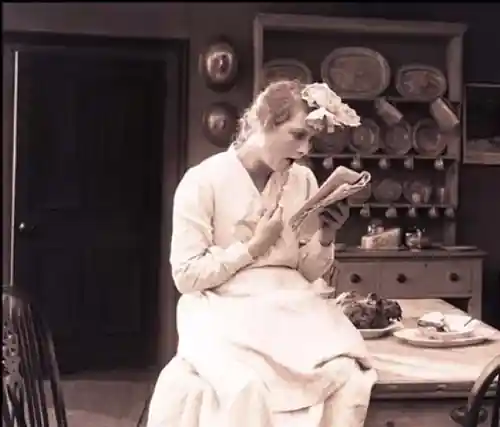
Gwynne Herbert plays the maid, Ruth—though the film withholds her name until the marriage registry flickers on-screen for eight frames. Herbert’s performance is calibrated in millimeters: a tremor along the clavicle when fingers touch the poacher’s torn cuff, a blink held one frame too long so the audience feels the insult of daylight. Silent-film acting too often tips into semaphore; Herbert works in micro-climates, letting the valley’s wind finish the emotion her face begins. Watch her when she unpicks the stitches of her own bodice to make a pocket for flint and tinder: the gesture is both seduction and inventory, a woman re-tailoring survival.
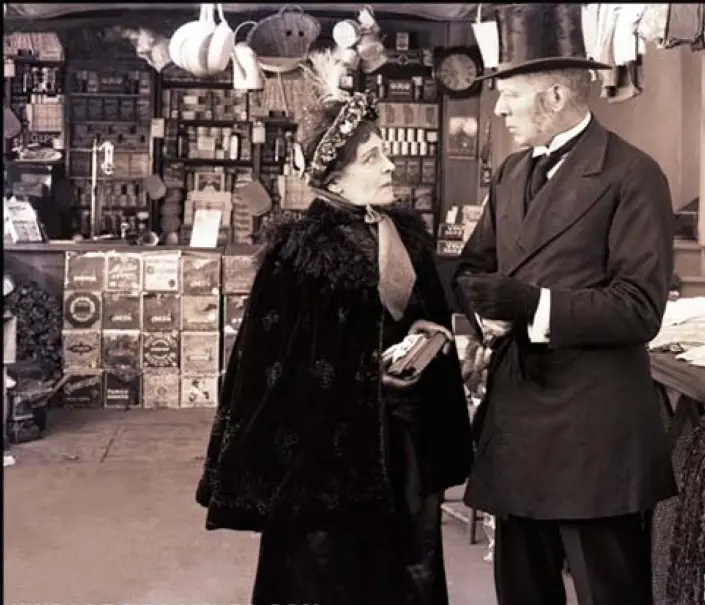
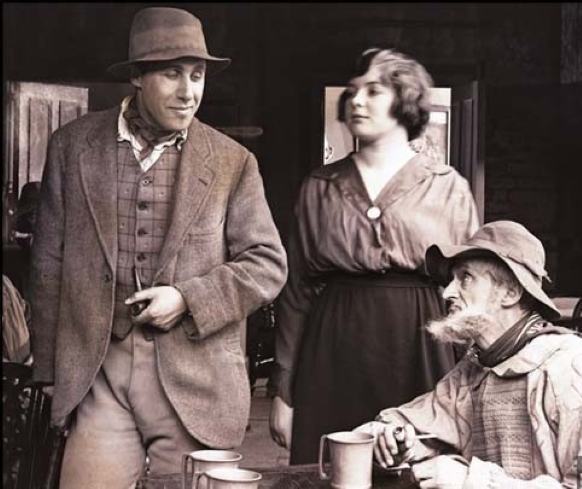
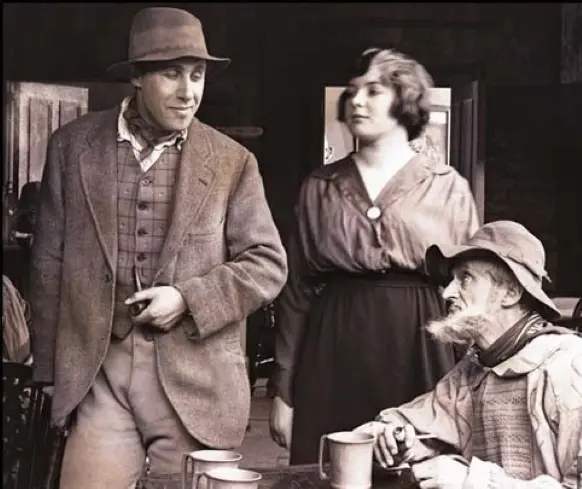
Gordon Holloway’s poacher, Elias, carries the hollow eyes of someone who has grown up beneath the sound of other people’s appetites. He is all contrapposto and wariness, a body assembled from leftover angles. In the scene where he teaches Ruth to set a snare, Dewhurst keeps the camera at ground level so the loop of wire resembles a halo gone feral. When Ruth’s finger slips and the noose snaps shut, the cut to her face is not shock but complicity—a silent acknowledgement that every ethic here is negotiable except hunger.
Cinematographer James Wilson shot on location in the White Peak, trusting the winter solstice to provide a sun that never climbs above the lens. The resultant grain—thick as oatmeal—turns each frame into stippled charcoal. Forget the postcard vistas of A Gentleman of Leisure; Dewhurst’s valley is a throat lined with molar-like boulders. Clouds drag across the hillsides like unwashed hair. You can almost smell peat and panic.
Alma Taylor cameos as the committee chair’s daughter, a girl who collects porcelain thimbles and moral failures. She appears only twice: first in a doorway, candle guttering behind her ringlets, and later at the riverbank where she offers Ruth a biscuit tin containing thirty shillings and a tract on fallen women. Taylor’s curtsey is a masterpiece of venomous courtesy; the tin lid snaps shut like a guillotine. The scene lasts twenty-two seconds yet inverts the entire power dynamic: charity weaponized into indictment.
The editing rhythm obeys geologic time. Shots hold until moss seems to grow on the emulsion. Then, without warning, Dewhurst inserts a four-frame flash of a hare’s eye—vertigo in the form of wildlife. The first time it happens you blame the projectionist; the second, you realize the valley itself is splicing the picture. Compare this to the staccato punch of Pay Day, where tempo is dictated by tramp comedy. Here, montage is erosion: swift when it needs to remove, patient when it intends to scar.
Music, now lost, was originally a single violin played live by a schoolteacher paid in ale. Contemporary accounts describe a drone that never resolved into melody—like a hymn stranded halfway through transposition. Modern restorations sometimes substitute pastoral pastiche, betraying the film’s abrasive pulse. I recommend viewing it mute; let the wind in the sprockets stand for orchestra.
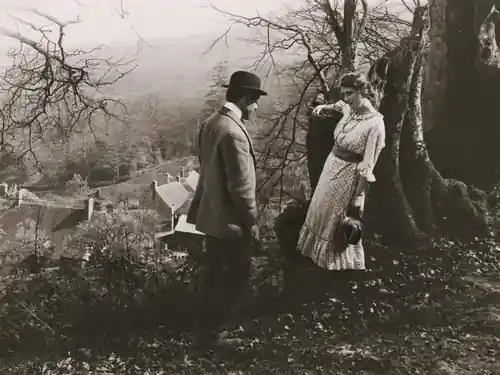
Gender politics seethe beneath wool and worsted. The village watch committee—all male, all waistcoated—polices female mobility with the zeal of border guards. Yet Dewhurst refuses to cast Ruth as mere victim. Her marriage is not rescue but incorporation of the outlaw into her own outlawry. When she and Elias disappear into the gorge, they leave behind a parody of domesticity: the marriage certificate skewered onto a thorn bush, ink bleeding into scarlet sap. It is both proclamation and eviction notice.
Notice, too, the economics. The draper’s shop where Ruth folds linens is stocked with calico printed by mills in Calcutta; empire’s fabric drapes this parish pantomime. Meanwhile Elias’s snares harvest the last wild coneys on land soon to be enclosed. Their union literalizes the marriage of exploited labor and poached commons—an ur-text for Brexit anxieties avant la lettre. When the couple burn their last shilling to cook a hedgehog, the coin glows like a miniature sun setting on mercantile faith.
Horror arrives obliquely. Midway, a title card whispers: “Sunday, missing.” Cut to a child’s boot suspended in a crabapple tree. Nothing else is shown; the film trusts the audience to furnish the eaten parts. This austerity makes The Bells look baroque. Dewhurst learned from Poe that suggestion is scalpel, not cudgel.
The final third abandons human physiognomy altogether. Wilson’s camera tilts skyward until faces exit the frame, leaving only wool-clad torsos wrestling with briars. Dialogue becomes footnotes crushed under bracken. You realize the film has been training you for this—teaching you to read shoulder blades instead of pupils. When Ruth’s hand finally re-enters shot, it is smeared with iron ochre. Whether blood or soil is irrelevant; the valley has accepted her dowry.
Restoration status: only a 35mm nitrate print at the BFI, twice struck by flash fire during inspection. A 2016 2K scan exists but circulates only in closed academic circles, watermarked with seizure-inducing security dots. Bootlegs surface on niche forums, usually cropped to 1.33:1, losing Wilson’s deliberate headroom. Lobbyists push for a 4K rescue; funding stalls because the film lacks name recognition next to The Napoleonic Epics. Cinephiles must content themselves with whispered lore—like the rumor that the original tinting used onion-skin dyes, giving flesh tones the tint of bruised apples.
Performances resonate beyond the frame. Herbert later became a suffrage orator; Holloway vanished into the Yukon in 1923, sending postcards postmarked “Beyond the credits.” Their absence amplifies the film’s ontology: people stepping out of history once narrative relinquishes them. Compare that to the franchised ghosts of modern cinematic universes who return for sequels, posthumously CG’d.
Thematic cousins? Mazeppa shares the motif of landscape as destiny, though its Ukrainian steppes preach expansion, not compression. Every Mother’s Son flirts with maternal dread but cushions it in Edwardian piety. Only Life’s Greatest Problem dares similar bleakness, yet still grants a closing-caption sermon. Dewhurst denies even that palliative.
Contemporary critics, blinded by war fatigue, dismissed the film as “a rural shudder.” They wanted morale, not erosion. One tradesheet lamented the absence of comic relief—proof they mistook suffocation for pacing flaw. Today the picture feels prophetic: a Brexit fable where borders are forged less by policy than by folklore, where marriage becomes passport and exile a cottage industry.
Viewing tips: watch at 5 a.m. when sky matches the print’s slate tone. Use headphones that leak wind; let traffic stand in for the committee’s horses. Pause on the 11-minute mark where Ruth’s silhouette bisects a waterfall—frame advance reveals a face dissolving into spray, a ghosted dissolve you can’t see at 16 fps. Screen-cap it; the still rivals any symbolist canvas.
Marketing ephemera survives: a lobby card promising “Love stronger than statute!”—as if romance were iron reinforcement. Another tagline: “See how innocence outwits tyranny!” Both lie, commodifying resistance into escapism. The film itself refuses catharsis. When the end card arrives—plain Helvetica on black—it reads: “They walked until the path forgot them.” No iris, no swell of violin. The projector’s after-image is your exit music.
Therefore, praise must be calibrated in negative space. Celebrate what the film withholds: backstory, redemption, close-ups of kisses. Its austerity is not asceticism but integrity; to prettify destitution would be colonial. In an era when even The Birth of Character leans on Freudian shorthand, Dewhurst trusts geology to psychoanalyze.
Final note: take care when recommending. Some viewers interpret the valley as purgatory and mistake austerity for theological allegory. Resist that. The gorge is not afterlife but audit—an accountant’s ledger carved in chert. It tallies who owes what to whom and then collects in pounds of flesh and topsoil. There is no priest, only gravity.
Watch it, then go outside and feel the ground pitch slightly, as if every meadow concealed a mouth rehearsing your name. That is the legacy of this forgotten reel: it re-writes topography as contract, and you, spectator, co-sign with every remembered frame.
IMDb —
1917
Community
Log in to comment.