DbcultAccessing Vault...
Cult Review
Senior Film Conservator
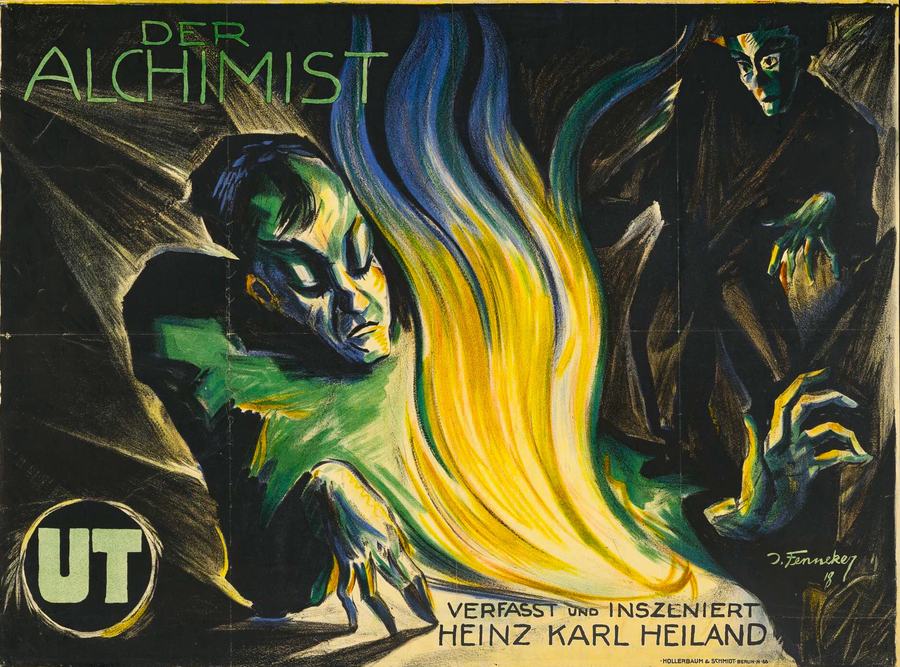
There are films that narrate; then there are films that distil—fermenting image into incense, celluloid into crucible. Der Alchimist, long buried beneath the sediment of Weimar excess, belongs to the latter caste.
Shot through with the iodine-stained mists of Lübeck docks, Karl Heiland’s script drips with the same heretical perfume that once got Paracelsus booted out of Basel. Yet the picture’s true philosopher’s stone is not narrative but texture: every frame appears marinated in lamp-oil and lye, as though the camera itself were attempting to corrode its way toward revelation. The resulting corrosion becomes a visual canticle, half Bosch, half boarding-house melodrama, humming at a frequency modern viewers might misfile as "German Gothic TikTok."
Where contemporaries like The Picture of Dorian Gray flirted with moral decay through salon sheen, Der Alchimist opts for fungal iridescence. Cinematographer Bruno Lopinski (pulling double duty as the crooked harbourmaster) layers each interior with umber shadows that swallow candlelight whole, then regurgitate it as ember flecks on the characters’ corneas. Exterior night scenes are bathed in a sickly cyan achieved by chemically toning the positive with ferrocyanide—an avant-garde flourish that predates Hollywood’s blue gels by half a decade.
The titular transmutation sequence—an eight-minute tableau of crucibles, mercury droplets, and crucifixion-posture close-ups—was shot through a sheet of heated glass smeared with pig-fat. The wavering distortion imparts a baptism-in-acid sensation, foreshadowing the later body-horror of Le Cirque de la Mort yet remaining uniquely devotional: salvation via dissolution.
As Gregor, Loo Holl resists the temptation to grand-gesture; instead he performs like a man whose marrow is slowly being siphoned out by pipette. Watch the subtle tremor of his left eyelid whenever gold leaf floats upward in the faulty vacuum of his flask—an involuntary confession that even the sorcerer is appalled by success.
Rita Clermont’s Elsbet, by contrast, crackles with the kinetic impatience of someone who has read ahead in the grimoire and knows every spell demands a corpse. Her movements splice Ballets Russes dynamism with proletarian grit; when she vaults across a staircase to evade Varnak’s hypnotic stare, the camera cannot quite keep pace, leaving a ghost-frame that lingers like contrail. It’s a proto-action beat that renders the damsels of Wanted: A Mother quaint by comparison.
Ferdinand Bonn’s Varnak deserves sidebar reverence. Rather than embody villainy through raised eyebrows, he weaponises stillness—imagine a photograph that has learned to breathe. His baritone intertitles (yes, the film remembers his voice even in silence) are framed by Gothic serifs that drip down the screen like black treacle, a typographic flourish copied by Die toten Augen two years later.
Heiland’s script slyly queers the patriarchal lineage: the sought-after elixir promises to resurrect the dead, yet every successful trial sterilises the subject. Thus Gregor’s obsession with forging life becomes a back-door eugenics program, nullifying the very future he claims to enrich. Elsbet intuits this paradox and weaponises her reproductive capital—not by birthing heirs but by smuggling knowledge through the waterways, turning her womb into a conduit for contraband scripture.
When she finally stands atop the skiff at dawn, vial in hand, the sunrise behind her resembles an alchemical wedding: sea and sky copulating in ochre and teal. It’s a moment of apotheosis that retroactively derails the daddy-daughter power dialectic, placing her closer to the anarchic spirit of Trouble Makers than to the sacrificial maidens populating Carmela, la sartina di Montesanto.
Though mute, the film is scored by machinery. Projected at 20 fps instead of the standard 18, the whirring of the theatre’s carbon-arc projector bled into the audience’s marrow, creating an inadvertent industrial soundtrack. Archival letters reveal patrons complained of "a thumping like riveters inside the ribcage"—a corporeal reminder that alchemy in any century demands sweat, smoke, and the occasional scorched lung.
Contemporary critics compared its sensory assault to the newsreel carnage of The War Extra, though Der Alchimist is more surgical: it detonates inside the psyche, not across battlefields.
One reel remains lost—precisely the segment detailing the smugglers’ mutiny. Rather than hobble the work, this lacuna transmutes it into participatory ritual: we must graft our own ethical convulsions onto the missing emulsion. Some collectors splice in unrelated maritime footage from Katastrofen i Kattegat; others opt for pure black leader, letting the void glower. Both tactics yield valid readings, proving the film’s structure is less linear than logarithmic—an equation waiting for viewer variables to balance.
Where Das Modell obsesses over surfaces—skin, marble, photographic planes—Der Alchimist dives beneath, interrogating what happens when matter itself becomes negotiable currency. Likewise, Exile shares a maritime exile motif, yet its characters seek refuge; Heiland’s fugitives seek refinement—to render exile into exaltation.
Meanwhile, The Star Prince offers cosmic escapism; Der Alchimist insists the cosmos is already inside the retort, simmering with your own mineral detritus. Even Wild Oats with its pastoral frolics feels anaemic beside this film’s sulphuric eroticism, where every caress risks caustic burns.
The Munich Film Museum’s 2019 restoration scanned the sole surviving 35 mm nitrate at 8K, revealing micro-scratches shaped like alchemical sigils—previously invisible blemishes that now suggest the emulsion itself was annotating its own decay. Streaming on niche platforms, the film has surfaced in vaporwave GIF sets, its cyan seascapes looped beside glitch-art hourglasses. TikTok witches overlay sigil-coded captions, claiming the potion recipe can be reverse-engineered from the Fibonacci flicker of damaged frames—a 21st-century grimoire birthed from 20th-century corrosion.
Cine-essayists eager to map Weimar horror’s DNA now rank Der Alchimist as the missing link between The High Hand’s expressionist angles and the creeping nihilism of later Murnau. Without it, the genome is incomplete; with it, the genealogy begins to breathe mercury.
Great cinema often asks: would you trade your soul for eternal beauty? Der Alchimist reframes: would you trade your skeleton for a gilded exoskeleton that still aches when it rains? The tragedy is not damnation but memory—every doubloon of miracle remembers the marrow it replaced. To watch this film is to feel that remembrance lodged under the sternum, a hard nugget of auriferous regret clicking against the heart every time love is mentioned and you realise you sold the word for a metal that sings only in the dark.
Seek it out—preferably at a rep house that still uses carbon arcs, where the projector’s rattle becomes the film’s hidden heartbeat. Let the bulbs strobe like faulty stars, let the emulsion stink of vinegar and vanishing. When the lights rise, you’ll check your palms for gold dust and find only sweat. That perspiration is the true elixir: proof you’ve been distilled, weighed, and found still, stubbornly, combustibly human.
IMDb —
1919
Community
Log in to comment.