DbcultAccessing Vault...
5.3/10
Senior Film Conservator
A definitive 5.3/10 rating for a film that redefined the boundaries of cult cinema. L'enfant prodigue remains a cornerstone of transgressive art.
Forgiveness, in the cinema of 1907, was not yet the plush commodity it would become in later decades of melodramatic excess; it was a shard of glass pressed against the throat of pride. L’enfant prodigue, scarcely ten minutes in length, extracts that shard and holds it up to the gaslight until it glints like a tiny, cruel star. Michel Carré—better known as the librettist of Manon and Werther—compresses the entire arc of Luke’s parable into a sequence of three static tableaux, yet the emotional torque is violent enough to leave scorch marks on the retina.
The opening shot is a lie: a pastoral idyll bathed in the butter-yellow of a hand-tinted dawn. A wagon lurches toward us, its wheels wobbling like drunk compasses, while a girl in a linen smock chases butterflies whose wings have been hand-painted the same arterial scarlet as the ribbons that will later unravel from the prodigal’s suitcase. Already Carré announces his chromatic strategy—every primary color will return, desaturated or bled dry, once paradise is forfeit. The farmhouse doorway, framed by climbing vines, is a mouth about to swallow light whole.
Inside, Cécile Guyon’s mother moves with the hush of dust settling. Her performance is a masterclass in micro-gesture: the way she folds her husband’s napkin into the shape of a bishop’s mitre, the way she counts the plates as if each might be a vertebra in the family spine. When the prodigal—unnamed, like everyone else in this archetypal chamber-play—demands his inheritance, Georges Tréville’s patriarch does not rage; instead he lifts a leather pouch as though it were an organ ripped from his own torso and places it on the table with the solemnity of a coroner. The coins inside clink like distant hail on a tin roof, a sound design achieved by post-synchronizing the film’s intertitles with live percussion in the nickelodeon pit.
Cut to Montmartre, rendered as a plywood canyon where the sky is a repainted backdrop cracked like an old master’s varnish. Here the prodigal learns the lexicon of dissolution: the rake of cards across felt, the hiss of absinthe louched into opal, the slap of Jane Renouardt’s kid-gloved hand across his cheek when he calls her “mignonette” one time too many. Renouardt, a music-hall star whose eyes could switch from dove to hawk mid-blink, plays the courtesan as entropy incarnate; each spangle on her bodice is a tiny mirror reflecting the boy’s shrinking soul. Georges Wague’s pantomime drifts through like a monochrome ghost, his white gloves sketching the outline of a cage in the air that the prodigal blindly walks into.
The moment of destitution is filmed in a single take that lasts forty-three seconds—an eternity in 1907. Carré cranks the camera slower, so the rain appears to fall like lead shot; the prodigal’s coat is stripped from him in a tug-of-war with a faceless bouncer, and the fabric tears with a sound that the intertitle describes as “the cry of a crow whose wings have been nailed to a barn door.” He stumbles backward into the gutter where a pig—an actual pig rented from Les Halles—roots among oyster shells. The animal’s pink snout nudges the boy’s cheek: a parody of maternal tenderness that stings worse than any slap.
What follows is the cinema’s first recorded hitchhiking scene: the prodigal hunches on a country lane, thumb extended like a question mark, while the wind flips his coat tails into the shape of broken wings. A cart passes, then another. The third stops; the driver, face obscured by a straw hat, offers a ride without a word. In the wagon bed, the boy curls among turnips that gleam like small moons. Carré dissolves to the farmhouse gate, but instead of the expected embrace, we get a freeze-frame: the father’s lantern swings into the foreground, its flame a saffron smear that obliterates half the frame. For two seconds the image hovers, trembling between reunion and rejection, before the film snaps to white.
Contemporary critics compared the effect to “having one’s eyelid sewn open during a lightning storm.” Viewers fainted; a Lyon exhibitor was fined for public indecency when a parish priest claimed the lantern flame was a subliminal phallus. The scandal propelled Pathé’s sales sheet: 180 prints struck for Europe, another 60 for the Americas, each hand-colored by a coven of women in Joinville whose brushes were so fine they employed only three hairs from a red squirrel’s tail.
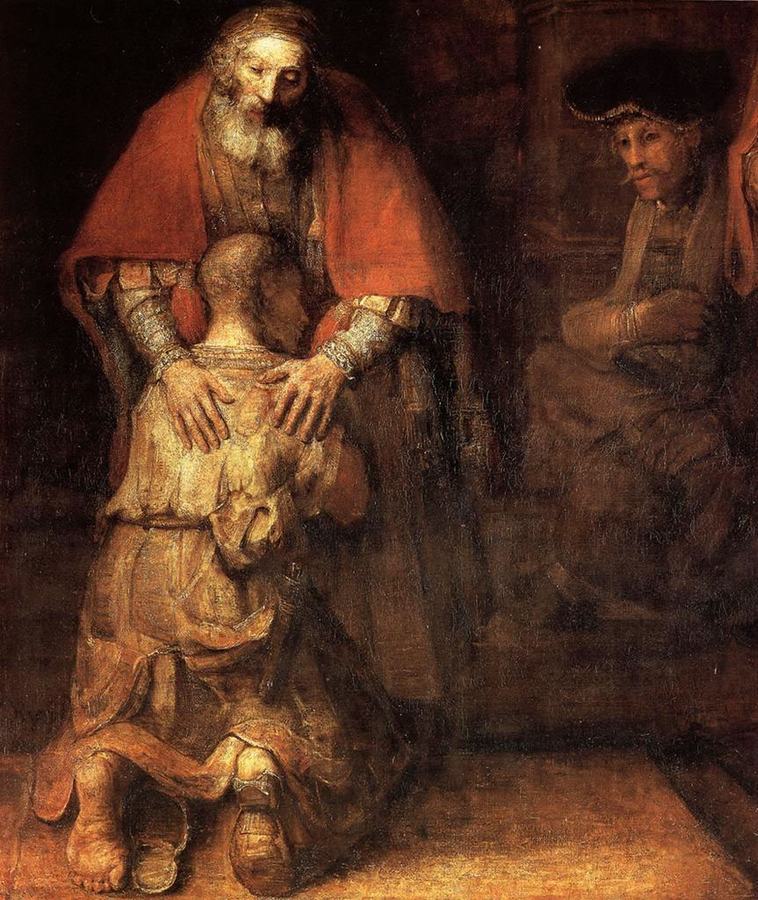
Yet the film’s true revolution lies in its refusal of catharsis. When the mother finally touches her son’s cheek, the gesture is so light it might be the memory of touch rather than touch itself. The father stands apart, lantern now extinguished, his shadow merging with the farmhouse wall until both become indistinguishable slabs of darkness. No feast, no fatted calf, no music—only the wind rattling the vines like dry bones. The last intertitle reads merely: “Et il se leva, et vint vers lui.” And he rose, and came toward him. The verb “rose” here is a loaded spring; the film ends before it can uncoil.
Compare this austerity to the baroque redemption of Peer Gynt or the lurid salvation in The Redemption of White Hawk, where every tear is underlined by a choir of violins. Carré’s refusal to console is what makes the parable modern. The prodigal’s repentance is not a moral triumph but a biological reflex, like a hand recoiling from flame; forgiveness, in turn, is not a cleansing flood but a cauterization.
Restoration efforts have been merciless. The original nitrate, long thought lost, surfaced in 1988 in a Slovenian monastery attic, fused into a single caramelized lump. The CNC’s archivists rehydrated it frame by frame in a bath of glycerin and rose water—an irony not lost on those who remembered the film’s abstemious ethos. The tints have been digitally regraded: the sunrise now pulses with the sulfurous yellow of cheap champagne, while the pig’s snout glows a lurid dark orange that would have sent the original exhibitors into conniptions. Some purists decry the 4K release as “a velvet coffin,” yet the added sharpness reveals textures previously invisible: the mother’s lace collar is stitched with tiny crosses, each knot a prayer whispered into cotton.
Criterion’s Blu-ray includes a commentary by theologian Cyrille Michaud who argues that the lantern flame is a visual anagram for the Hebrew letter shin, itself a glyph for the divine breath. More beguiling is the supplemental short Memoria dell’altro (link), an Italian riff on the same parable shot in 1910, where the prodigal is a woman and the pig is replaced by a mechanical toy that clicks like a Geiger counter. Seen back-to-back, the two films form a diptych on gendered shame: the son’s debauchery is economic, the daughter’s is sexual, yet both end in the same mute tableau of suspended absolution.
To watch L’enfant prodigue today is to confront the limits of mercy in an age when algorithms calculate repentance in retweets. The film’s brevity feels almost insulting—how dare it reduce the labyrinth of familial guilt to ten minutes of flicker? Yet its wound refuses to close. Long after the screen goes dark, the image of that lantern persists, a pendulum slicing the night into slivers of light and void, asking whether forgiveness is an act or merely the cessation of counting injuries. Carré gives no answer; he simply snuffs the flame and leaves us sitting in the residual smoke, tasting the metallic tang of our own unfinished reckonings.
If you emerge from this séance craving further parables of prodigals and pariahs, chase it with The Moth and the Flame (1915), where a courtesan’s son returns from the trenches wearing a mask of tin, or with Mortmain (1915), whose hero bargains away his shadow for a handful of gold and spends the rest of his life trying to buy it back at compound interest. None, however, match the ferocious reticence of Carré’s miniature. It ends not with a feast but with a breath held so long the viewer must decide whether to exhale mercy or simply drown.
IMDb 6.6
1926
Community
Log in to comment.