DbcultAccessing Vault...
Cult Review
Senior Film Conservator
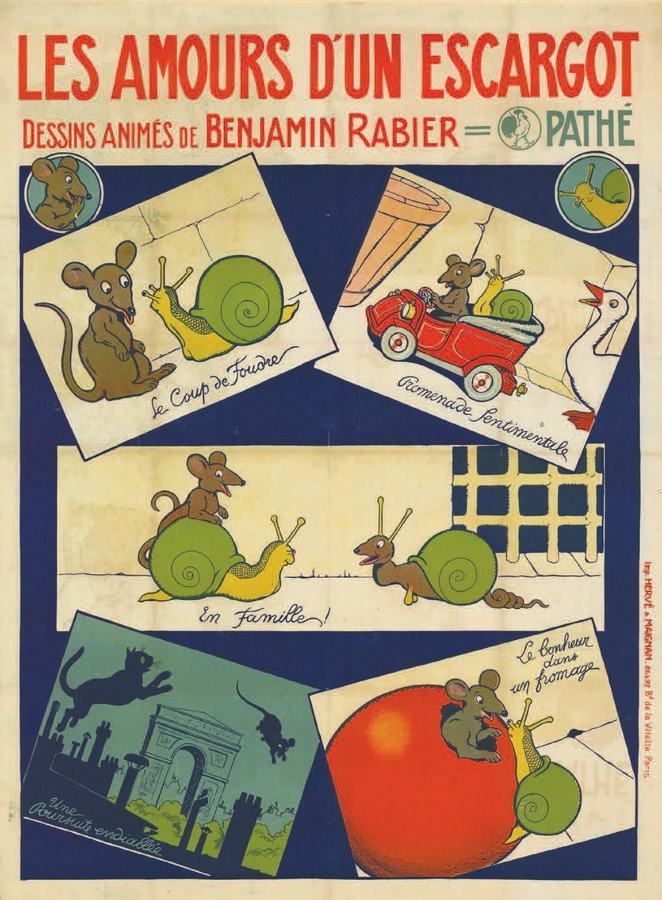
In the annals of early animation, where the nascent art form often delighted in simple gags and visual curiosities, Benjamin Rabier's Les Amours d'un Escargot emerges as a surprisingly profound and tender narrative. Far from a mere cartoon diversion, this film posits a world where the boundaries of species and societal expectations dissolve under the fervent heat of genuine affection. It's a whimsical journey, yes, but one imbued with a philosophical undercurrent that challenges conventional notions of love, family, and belonging. The film, a testament to Rabier's distinctive anthropomorphic style, invites us into an almost fantastical realm, yet grounds its most extraordinary elements in universally relatable emotions.
At its core, Les Amours d'un Escargot is a love story—an utterly unconventional one between Honoré, a snail, and Lucie, a mouse. Their initial vow of eternal devotion is presented not as a comedic premise, but with a sincerity that immediately endears them to the viewer. Rabier, with his characteristic economy of line and expressive characterizations, establishes their bond with a conviction that transcends their biological differences. This isn't merely a tale of two creatures; it's an allegorical exploration of love's capacity to bridge the most disparate of worlds. Honoré, with his deliberate pace and introspective gaze, complements Lucie's vivacious energy and quick wit, creating a dynamic duo whose compatibility seems to defy the very laws of nature. Their commitment to one another becomes the fulcrum around which the entire narrative pivots, setting the stage for a journey that is both romantic and fraught with peril.
The decision by Honoré and Lucie to embark on a pilgrimage to Cythera is particularly telling. Cythera, in classical mythology, is the island of love, the birthplace of Aphrodite. This destination is not just a geographical point but a symbolic aspiration, representing the idyllic, unblemished paradise where their love can flourish without external judgment or threat. It speaks to a universal human (and, in this case, animal) desire for a sanctuary, a place where the purity of emotion can exist unmolested. This quest for an idealized existence immediately elevates the film beyond simple slapstick, imbuing it with a sense of romantic idealism that resonates deeply. It's a poignant reminder of the lengths to which beings will go to protect and nurture their most cherished bonds, even if that sanctuary is ultimately a metaphorical one.
Yet, the path to Cythera, whether literal or metaphorical, is rarely smooth. Rabier swiftly introduces the harsh realities that threaten to shatter Honoré and Lucie's utopian dreams. Honoré finds himself confronted by a snail hunter, a stark embodiment of existential threat. This isn't a natural predator driven by instinct, but a human agent of utility, illustrating the indifference of the larger world to the tender narratives unfolding within it. For Lucie, the danger manifests in the form of a cat, a more primal and immediate threat from the animal kingdom. These encounters serve as crucial turning points, forcing our protagonists to confront the fragility of their nascent love against the indifferent sprawl of civilization and the unforgiving logic of the food chain. The introduction of these adversaries transforms the romantic quest into a desperate struggle for survival, lending a palpable tension to the narrative that belies its whimsical aesthetic.
The ensuing chase through Paris is a masterclass in early animated suspense, utilizing the urban landscape not just as a backdrop, but as an active participant in their flight. The labyrinthine streets, the towering buildings, the bustling city life—all conspire to create a sense of overwhelming scale and relentless pursuit. This segment of the film is a vibrant departure from the pastoral idealism of their initial quest, plunging Honoré and Lucie into a concrete jungle where their unique attributes become both strengths and vulnerabilities. Honoré's protective shell and Lucie's agility are tested against the relentless pace of urban existence and the cunning of their pursuers. This sequence also highlights Rabier's skill in visual storytelling, conveying urgency and emotion through movement and expressive character design, even within the technical limitations of early cinema. One might find thematic echoes here with the persistent, often futile, struggles against overwhelming odds seen in films like The Mortal Sin, though Rabier's approach retains a distinct lightness.
Remarkably, the grand quest for Cythera concludes not in an exotic paradise, but in the most prosaic of refuges: a piece of cheese. This seemingly humble sanctuary is, in fact, one of the film's most profound symbolic gestures. It underscores the idea that true happiness and security are not necessarily found in distant, idealized locales, but often in the simple, immediate comforts that love can transform into a home. The cheese represents a haven from the chaos of Paris and the threats of the outside world, a small, self-contained universe where their unique bond can finally flourish in peace. This choice of sanctuary is deeply resonant, suggesting that 'home' is not a grand edifice or a mythical island, but any place where love and companionship can thrive, however modest. This notion of finding unexpected solace in the ordinary resonates with the quiet triumphs found in narratives like Happiness a la Mode, which often explores the nuanced pursuit of contentment.
Within the confines of this cheesy abode, the ultimate expression of Honoré and Lucie's love manifests: a child. But this is no ordinary offspring. Their progeny is a hybrid marvel, bearing its mother's head, two antennae, and a snail's shell. This biological fusion is not merely a narrative twist; it is a profound allegorical statement on the nature of identity, the fluidity of species boundaries, and the radical acceptance required for true, unbounded affection. The child embodies the successful, albeit improbable, synthesis of two distinct worlds, a living testament to the power of their union. It challenges conventional notions of family and lineage, asserting that love can create new forms of life and belonging that defy established categories. This miraculous birth is the culmination of their journey, a tangible representation of their enduring bond and a hopeful vision for a future defined by acceptance rather than division.
Benjamin Rabier, renowned for his distinctive animal illustrations, brings his unique aesthetic to life in Les Amours d'un Escargot. His animation style, though rudimentary by today's standards, possesses an undeniable charm and clarity. Rabier’s anthropomorphic characters are expressive and instantly recognizable, conveying emotion and personality through minimalist design. The simplicity of the animation allows the narrative and thematic depth to shine through, rather than being overshadowed by elaborate visual effects. This early cinematic work exemplifies the pioneering spirit of animation, demonstrating how compelling stories could be told with limited resources, relying instead on imaginative concepts and strong characterizations. Rabier's influence on subsequent animators and illustrators, particularly in the realm of animal fables, cannot be overstated. His ability to imbue animals with distinct human traits and emotions, while retaining their inherent animalistic qualities, is a hallmark of his genius.
The visual humor and pathos in the film arise naturally from the situations and the characters' reactions, rather than forced gags. The chase through Paris, for instance, is thrilling but never loses its underlying emotional stakes. The quiet moments of affection between Honoré and Lucie are rendered with a gentle sincerity that makes their extraordinary relationship feel utterly believable. This subtle approach to storytelling, prioritizing emotional resonance over overt spectacle, sets Les Amours d'un Escargot apart from many of its contemporaries. It is a film that understands the power of suggestion and the audience's capacity for empathy, allowing them to connect deeply with its unusual protagonists. The film's understated brilliance reminds one of the narrative elegance sometimes found in works like The Adventures of Felix, where the journey of an animated character unfolds with both charm and emotional weight.
Beyond its surface-level charm, Les Amours d'un Escargot delves into profound themes relevant even today. The central premise of interspecies love, culminating in a hybrid child, is a powerful metaphor for acceptance and the breaking of societal norms. In a world often preoccupied with divisions and purity of lineage, Honoré and Lucie's story champions the idea that love knows no bounds, and that true family can be forged from the most unexpected unions. The child, with its mixed heritage, becomes a symbol of hope and a challenge to rigid classifications. It prompts viewers to consider what truly constitutes identity and how we define belonging. This radical embrace of difference resonates with the spirit of narratives that explore unconventional relationships and their outcomes, echoing the challenging societal norms observed in films like Forbidden Fruit, albeit with a more innocent and less overtly moralistic tone.
The film also subtly critiques the relentless pursuit of an idealized existence. While Cythera initially represents their ultimate goal, their ultimate sanctuary in a piece of cheese suggests that happiness and fulfillment are often found not in grand, distant ideals, but in the humble, tangible realities of shared life and mutual support. This philosophical pivot from the mythical to the mundane is a testament to the film's nuanced understanding of contentment. It’s a story about finding paradise not where you expected it, but where you make it, through resilience and unwavering affection. The journey itself, with its trials and tribulations, becomes as important as the destination, shaping the characters and solidifying their bond. This journey of transformation through adversity, leading to a redefined sense of self and belonging, brings to mind the character evolutions seen in films like The World Apart, where disparate elements eventually find a harmonious, albeit unexpected, union.
Despite its age, Les Amours d'un Escargot remains remarkably fresh and relevant. Its themes of overcoming adversity, the power of unconditional love, and the beauty of unconventional families are timeless. Benjamin Rabier’s ability to weave such profound ideas into a seemingly simple animated fable is a testament to his storytelling prowess. The film’s charm lies in its earnestness and its refusal to shy away from either the dangers of the world or the wondrous possibilities of love. It’s a gentle reminder that even the smallest creatures, facing immense challenges, can forge a life filled with meaning and joy, creating a legacy that defies all expectations. The enduring emotional core makes it a compelling watch for anyone interested in the foundational works of animation or simply a heartwarming tale of perseverance. The narrative's subtle emotional depth and the characters' unwavering devotion evoke a sense of warmth akin to the quiet reflections on love and connection found in films like Hearts Asleep, demonstrating that profound sentiment can be conveyed without grand gestures.
In conclusion, Les Amours d'un Escargot is far more than an early animated curiosity. It is a tender, imaginative, and deeply resonant film that speaks to the universal human experience of love, struggle, and the search for belonging. Benjamin Rabier, through his endearing characters and evocative narrative, crafts a miniature masterpiece that continues to charm and provoke thought. It stands as a testament to the power of animation to convey complex emotions and ideas, proving that even the most whimsical premises can house the most profound truths about the nature of existence and the boundless capacity of the heart. Its legacy is not just in its pioneering animation, but in its timeless message of love's triumphant defiance against all odds, a true gem in cinematic history that deserves continued appreciation.

IMDb —
1924
Community
Log in to comment.