DbcultAccessing Vault...
Cult Review
Senior Film Conservator
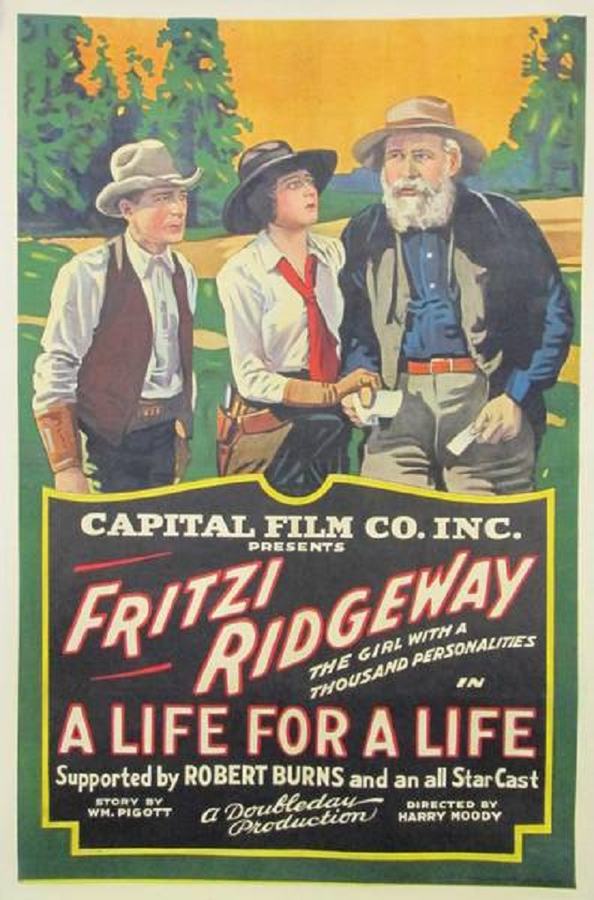
In the flickering pantheon of early cinema, few works attempt to grapple with the heavy, existential dread of moral reciprocity as unflinchingly as A Life for a Life. This is not merely a relic of the silent era; it is a visceral, pulsating document of human desperation. Directed with a surprising lack of sentimentality, the film peels back the layers of societal expectation to reveal the raw, often terrifying impulses that drive us toward redemption or ruin. While many contemporary films of the 1910s sought to comfort audiences with binary moralities, William Pigott’s script ventures into a gray expanse where every action carries a crushing weight.
At the heart of this narrative vortex is Fritzi Ridgeway, an actress whose ability to convey internal fracture through a single glance remains unparalleled. In an era where 'overacting' was often a necessity of the medium, Ridgeway practices a revolutionary economy of movement. Her performance doesn't just inhabit the screen; it haunts it. She portrays a character caught in an impossible vice, and we feel the tightening of the screws in every frame. Much like the tonal shifts found in The Witness for the Defense, there is a sense that the truth is a shifting target, visible only to those willing to look past the surface-level histrionics.
Bob Burns provides a rugged, grounded counterpoint to Ridgeway’s more delicate intensity. Burns possesses a physicality that feels hewn from the very earth of the filming locations. He doesn't just play a man of the era; he embodies the stoicism and the underlying turbulence of a generation defined by hard labor and harder choices. His chemistry with T.C. Jack creates a friction that drives the second act toward its inevitable, tragic collision. Unlike the more whimsical charms of How Molly Malone Made Good, the stakes here are perpetually life-and-death, handled with a gravity that borders on the religious.
William Pigott, as a writer, seems obsessed with the concept of the 'unbreakable bond.' Whether it is a bond of family, a bond of debt, or a bond of shared sin, his characters are never truly free. In A Life for a Life, the screenplay functions as a series of interlocking traps. Just when a character believes they have escaped their past, the past manifests in the present with a demand for payment. This thematic obsession with the 'debt of the soul' is something we see echoed in the later, more stylized Inherited Passions, though perhaps never with the same raw efficiency found here.
The pacing of the film is deliberate, almost penitential. Pigott allows the silence to breathe, forcing the audience to sit with the discomfort of the characters' choices. There is no jaunty soundtrack to tell us how to feel; instead, we are left with the visual rhythm of the editing. The juxtaposition of wide, desolate landscapes with tight, suffocating interior shots creates a visual metaphor for the protagonist’s internal state: a vast world of possibilities that has narrowed down to a single, fatal path.
When examining A Life for a Life alongside its contemporaries, its unique texture becomes even more apparent. While A Royal Romance indulges in the escapist fantasies of the upper crust, Pigott’s work is firmly rooted in the dirt and sweat of the common struggle. It shares a certain spiritual DNA with A Yoke of Gold, particularly in its exploration of the burdens we choose to carry for others. However, where A Yoke of Gold leans into a more traditional redemptive arc, A Life for a Life is more interested in the cost of that redemption—the literal and figurative price tag attached to every 'good' deed.
Even the more adventurous titles of the time, such as On the Spanish Main, feel somewhat superficial when compared to the psychological density of this film. Pigott is not interested in the spectacle of the journey, but in the wreckage left behind at the destination. The film’s grit is more akin to the harrowing realism found in Barbarous Mexico, though it trades that film's political fury for a more intimate, personal brand of nihilism.
Technically, the film is a marvel of resourcefulness. The use of natural light to sculpt the actors' faces gives the film a painterly quality reminiscent of the Dutch Masters. The shadows aren't just absences of light; they are characters in their own right, encroaching upon the protagonists as their secrets come to light. This chiaroscuro effect is far more sophisticated than the flat lighting found in Look Pleasant Please, elevating the film from a mere story to a piece of visual art.
The set design, though minimal, is incredibly effective. Every object in the frame feels lived-in and heavy with history. A simple wooden table becomes an altar of sacrifice; a dusty road becomes a purgatorial path. This attention to detail ensures that the world of the film feels tangible, making the eventual tragedy feel all the more impactful. It lacks the grandiosity of Christus, but it gains a staggering intimacy in its place.
What makes A Life for a Life remain relevant over a century later is its refusal to offer easy answers. It asks the viewer: what is the limit of your empathy? At what point does the survival of the self outweigh the survival of the other? These are the same questions that haunt the darker corners of The Straight Road, but Pigott strips away the veneer of social reform to look at the primal core of the issue. This is a film about the terrifying arithmetic of the heart.
The final act of the film is a masterclass in tension. As the various plot threads are pulled taut, the inevitability of the conclusion becomes almost unbearable. It is a slow-motion car crash of morality. There is no deus ex machina here, no last-minute reprieve. There is only the cold, hard logic of the film's title. In this regard, it stands in stark contrast to the more lighthearted resolutions of A Harem Hero or the societal playfulness of The Chaperon.
In the end, A Life for a Life is a testament to the power of silent cinema to communicate complex, agonizing truths. It reminds us that before the advent of synchronized sound, film was a medium of pure, unadulterated emotion and light. While it may not have the name recognition of some other classics, its influence can be felt in every modern noir and psychological thriller that dares to suggest that our pasts are never truly behind us. It is a dark, sparkling jewel of a film that deserves to be pulled from the depths of obscurity—much like the themes explored in Up from the Depths—and examined with the reverence it so clearly earns.
Whether you are a scholar of the silent era or a casual fan of gritty drama, this film offers a profound experience. It is a reminder that even in the infancy of the medium, filmmakers like William Pigott and actors like Fritzi Ridgeway were already pushing the boundaries of what stories could be told and how deeply they could cut. It is a cinematic debt that we, as modern viewers, should be more than happy to pay by giving this masterwork the attention it deserves. Do not expect a comfortable ride; instead, prepare for a journey into the very soul of human consequence.
IMDb 2
1916
Community
Log in to comment.