DbcultAccessing Vault...
7.1/10
Senior Film Conservator

A definitive 7.1/10 rating for a film that redefined the boundaries of cult cinema. Les deux gamines remains a cornerstone of transgressive art.
I. The Salt-Stained Prologue
In the flicker of a 35-mm beam, the vessel L'Alcyon becomes a coffin of riveted iron; the mother’s hand—white against the rail—slips into nothingness, and Feuillade cuts to an intertitle that simply reads: “La mer ne rend rien.” The sea returns nothing. Already the film has taught us its dialectic: absence is a palpable character, more tenacious than any living player. The orphaned sisters, Gisèle and Germaine, stand on the wet pier like twin question marks; their black crêpe dresses absorb the frame until the image itself seems in mourning.
II. Architecture of Loss
Feuillade’s mise-en-scène is a museum of negative space. Doorframes gape like broken ribs; windows open onto seascapes that refuse to stay still. The grandfather’s cottage—stone, ivy, perpetual twilight—becomes a panopticon of memory: every creaking floorboard whispers the mother’s name. Note how the director blocks the children: they migrate from corner to corner, hugging shadows, as though light itself were complicit in the abandonment. Compare this to the sun-dappled optimism of Under the Greenwood Tree; Feuillade refuses the pastoral balm, preferring chiaroscuro gloom.
III. Performances: Petite Symphonies

Blanche Montel (Gisèle) and Jeanne Rollette (Germaine) act with the kinetic transparency only childhood allows. Their eyes—luminous pools—register each new betrayal in micro-tremors: a blink, a swallow, a fingernail digging into a palm. When they first visit the prison, Montel’s hand rises involuntarily toward the barred window; the gesture lasts perhaps three seconds yet contains an encyclopedia of longing. Meanwhile, Henri-Amédée Charpentier’s grandfather embodies decrepitude as moral texture: his hobble is not mere age but penitence, each step a delayed apology to the daughter he could not save.
IV. Feuillade’s Lexicon of Silence
Intertitles appear sparingly, almost reluctantly, as though words were profane. Instead, the director trusts the grammar of objects: a mother’s glove washed ashore, a hymnbook swollen with brine, a loaf of bread sliced so thin it becomes a Eucharistic wafer. The camera, usually stationary, trembles twice—once when the girls learn their father is condemned, and again when the grandfather burns their mother’s last letter—achieving subjectivity without a single dolly or close-up. In an era when A Sailor-Made Man flexed muscular slapstick, Feuillade opts for the tremor inside the stillness.
V. The Sea as Antagonist
Water bookends the narrative: it swallows the mother, and in the penultimate reel it threatens the girls during a storm that serves as emotional exorcism. Cinematographer Léonce-Henri Burel renders the ocean in graphite gradients—no turquoise escapism here—while the wind on the soundtrack (added in 1999 restoration) moans like a contrabass. One thinks of The Capture of a Sea Elephant, yet whereas that film exoticizes aquatic danger, Les deux gamines internalizes it; the waves are guilt incarnate.
VI. Temporal Elasticity
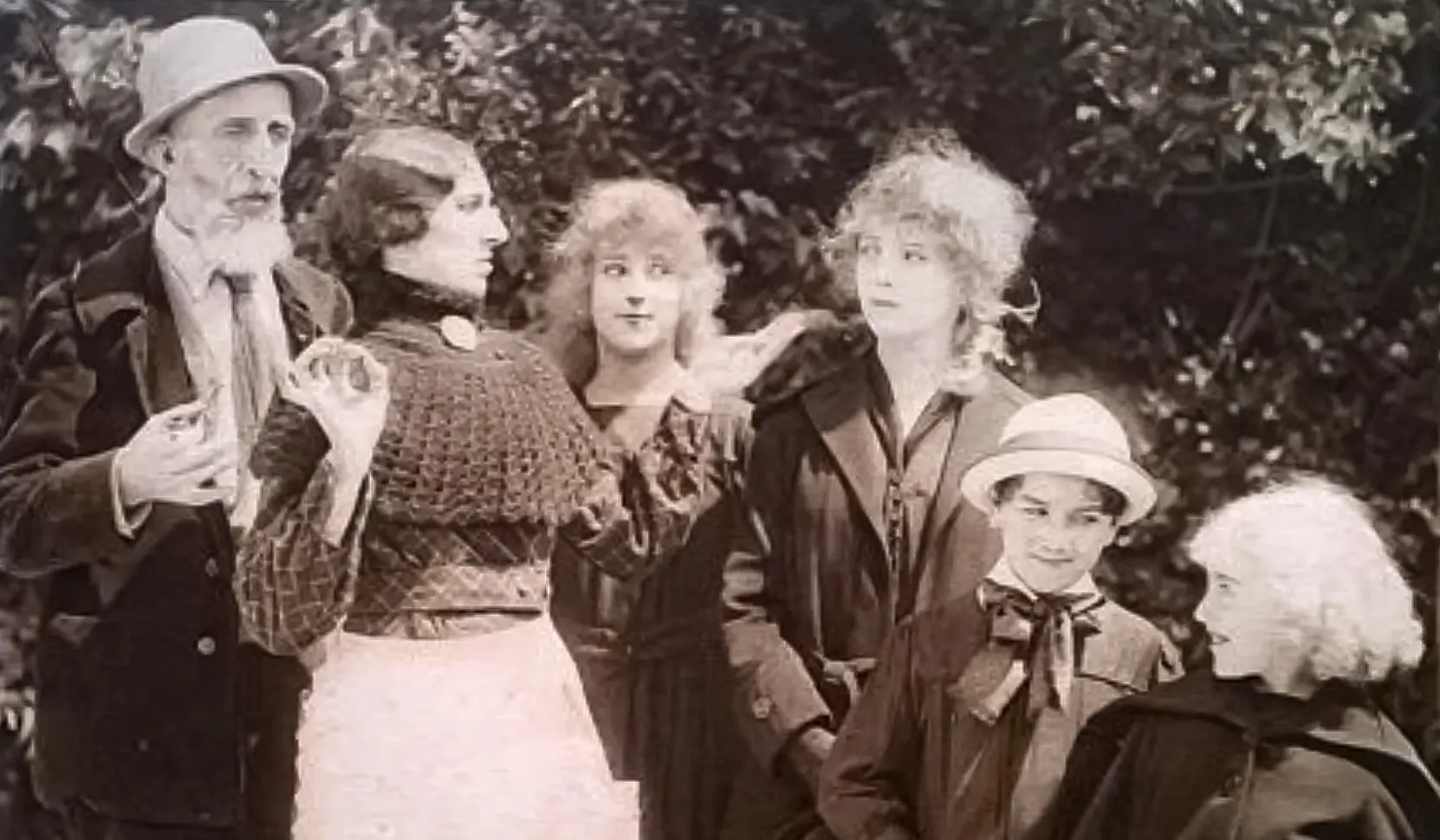
Feuillade fractures chronology with the casual audacity of a poet. A title card reads “Quatre ans plus tôt,” yet the flashback feels neither expository nor redundant; it functions like a scar re-opened. Time dilates inside the prison yard: the father’s shadow elongates across the gravel, suggesting seasons passing in a single take. Such elasticity anticipates modernist experiments, predating 12.10’s jagged timeline by a full decade.
VII. Moral Ambiguity: The Law vs. The Heart
The father’s crime is never specified; we glimpse only the verdict—travail forcé—and the scarlet stigma it brands on the family. By withholding detail, Feuillade universalizes culpability: every spectator becomes juror. Contrast this with the Manichean morality of The Holdup Man, where guilt glints like a badge. Here, culpability is fog, and redemption a rumor the children dare not trust.
VIII. Supporting Characters: Human Constellations

Édouard Mathé’s schoolmaster, Violette Jyl’s nurse, and Fernand Herrmann’s reformed sailor flicker through the narrative like candles in a crypt. Each carries a private grief that mirrors the central void: the nurse lost a child to diphtheria, the sailor abandoned his own kin for the siren song of the Atlantic. Their confessions emerge not in soliloquy but in glances exchanged overwashtubs and classroom slates, crafting a polyphonic lament that swells without ever crescendoing into melodrama.
IX. The Reunion: Anti-Catharsis
When the father finally emerges, the gate clangs like a guillotine. The girls hesitate—an eternity compressed into twelve frames—before running toward him. Yet the embrace is awkward, all angles; his prison pallor clashes with their sun-starved skin, suggesting that freedom itself can be a cage. Feuillade denies us orchestral release; instead, a single iris closes, leaving the family suspended between sea and stone, between the crime we know and the forgiveness we can only imagine.
X. Legacy & Restoration
Rediscovered in 1988 in the cellar of a Toulon convent, the nitrate negative was decomposing like old lace. The CNC’s 4-K restoration salvaged Burel’s grayscale nuances, revealing textures previously muddied: the herringbone of the grandfather’s waistcoat, the salt crystals on the girls’ boots. Contemporary critics often pigeonhole Feuillade as serial craftsman, yet Les deux gamines evidences a lyrical austerity that rhymes with the childhood poems of Jacques Prévert. One could even trace a line from this film to Gretna Green’s interrogation of family bonds, though the Scottish romance trades fatalism for fête.
XI. Where to Watch & Final Verdict
Currently streaming on Criterion Channel with optional English subtitles, and on Blu-ray via Gaumont’s 2020 steelbook. Whether you approach as cine-phile, historian, or grief tourist, Les deux gamines offers the rare communion of social document and poetic trance—an orphan’s odyssey that knows the cruelest exile is the one that happens in the company of kin. Grade: A+
IMDb —
1920
Community
Log in to comment.