DbcultAccessing Vault...
Cult Review
Senior Film Conservator
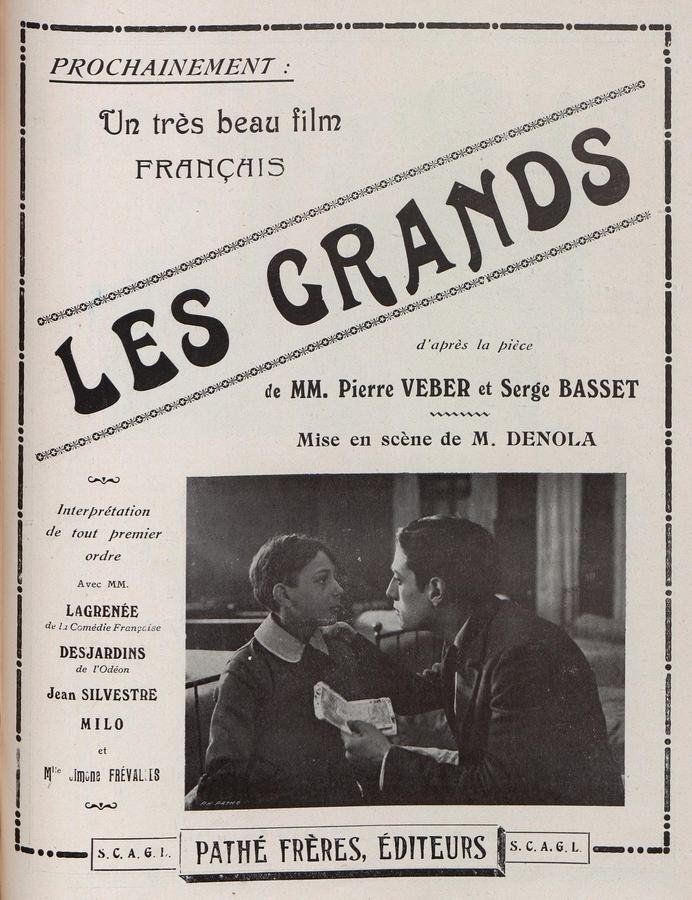
A Masterclass in Contradictions: 'Les Grands' and the Illusion of Grandeur
Few films so deftly balance the opulence of setting with the raw vulnerability of its characters as 'Les Grands.' Pierre Veber and Serge Basset’s 1937 script is less a narrative than a philosophical exercise, peeling back the layers of a decaying French aristocracy to reveal the existential dread beneath. The film’s title, which could mean 'The Greats' or 'The Big Ones,' is a sly double entendre; greatness here is both aspired to and ridiculed. The sprawling estate of Maxime Desjardins’ character, a once-proud nobleman now clinging to fading relevance, serves as the perfect microcosm for a society in transition. This is not the France of romanticized pastoralism but one of gnawing uncertainty, where every gesture carries the weight of history.
The film’s opening sequence—a slow pan across the overgrown gardens of the protagonist’s château—sets the tone. The camera lingers on cracked stone and wilting flowers, suggesting decay that precludes renewal. When Desjardins’ character finally enters, his movements are measured, almost ceremonial, as if performing for an audience that no longer exists. His interactions with Albert Bras’ pragmatic, rising bourgeoisie and Herman Grégoire’s cunning, scheming rival are charged with subtext. A single glance, a misplaced fork, a half-heard word—all become battlegrounds for power. The dialogue, though sparse, is dense with implication, a hallmark of the film’s economy of expression.
What elevates 'Les Grands' beyond its contemporaries is its refusal to romanticize its characters. Desjardins’ aristocrat is not a tragic hero but a flawed individual, his pride both a source of dignity and a fatal flaw. This ambiguity is mirrored in the film’s visual style. The cinematography alternates between lush, almost painterly compositions and jarring close-ups that expose the characters’ raw emotions. A scene where the protagonist confronts his financial ruin in a dimly lit study is particularly striking: the shadows swallow his face, leaving only his eyes visible, a visual metaphor for the erosion of identity.
The supporting cast, including Maurice Lagrenée and Émile Mylo, adds depth to the film’s exploration of class and morality. Their characters are not mere foils but fully realized individuals, each embodying different facets of a society in flux. Jean Silvestre’s role as a cynical journalist who documents the crumbling aristocracy is especially poignant. His monologue to the camera—delivered in a single, unbroken take—feels like a eulogy for an era. The film’s pacing, deliberate yet never sluggish, allows these performances to breathe, creating a sense of inevitability that lingers long after the credits roll.
Technically, 'Les Grands' is a triumph. The sound design, particularly the use of diegetic noise—a creaking floorboard, a distant church bell—immerses the viewer in the film’s world. The score, minimal yet piercing, underscores the tension between tradition and modernity. One standout scene involves a horse race, where the galloping hooves and the characters’ desperate expressions merge into a chaotic symphony. This sequence, reminiscent of the climactic races in 'The Good Bad-Man' and 'The Undying Flame,' is not just a spectacle but a narrative device, symbolizing the reckless pursuit of glory.
The film’s themes resonate with contemporary audiences. In an age of social media and curated identities, 'Les Grands' reminds us of the futility of seeking validation through external measures. The characters’ struggles with self-worth and legacy mirror modern anxieties about relevance and obsolescence. When compared to other works from the era, such as 'The Dagger Woman' and 'The Service Star,' 'Les Grands' stands out for its introspective approach. While those films focus on external conflicts—murder, espionage, and duty—this one delves into the internal disintegration of its characters.
The performances are a masterclass in subtlety. Desjardins’ portrayal of the aristocrat is nuanced; he conveys a lifetime of repressed emotion through minute gestures. In one particularly effective scene, he watches a childhood friend’s funeral from his window, his face a mask of conflicting emotions. There is no grand speech, no dramatic collapse—just a man grappling with the weight of memory. Bras and Grégoire, meanwhile, embody the duality of ambition and insecurity. Their rivalry is not driven by malice but by a shared fear of irrelevance, a theme that feels startlingly modern.
The film’s technical achievements are equally impressive. The use of light and shadow—often underappreciated in pre-war cinema—is both poetic and purposeful. A sequence where the protagonist walks through a forest at twilight, the camera slowly zooming in as the light fades, captures the fragility of human existence. The editing, too, is noteworthy. The abrupt cuts between extended takes create a jarring effect, mirroring the characters’ disrupted psyches. This technique, later perfected by filmmakers like Renoir and Renoir fils, gives the film a modernist edge that defies its era.
'Les Grands' also excels in its exploration of gender roles. The female characters, though fewer in number than their male counterparts, are not relegated to passive roles. Simone Frévalles’ performance as a jaded socialite is a standout; her character’s gradual disillusionment is portrayed with quiet intensity. Jeanne Brindeau’s role as the protagonist’s estranged wife adds another layer of complexity. Her interactions with the male characters are charged with unspoken history, and her eventual departure from the château is as much about personal liberation as it is about the story’s resolution.
The film’s climax—unpredictable yet inevitable—is a masterstroke of narrative construction. Without giving away the plot, suffice it to say that the resolution is not one of catharsis but of quiet resignation. This refusal to offer easy answers is a testament to the film’s intellectual honesty. The final shot, a wide-angle view of the château now abandoned to the elements, is a powerful visual metaphor for the transience of all things. It is a moment that lingers, not because it is dramatic, but because it is true.
In the broader context of French cinema, 'Les Grands' holds a special place. It bridges the gap between early silent films and the新浪潮 movement, incorporating elements of both. The film’s introspective style and focus on character psychology prefigure the works of directors like François Truffaut and Jean-Luc Godard. Comparisons can also be drawn to 'Raskolnikov' and 'The Cigarette Girl' for their exploration of moral dilemmas and societal pressures. Yet 'Les Grands' remains distinct in its commitment to ambiguity and its refusal to moralize.
For modern viewers, the film offers both a window into the past and a mirror to the present. Its themes of legacy, pride, and the search for meaning are as relevant now as they were in 1937. The film’s technical and artistic achievements, though rooted in their time, feel timeless. Whether you watch 'Les Grands' for its historical significance, its acting, or its philosophical depth, it is an experience that demands—and rewards—multiple viewings.
In conclusion, 'Les Grands' is more than a film; it is an artifact of a bygone era and a testament to the enduring power of cinema to provoke thought and emotion. It stands as a benchmark for how to tell a human story with artistic integrity and narrative precision. For those seeking a cinematic journey that is as intellectually stimulating as it is emotionally resonant, this is an essential viewing. Just be prepared to wrestle with its questions long after the screen fades to black.
IMDb —
1931
Community
Log in to comment.