DbcultAccessing Vault...
Cult Review
Senior Film Conservator
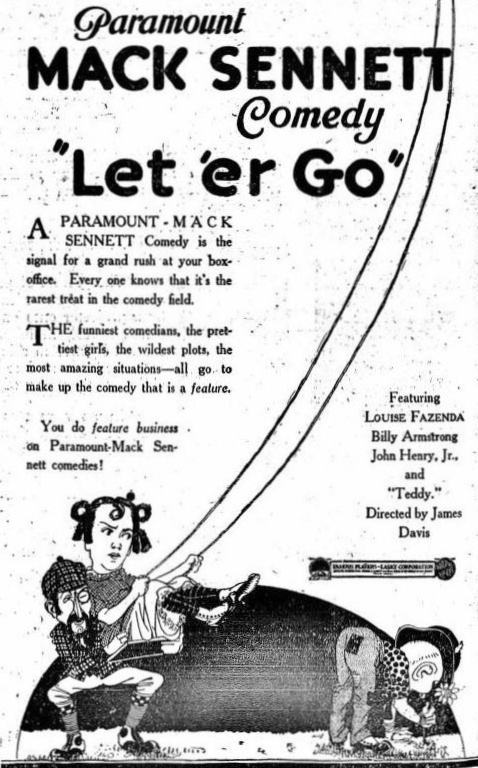
Mack Sennett’s 1920 one-reeler Let ‘er Go is less a narrative than a sackful of barnyard booby traps rigged to detonate on cue; yet within its 18-minute sprint there pulses a demented affection for human clumsiness and animal agency that still feels startlingly modern.
Picture, if you can, the standard pastoral romance: bashful swain, coy milkmaid, rival belle fluttering her parasol. Now imagine Cupid’s arrow rerouted through a cattle chute. Sennett, ever the mischievous deity of silent comedy, yanks the cliché inside out, knotting the tail of a Guernsey to the milker’s suspenders. What begins as a quaint attempt at bovine etiquette snowballs into centrifugal slap-ballet: each frantic moo yanks trousers northward while gravity insists on southward modesty. The resulting pas de deux is a triumph of physics and embarrassment, a kinetic epigram on the folly of masculine control.
The bee sequence—often excerpted in retrospectives—deserves its legendary status. A blindfolded player, giddy from children’s party hubris, wanders into the arc of a wooden swing. The impact resembles a human cannonball launched into apiarian airspace. Cinematographer Edward C. Foster cranks the camera slightly under normal speed, so the cloud of bees resembles acidic confetti. Our hero’s flailing silhouette, framed against a white summer sky, becomes a hieroglyph of panic.
Sennett’s comic grammar is all escalation. One sting multiplies into a hundred; one shriek ignites a chain-reaction involving a dog (the scene-stealing Teddy), a runaway phaeton helmed by a toddler barely tall enough to clutch ribbons, and a phalanx of bicycling postmen who pedal straight into a duck pond. The director’s credo: if chaos knocks once, invite it to dinner and let it set the table on fire.
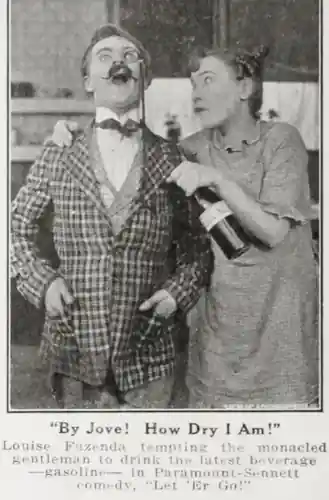
Yet amid the pandemonium, Louise Fazenda floats in like a modest Venus borne on a fishing line. The bathing-suit gag—demure by today’s standards—carries 1920s frisson precisely because of its restraint. A single hook slips beneath her belt, she rises from the creek dripping, startled, yet unviolated. Sennett pauses on her startled profile: a rare close-up that suspends hilarity for three heartbeats of cinematic poetry. In that moment the film acknowledges the female body without leering, a nuance often lost in Keystone’s raucous legacy.
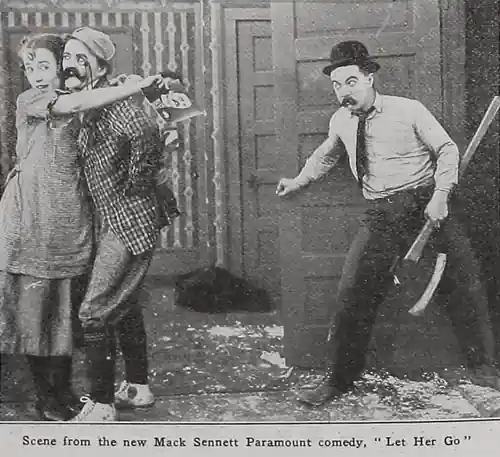
Compare this aquatic rescue with the hallucinatory river sequence in The Wandering Image, where ripples become emotional barometers. Sennett’s stream is sillier, yet both films understand water as narrative solvent: it dissolves dignity, dissolves clothing, dissolves plot contrivance until only pure instinct remains.
Performers orbit like misaligned planets. Don Marion plays the callow sweetheart with a porcelain grin; Charlotte Mineau sashays as the vamp who owns every doorway she leans against. Meanwhile Billy Bevan, Billy Armstrong, and Bert Roach pop in as assorted bumpkins, each sporting a moustache that looks like a caterpillar on furlough. Their collective timing is Swiss-watch precise, even when the watch explodes.
The film’s anarchic locomotion anticipates later Sennett alumni: without Let ‘er Go there is no logical runway for Two-Gun Betty’s rodeo rodeo, nor for the haunted-house collisions of A Scream in the Night and The Terror. Even the existential entanglements of The Rack echo the same question Sennett poses here: how much disorder can the human frame absorb before it snaps into absurd grace?
Technically, the short survives only in a 9.5 mm Pathéscope condensation, complete with French intertitles and a sepia tint that pools like weak tea. Yet the wear only amplifies its ghostly charm. Scratches dance like embers across the frame; the missing footage becomes negative space where imagination rushes in. Film preservationists at La Cinémathèque de Toulouse stabilized the transfer at 20 fps, correcting the projection speed so the bee swarm no longer resembles time-lapse pollen.
The score on current streaming prints is a jaunty salon orchestra pastiche. Accordion and xylophone chase each other much like the on-screen dog and toddler. Purists may grouse, yet the music’s oom-pah heartbeat syncs uncannily with the cutting rhythm, recreating the nickelodeon ambience lost for a century.
Critical reception in 1920 was rapturous. Moving Picture World hailed the cow-tail gag as “one of the most original,” while Variety sniffed that “Sennett has milked more than cows for laughter.” Both verdicts ring true. Originality, after all, is less about never-seen-before than about never-seen-in-quite-this-context. And Sennett’s genius lies in remixing rustic Americana—the milking stool, the beehive, the Sunday swing—into a centrifuge that flings clichés into orbit.
Socially, the film is a time capsule of country leisure before Prohibition prudery set in. Women’s bathing suits resemble woolen armor, yet Fazenda’s comic verve blasts through the fabric. The toddler driver gag, meanwhile, tickles contemporary fears about unattended children; in 1920 it registered as harmless hyperbole. Today, the image of a baby gripping reins while horses thunder toward a ravine lands closer to nightmare, reminding us that slapstick’s innocence is always historical, never absolute.
Still, Let ‘er Go endures because it distills the essence of screen comedy: the moment when flesh and gravity negotiate a new, preposterous contract. Every age has its own metaphorical bees—data overload, economic collapse, social media swarm—and Sennett’s characters show us how to run, flail, and somehow keep laughing.
For collectors, the sole home-video release floats on the out-of-print “Slapstick Carnival” DVD, paired with Miss Adventure. Expect to pay collector prices, or trawl the Internet Archive for a public-domain 480p rip. Better yet, lobby your local cinematheque: this is a print that deserves carbon-arc projection, the kind that flickers like lightning and smells of warm celluloid and ozone.
Ultimately, Let ‘er Go is a pocket-sized manifesto: life will knot your suspenders to catastrophe, unleash the bees, and fish you bare from the drink. All you can do—Sennett insists with a grin wide enough to swallow the horizon—is let it go.
IMDb —
1935
Community
Log in to comment.