DbcultAccessing Vault...
6.9/10
Senior Film Conservator
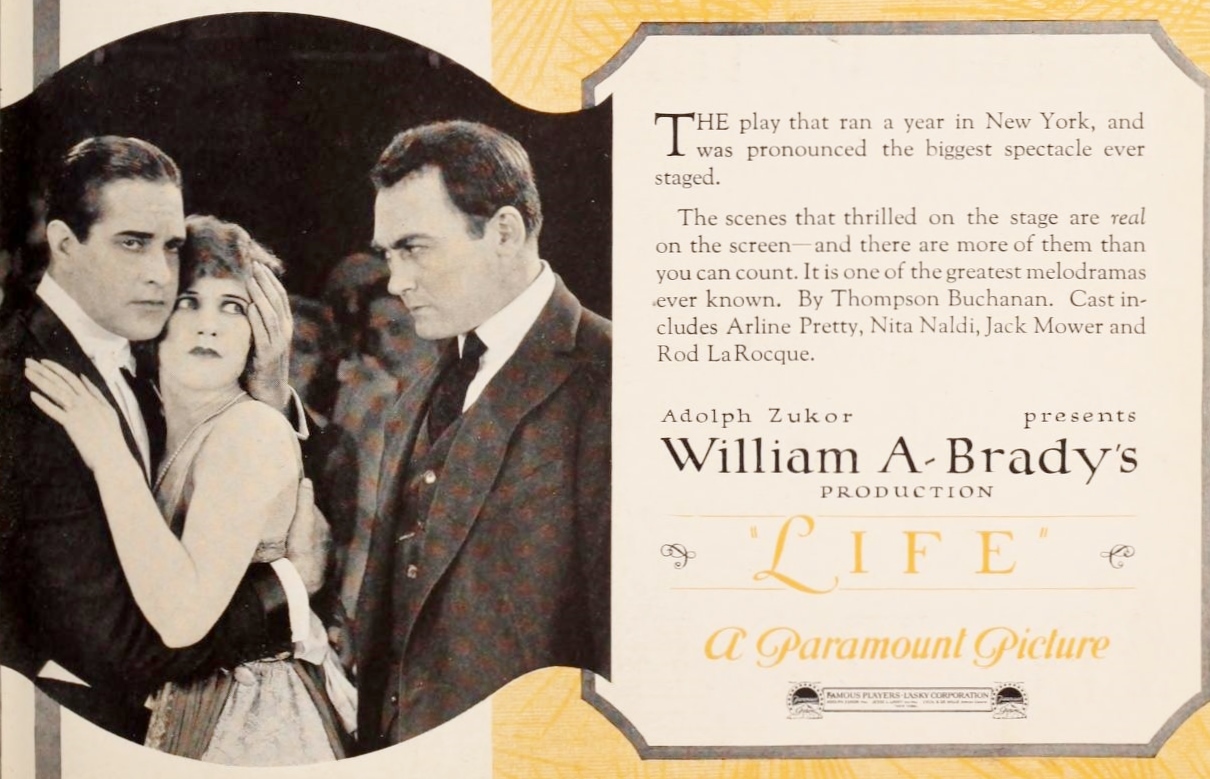
A definitive 6.9/10 rating for a film that redefined the boundaries of cult cinema. Life remains a cornerstone of transgressive art.
Picture the Roaring Twenties not as flapper clichés but as a single pane of glass trembling under the weight of its own reflections. Life (1923) is that pane: fragile, slick, and ready to slice any palm that presses too hard. Director Robert A. Dillon and scenarist Thompson Buchanan adapt a Broadway hit into a silent fever of embezzlement, ballroom glitz, and scaffold terror. The result lands somewhere between The Cloven Tongue’s psychosexual tangle and Stripped for a Million’s underworld nihilism, yet it predates both.
Every transaction in this film is double-entry: love against interest, loyalty against liquidity. Reid’s promotion is the first debit, an honor that paints a bull’s-eye on his integrity. Ralph’s forgery is the reckless credit, a spectral duplicate of his father’s autograph that circulates like a counterfeit soul. Burnett’s accusation is the adjusting entry, a crooked ledger line that shifts guilt from one column to another. When the banker’s corpse hits the parquet, the books slam shut—only to be pried open by Ruth’s tremulous fingers and the chief detective’s magnifying glass.
Notice how the narrative refuses the comfort of linear guilt. We witness Ralph’s forgery early, yet the film insists on Reid’s entrapment, forcing us to taste the metallic tang of wrongful conviction long before redemption arrives. The structure is less whodunit than who-will-pay, a distinction that keeps tension coiled even when culprits are known.
Geoffrey Stein plays Reid with a recessive magnetism—his shoulders carry the stoop of a man who has read too many balance sheets and not enough poetry. Watch his eyes in the death-row montage: they flicker between resignation and a nascent animal cunning, as if realizing that survival will demand a second self.
Arline Pretty’s Ruth is no decorative ingenue. She haunts corridors in velveteen coats, clutching documents like ransom notes. Her courtroom outburst—intercut with iris shots of Reid behind bars—feels raw enough to scratch the emulsion.
Meanwhile, Hubert Druce sculpts Ralph’s dissipation with feline grace: each cigarette lit for Grace is a semaphore of surrender. And Nita Naldi, pre-Blood and Sand, exudes a vampiric languor. She lounges on chaises as though they were altars, demanding pearls the size of pigeon eggs with the languid authority of a high priestess who knows every sin has its price in carats.
Cinematographer L. William O’Connell renders the bank as a cathedral of capital: aerial shots of teller cages resemble stained-glass compartments, while low-angle lenses make columns loom like secular saints. The ballroom sequence is a kinetic kaleidoscope—mirror balls fling constellations across waltzing couples, and the murder occurs in a iris wipe that shrinks to a trembling pupil.
But the film’s visual apex is the escape sequence. Reid breaks from prison into a labyrinth of smoke stacks and tenement shadows. Silhouettes stretch across brick like Expressionist woodcuts; searchlights slice rain into silver needles. It’s as if Caligari’s set designer moonlighted on a New York backlot.
I counted at least four separate dissolve transitions that layer Ruth’s tear-streaked face over Reid’s sprinting silhouette—an early instance of emotional montage that anticipas the later, more famous work of Soviet editors.
Original release prints shipped with a cue sheet calling for Chanson Triste during Ruth’s midnight vigils and Inferno (a furious Wurlenstein piece) for the man-hunt. Modern restorations often substitute a contemporary trio—piano, violin, and trap set—yet even anachronistic accompaniment cannot dull the film’s percussive tension. Each intertitle arrives with the abruptness of a gavel: “The jury finds—” cuts to black, then a single word inflates: GUILTY.
Place Life beside Les Misérables, Part 2: Fantine and you find two convicts—Reid and Jean Valjean—both condemned by paperwork. Yet where Victor Hugo wields spiritual transcendence, Dillon clings to civic restitution, a secular absolution that feels chillingly modern. Conversely, the film’s ballroom murder rhymes with the operatic assassinations in Quo Vadis?, only stripped of imperial pomp and relocated to Jazz Age marble.
Curiously, Life also anticipates noir. Burnett’s motivation—love neither genuine nor erotic but fiduciary—prefigures the post-war shift from romantic to monetary fatalism. If you squint, the film’s chiaroscuro DNA splices into Double Indemnity a full twenty-one years early.
Women circulate as both asset and liability. Grace is the luxury item whose price inflates beyond Ralph’s solvency; Ruth is the heiress whose hand functions as merger. Yet the film grants them agency in the margins—Ruth’s detective work, Grace’s refusal to perjure herself once cornered. These micro-rebellions complicate what could have been a simple parable about profligate sons.
No complete 35 mm negative is known to survive. The Library of Congress holds a 226-foot fragment—Ralph forging the check—while a 9.5 mm Pathéscope abridgment (UK, 1926) runs eight minutes and ends mid-trial. Cinephiles trade a 480p DVDRip rumored to derive from a 1950s TV syndication print; contrast blooms like fungus, but it’s the only way to witness the rooftop denouement. Boutique labels whisper of a 4K “phantom restoration” using AI interpolation, yet rights sit tangled in the William A. Brady estate.
Variety (Jan 1924) praised the “nerve-tightening finale” but sniffed at the courtroom clichés. Photoplay adored Naldi, calling her “a cobra in a silk kimono.” Modern aggregator SilentEra lists a 7.2/10 from 112 votes—impressive for a partially lost film. On Letterboxd, the movie surfaces in lists like Pre-Code Noir Before the Code and Capital Punishment Aesthetics.
I first encountered Life on a mildewed VHS in a Pittsburgh archive. The image wobbled like a lantern in wind, yet the story’s ethical vertigo bored into me. I kept replaying the moment Reid, hidden inside a freight car, watches dawn split the skyline—an inversion of the American promise: instead of horizon-wide opportunity, he sees a nation ready to electrocute the innocent.
What lingers is the film’s refusal to grant catharsis. Yes, the villains fall, but the hangover of institutional failure—banks that forgive fraud when perpetrators are kin, courts that sentence on circumstantial ledgers—remains. The final embrace between Reid and Ruth feels perfunctory, almost embarrassed, as if even love understands it must now compete against compound interest.
I rate Life on a curve of availability: if cinema is a democracy of ghosts, this one deserves parole into the digital light. For ingenuity of visual metaphor, for Naldi’s decadent élan, for the prescient fusion of social commentary and pulp thrills—
8.5 / 10
Seek it however you can: digitized bootleg, flickering 9.5 mm, or the echo of a cue sheet played on solo piano at midnight. Just don’t expect moral bookkeeping to balance. In the ledger of Life, the only certainty is accrued risk—and the compound interest of injustice never stops climbing.
Tags: Life 1923, silent thriller, Robert A. Dillon, Nita Naldi, death-row escape, Jazz Age noir, lost film, early crime cinema, When Love Is King comparison, The Cost capitalism critique
IMDb 6.6
1934
Community
Log in to comment.