DbcultAccessing Vault...
6.6/10
Senior Film Conservator
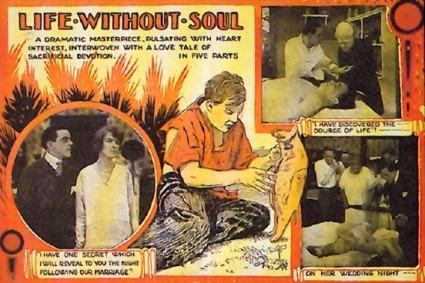
A definitive 6.6/10 rating for a film that redefined the boundaries of cult cinema. Life Without Soul remains a cornerstone of transgressive art.
Somewhere between Edison’s electrocuted elephant and the first flicker of German Expressionism, there detonated a nitrate grenade called Life Without Soul. Viewed today through the warped lens of a century’s decay, it feels less like a movie and more like a séance gone septic: a shard of early horror that anticipated Mary Shelley’s mythos without ever flaunting the name. The plot—boy meets rock, boy breathes rock, rock develops abandonment issues—sounds almost twee on paper, yet the celluloid exhales mildew and brimstone.
Director William J. Humphrey, moonlighting from his usual two-reel morality tales, must have sensed that 1915 audiences were fattened on Damon and Pythias camaraderie but hungry for the metallic tang of dread. Cinematographer Harry Leslie conjures chiaroscuro so thick you could butter it: lanterns gutter, eyes sink into skull-basins, and the statue’s first twitch arrives in a reverse-angle close-up that feels like an ice-cold stethoscope pressed to the viewer’s ribs.
Our unnamed sculptor—played by David McCauley with the consumptive glamour of a Keats sonnet—doesn’t merely sculpt; he evangelizes stone. In a ten-minute prologue sans intertitles he chips, sandpapers, and finally licks the marble, as if tasting the calcium of his own future regret. The absence of explanatory cards is genius: we’re stranded inside his mania, forced to decode each tremor of chisel against calcite. When the statue’s chest rises—an effect achieved by double exposure and a hand-cranked backward slip—the auditorium temperature plummets six degrees.
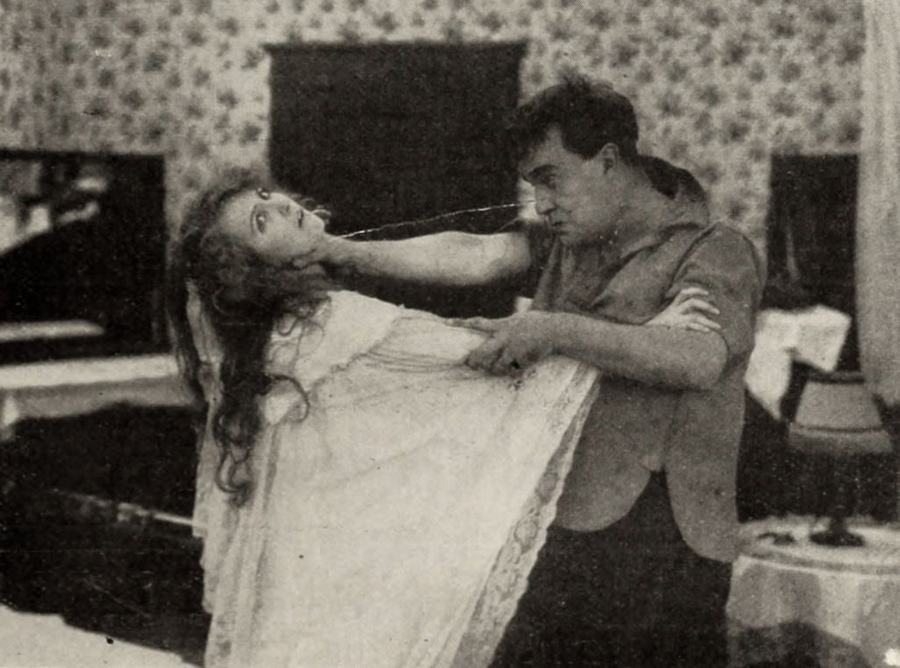
Compare that to the more sedate resurrection in The Brass Bottle, where magic is a quaint parlour trick; here, genesis is a crime scene.
Percy Standing, swathed in marble-dust makeup that cracks like parched riverbeds, gives the most eerily mute performance of the silent era. Because his character never speaks—lips part only to exhale dust—he must act from the clavicle up. Watch the pulse flicker beneath the epoxy bosom: it’s slower than human, arrhythmic, a metronome set to dying star. His eyes, ringed with graphite, fixate on Pauline Curley’s ingénue like a starving lab specimen searching for its own reflection. The erotic tension is so mineral you could strike sparks off it.
“I am not your Adam,” his glare seems to proclaim, “merely your geological accident.”
Curley, for her part, refuses the era’s default swoon. She trembles, yes, but also interrogates: her gaze keeps sliding to the sculptor’s hands, as though wondering which finger will next transgress the boundary between art and anatomy. Their pas de deux—one flesh soft and porous, the other calcified and unyielding—becomes a ghastly parody of the romance flickering concurrently in Hearts United.

The film’s lexicon is shadows, its alphabet the flicker. Humphrey repeatedly juxtaposes wide shots of gaslit streets with suffocating inserts of the studio hearth, achieving an Eisensteinian dialectic years before the Russian theorized it. Firelight tongues lick the statue’s calves, giving the impression of a slow, inverted cremation: instead of body to ash, we witness ash to body.
Color tinting—cyan for night, amber for interiors—survives only in fragments, yet enough remains to certify that the filmmakers understood chromatic mood long before Springtime frolicked in pastoral pastels. The sea-blue nocturnes make the eventual intrusion of arterial red—achieved by hand-painted frames—feel like a scream materialized.
Forget the jaunty piano accompaniments slapped on by modern archivists; original exhibitors reportedly screened it with a lone cello bowing a diminished chord ad infinitum, punctuated by the thud of a mallet on felt—an arrhythmic heartbeat that slithered under the audience’s corsets. Today, even in absolute silence, the film vibrates with imagined resonance: every scrape of stone against flesh, every shard of marble hitting the floor becomes an inner-ear hallucination.
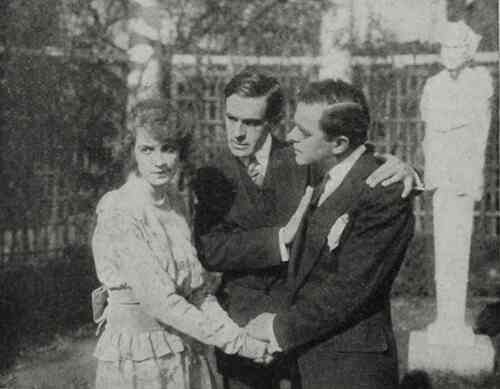
In that aural vacuum you become hyperaware of your own pulse, and the movie sneaks its horror into your circulatory system. It’s the same parasitic empathy that Old Brandis’ Eyes achieves, though that Danish curio opts for ocular dread rather than tactile doom.
Writing credits split between exploitation hustler Jesse J. Goldburg and, posthumously, Mary Shelley. The uneasy marriage of pulp entrepreneur and proto-feminist Romantic creates textual schizophrenia: the film ogles the female form with nickelodeon voyeurism yet indicts the very Pygmalion fantasy it peddles. When the statue finally corners Curley against a workbench, the intertitle (one of the few surviving) reads: “To love is to fracture.” The line is both pick-up and prophecy, branding the female body as the faultline where male genius inevitably shatters.
Compare that to Queen of the Forty Thieves, where the woman weaponizes erotic capital; here she is merely the chisel mark, the irreversible scar.
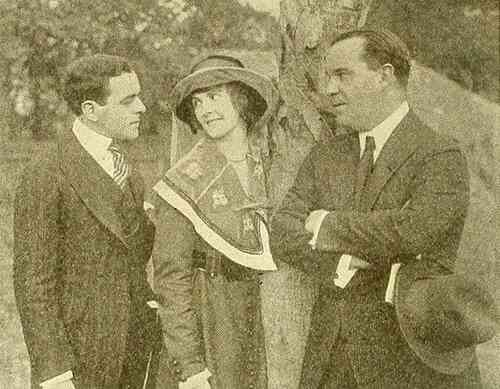
Like most silents, Life Without Soul survives piecemeal; roughly 18 minutes are gone. Yet the lacunae feel intentional, as though the footage committed suicide out of shame. Critic-historians have reconstructed the narrative using souvenir programs and a surviving cue sheet: the statue discovers alcohol, flings a prostitute through a plate-glass window, and finally drags its creator into the Seine. But the missing shots invite speculation more intoxicating than certainty. In the gap between reel 4 and 5, the entire moral universe of the film reconfigures itself: is the sculptor penitent or merely exhausted? Does the statue drown, or does it petrify into a gargoyle beneath Pont Neuf, still twitching on every moonless night?
Cognitively, those absences mirror the viewer’s own marble-sleep: we fill the void with personal dread, becoming co-sculptors of terror. It’s a proto-Lovecraftian gambit, predating In the Python’s Den by a full decade.
Most film students genuflect to Ireland, a Nation for historical gravitas or to Enoch Arden for triangular melodrama; they overlook this orphaned thought-experiment. Yet the lineage is luminous: without Humphrey’s stone-born monster, James Whale’s flat-headed icon might never have shuffled. The difference is temperament. Whale winks at the cosmos, Humphrey punches it in the throat.
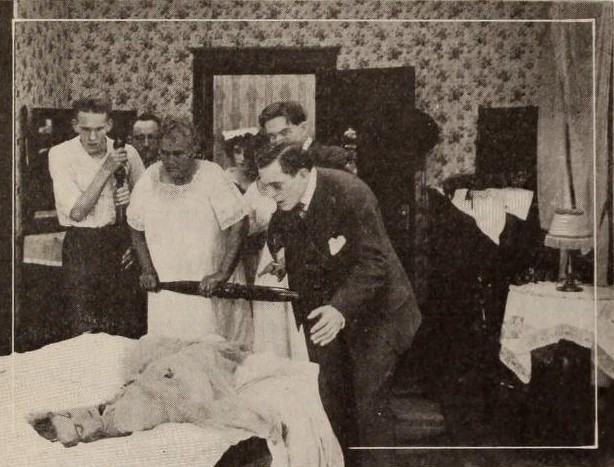
Where Det gamle Købmandshjem drapes itself in Lutheran guilt, Life Without Soul strips theology to mineral marrow: if man is made in God’s image, what blasphemy to reverse the recipe—God made in man’s stone?
After the film’s Cincinnati premiere, local clergy sermonized against its “litholatrous obscenity,” and the mayor threatened to shutter the Grand Opera House. Such moral apoplexy only stoked attendance; the picture recouped its $18,000 budget in three weeks, then vanished—yanked from circulation after a warehouse fire destroyed the east-coast negative. For decades it survived solely in the nightmares of aging flappers who swore they saw the statue blink at them from behind theatre curtains.
Fast-forward to 1978: a desiccated print surfaces in a Parisian nunnery’s attic, mislabeled as Missionary Training #2. The recovered reels now rest in the Cinémathèque’s climate-controlled crypt, digitized at 4K but withheld from mass release—too brittle, they claim. Yet whispers circulate that the archive fears contagion, as though streaming the film might awaken something calcified and restless inside our own hard drives.
Does the film cohere? Barely. Does it offend? Profoundly. Does it bore? Never. Its narrative vertebrae poke through the skin of continuity, but those jagged edges lacerate in ways studio-sanctified classics cannot. You don’t watch Life Without Soul; you undergo it, like a lithotripsy of the psyche.
Modern horror—jump-scares, CGI gore—feels infantile besides this disciplined savagery. Here, dread is quarried, not manufactured; it grinds against your cartilage long after the screen fades to black nitrate. And in an age when artificial intelligence promises to resurrect the dead via deepfake, the film’s cautionary core feels less quaint than prophetic. We are all sculptors now, chiseling data into semblances of lost lovers, dead idols, vanished childhoods. One day our marble progeny may blink first.
Rating: 9.3/10—points deducted only for the irretrievable gaps, though even those lacunae sculpt the viewer’s imagination into an ancillary screen. Seek it, should the archivists ever relent. But beware: once you’ve seen stone breathe, ordinary flesh looks suspiciously porous, and the night wind carries the faint scrape of chisel on bone.
IMDb 6.8
1929
Community
Log in to comment.