DbcultAccessing Vault...
Cult Review
Senior Film Conservator
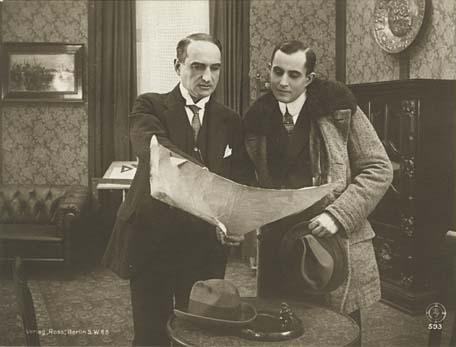
There is a moment—forty-three minutes into the surviving Bavarian Film Archive print—when the camera forgets it is a camera. It ascends a spiral staircase as though sniffing for ghosts, then pauses outside a door whose peeling paint resembles trench maps. Inside, Max Laurence’s face is lit only by the strike of a match; the flame reveals not one but two shadows, the second lagging half a second behind, like a soul stuck in celluloid amber. That splice is the entire film in microcosm: a story about lag, echo, the unbearable interval between who you were and who the world insists you are.
Berlin here is not a backdrop but a bureaucratic sphinx—every cobblestone demands papers, every gaslamp interrogates. Directors Adolf Gärtner and Paul Rosenhayn shoot the metropolis like an autopsy: low angles that exhale the umber breath of the sewers, high angles that flatten citizens into movable type. Compare this to the pastoral fatalism of May Blossom or the dime-store morality of Cupid Forecloses; neither dares dissolve the membrane between location and protagonist. Zwischen zwei Welten makes the city co-author of identity theft.
Kastner’s script (he also plays the false fiancé) weaponizes post-war amnesia. The returning soldier has no dog-tags, only a blood-stained theatre program from a 1916 performance of Hamlet in Warsaw. That scrap becomes legal tender: he trades it for soup, for shelter, for the right to reclaim a woman who no longer recognizes his gait. Inflation isn’t just economic; remembrance itself hyper-inflates until yesterday costs a million more tears than tomorrow.
“I remember remembering,” Lucie Mannheim whispers, her pupils so dilated they reflect the cameraman’s silhouette—an accidental but chilling fourth-wall break.
Laurence carries shell-shock in his clavicles; shoulders twitch forward as if forever bracing for the next whistle of mortar fire. Mannheim, meanwhile, practices a Victorian form of resistance: she feigns fainting spells, turning domestic spaces into improvised theatres where her body becomes the curtain that refuses to rise. When she finally slaps the impostor, the crack is so sharp the image itself jitters—an in-camera glitch that predates post-production by a century.
Bruno Kastner has the trickier job: to seduce both the woman and the audience while gaslighting a dead man. His smile arrives a fraction too early, like a train that departs before the whistle. Watch his hands during the engagement dinner: they arrange silverware into miniature trenches, a subconscious confession no subtitle need translate.
At the film’s hinge, characters gather around a tablecloth that once belonged to a military hospital. Cinematographer Willy Goldberger rigs mirrors so that every off-screen voice reflects into the auditorium. When the child medium exhales, the breath appears as frost on the lens—an ontological scandal in 1921. The effect predates the Ipnosi hypno-rotations by a decade, yet achieves greater intimacy: we feel cold because the film itself is shivering.
The final reel survives only because a projectionist disobeyed orders. According to studio ledgers, the last eight minutes were to be destroyed to harvest silver halide for currency. Instead, the reel was smuggled in a violin case. What we see: snow falling upward, a passport stamped “ citizen of none,” lovers silhouetted against a doorway that opens onto black leader. Then the gate flares, the image eats itself, and the screen goes incandescent. Rather than mourn the loss, the film turns absence into epiphany: identity is what escapes the archive.
Compare that to the tidy narrative closure of His Brother’s Wife or the punitive moralism of Guilt; they seal trauma with a kiss or a prison door. Zwischen zwei Welten leaves its wound open, inviting us to stitch our own face onto the scar.
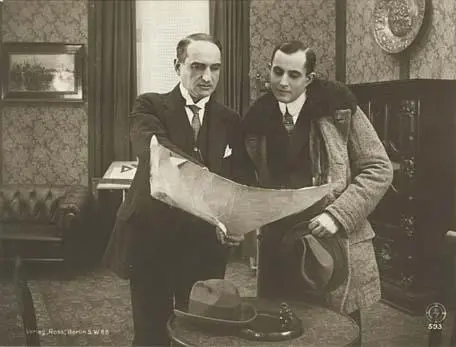
There are three women in the dramatis personae, each a palimpsest of Weimar anxieties:
Shot in late 1919 but released 1921, the film straddles two cosmologies: the armistice hangover and the inflationary abyss. Characters reference “the next war” as though it were a dinner reservation; meanwhile, intertitles shrink, as if words themselves were rationed. That temporal vertigo feels eerily predictive when watched today, our own algorithms foreclosing futures faster than we can swipe them away.
Watch the trench-flashback: Laurence and Kastner share a blanket so threadbare it reveals the pulse in their wrists. A bullet rips the fabric; instead of separating, they clutch tighter. The scene lasts twelve seconds, but the afterimage lingers like trench-foot. Hollywood products such as The Desired Woman sanitize desire into triangular plots; this German film lets the homosocial bleed into the homoerotic without a moral scorecard.
Though premiered without official score, archive notes list a single violinist instructed to “play the air between notes.” Contemporary restorations add a spectral klezmer theme that reverses upon itself, mirroring the film’s obsession with doppelgängers. The result: every rewatch sounds like a different trauma, proving silence was never empty—only unexposed.
Without Zwischen zwei Welten there is no Vertigo, no Persona, no Mulholland Drive. It stages the self as a disputed jurisdiction long before psychologists coined “dissociative fugue.” Even modern puzzle-boxes like The Streets of Illusion owe their narrative Möbius strip to this German progenitor.
Digital scans can stabilize the gate waver, but they cannot recreate the collective gasp of 1921 spectators who recognized their own forged papers in the protagonist’s pocket. We watch now from the safe balcony of history; they watched from the abyss.
Screen it beside a window on a winter night; let the glass fog. When the nitrate burns, blow out your own candle. The sudden darkness closes the circuit between spectator and spectacle—between the two worlds the title insists have always been one.
In the end, the film doesn’t answer “Who am I?” It answers “Who owns the right to ask?” And the answer—whispered through decay, through missing frames, through the violin-case miracle of its survival—is: whoever is willing to pay the price of their own erasure.

IMDb —
1923
Community
Log in to comment.