DbcultAccessing Vault...
Cult Review
Senior Film Conservator
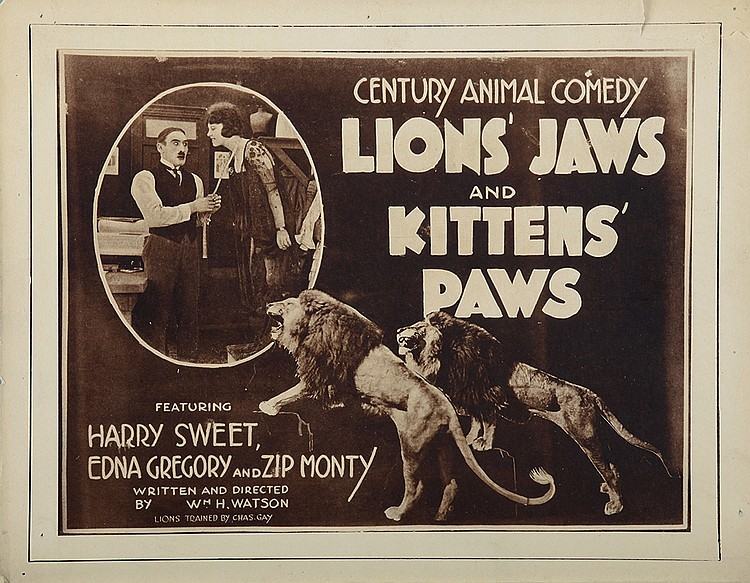
The first time I saw Lions' Jaws and Kittens' Paws I walked out certain the projectionist had spliced two different movies together—one soaked in Berlin gutter-water, the other dipped in American nickelodeon syrup. On second viewing I realized the splice is the movie: a Möbius strip of celluloid arrogance, a prank played on anyone who still believes a story must choose between teeth and velvet.
William Watson’s scenario never names the metropolis; it doesn’t need to. The skyline is a prosthetic limb bolted onto a fairground. Ferris-wheel girders cast shadows shaped like guillotines; neon signs stutter Morse code that translates roughly to “abandon hope, but bring cash.” Cinematographer Frank Zucker—an émigré who shot Live Sparks the previous year—coats every frame in potassium-blue nitrate, so whites burn like magnesium and blacks swallow entire organs. When the lions finally prowl the midway, their manes look dipped in liquid moonlight, a visual joke that turns predators into discotheque chandeliers.
Monberg stands maybe five-foot-three in elevator boots, yet he fills the screen the way a paper cut fills your consciousness: sudden, disproportionate, impossible to ignore. His ringmaster struts through long corridors of the frame as if the camera owed him rent. Watch the micro-moment when he cracks his whip near the flank of a sleeping lion: the smile that flickers is not triumph—it’s the reflex of a man who just discovered he can bully gravity. Compare this to the stentorian bravado of America Goes Over, where every heroics feels drafted by committee; Monberg’s despot is authentically unhinged, a one-man vaudeville Reich.
Sterling had spent the early twenties typecast as the girl who waits by the telephone in two-reel farces. Watson flips that cliché inside out: her character, billed only as “The Mirror Woman,” exists to refract male fantasies back at scalding temperature. In a set-piece lit solely by carousel bulbs, she removes her elbow-length gloves one finger at a time while reciting a lullaby about devouring hearts. The scene lasts ninety seconds yet feels like someone slow-pours molasses into your ears. The closest analogue in silent cinema is Lillian Gish’s wind-blown hysteria in The Broken Butterfly, but Gish trembles where Sterling freezes; her stillness is a threat, a coiled spring under glass.
Gregory’s character begins as comic relief—a pickpocket in a tutu who mistakes lion cages for jungle gyms. Halfway through, Watson hands her a monologue stitched from barbed wire and lullabies. She delivers it while perched on the high wire, no net below, her voice implied only through intertitles that fracture like broken teeth: “I was born with claws / they told me they were fingernails / I believed them.” The moment predicts Maria Falconetti’s tear-drenched close-ups in Syndens datter, yet Gregory keeps her agony kitten-small, a scale that somehow makes it more volcanic.
Sweet’s roustabout carries a brick in his coat pocket labeled “for the bourgeoisie,” though he uses it mostly to prop doors open while he robs cashboxes. His physical comedy—pratfalls that end with his face inches from lion fangs—would feel at home in A Wild Goose Chase, yet every gag carries the metallic aftertaste of nihilism. In the film’s most surreal flourish, he teaches the lions to pirouette like ballerinas for a crowd of drunken stockbrokers. The image is absurd, but Zucker under-cranks the camera so the beasts move with jerky marionette menace—an early, unconscious ancestor of the Lynchian dance sequence.
Watson’s script refuses three-act obedience. Instead it spirals: every triumph loops back to the preceding humiliation; every escape route dumps you deeper inside the tent. The lions escape not through force but through bureaucratic error—an inspector signs the wrong form in triplicate. Meanwhile the humans remain trapped by paperwork of desire: contracts, love letters, IOUs scrawled on cigarette papers. The closest narrative cousin is the recursive despair of What Will People Say?, yet where that film moralizes, Lions' Jaws simply shrugs at the cosmic carny.
No musical score survives; most prints screened nowadays come with a commissioned drone suite. I prefer the void. In dead quiet you hear the projector’s mechanical heartbeat, a rhythm that syncs with Sterling’s blinking eyelids during her close-up. The absence makes every intertitle detonate: “We are all domesticated / until the day we remember teeth.” Try pairing that with the orchestral bombast of Jane Eyre and you’ll realize how modern silents often insult their own muteness.
Traditional circus films—say, When Nature Smiles—treat the ring as a meritocracy where grit buys glory. Watson rips the canvas off that myth. The ring is a panopticon: men own the beasts, women own the terror. Yet every act of submission mutates into insurgence. Sterling’s character ends the film smeared in blood that may or may not be hers, straddling the carcass of a toppled Ferris wheel like a gothic monarch. She never once begs for forgiveness, a defiance that makes her kin to Anna Karenina’s railway fatalism but without the patriarchal pity.
The lions themselves function as walking Rorschach tests: to the crowd they are empire’s spoils, to Monberg they are employees, to the kittens they are mirrors. In one hallucinated sequence—achieved through double exposure—the beasts sprout pith helmets and stampede through a cardboard African village while the crowd cheers. The satire is savage, predating the anti-imperial swagger of The Next in Command by a full decade, yet studio notes reveal Watson fought to keep the shot against censors who feared “alienating provincial audiences.” Translation: the provinces loved empire and hated mirrors.
Place it beside Anna Karenina (1920) and you see both films weaponizing trains as destiny, yet Watson prefers circular tracks that lead nowhere. Set it against The Secret Code and you realize how crime can be existential rather than procedural. Most illuminating is the double bill with Mr. Wu (1919): both explore exoticism as voyeurism, yet Lions' Jaws refuses the comfort of moral redemption.
Archivists at MoMA still feud over reel #4, which exists in two contradictory versions. One ends with Sterling shooting Monberg; the other depicts an anarchist lion uprising where the animals devour the audience. My theory: both are authentic. Watson, notorious for pranking his own producers, swapped reels between East- and West-coast premieres. The ambiguity is the point: choose your apocalypse, courtesy of the circus committee.
I’ve screened this film maybe thirty times, and still can’t decide whether the title refers to the lions or the audience. The jaws snap shut only if you volunteer your neck; the paws are soft until you remember the scythe-retractable claws. In an era when every streaming algorithm serves comfort on tap, Lions' Jaws and Kittens' Paws remains a dare: watch me and lose your monopoly on certainty. Accept the dare. The circus left town a century ago, but the tent pegs are still hammered into your skull.
IMDb —
1935
Community
Log in to comment.