DbcultAccessing Vault...
Cult Review
Senior Film Conservator
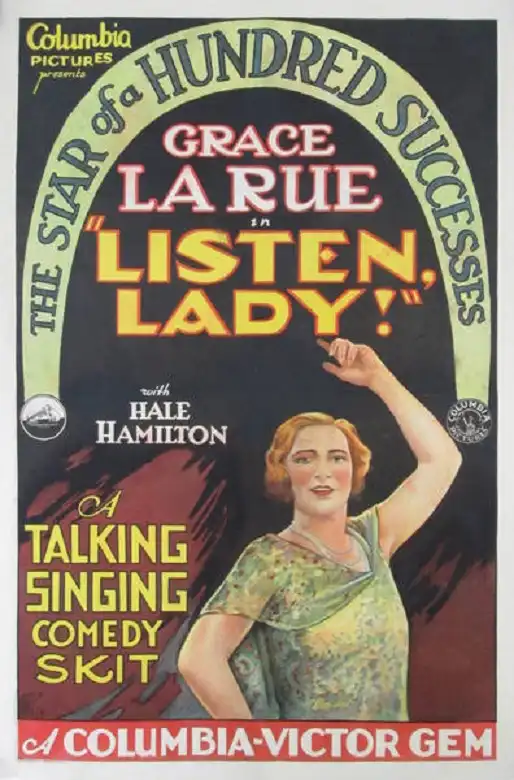
Alright, let’s be real upfront: Listen, Lady is not for everyone. If you’re here for a tight plot, snappy dialogue, or anything resembling modern pacing, you’re going to have a rough time. This one’s for the film buffs, the historians, or maybe just the incredibly curious who wonder what cinema was like way back when. Everyone else? Probably give it a miss. And that's okay! 🤷♀️
It’s hard to talk about this film like you would a new release. It’s more like digging up an old photograph, slightly faded, a bit creased. You stare at it, trying to figure out the story behind the smiles, or lack thereof. That’s Listen, Lady.
Grace La Rue is on screen, and she’s got this presence. It’s very much a stage presence, you know? Big gestures, expressions that feel like they're meant to be seen from the back row of a theater. Not quite subtle, but honestly, pretty engaging in its own way for the period. You can almost see her commanding a proscenium arch.
Hale Hamilton is there too, playing it a bit straighter. He’s the grounding force, I guess. Though sometimes his reactions feel a beat off, like he’s responding to something that happened just before the cut. Or maybe *I* was a beat off. Who knows?
The story, what I could really gather from it, is pretty simple. It feels like a stage play crammed into a film. Not a lot of location changes, mostly interior shots. It gives everything a very intimate, almost claustrophobic feel. Which, you know, could be intentional. Or just budget constraints.
There’s a moment, not long in, where La Rue is trying to convey some really intense emotion. It’s all in her eyes, really. And her hands. Her hands are *doing things*. It’s a very specific kind of acting, almost a lost art now. You don't see it much anymore, that kind of pure, unadulterated emoting. It’s almost a little funny how dramatic it is, but then you remember what era it’s from, and it just becomes… *fascinating*.
The rhythm of the film is what really struck me. It’s so different. Sometimes scenes just *linger*. Like, longer than you’d expect. A person walks into a room, and the camera just watches them for a few extra seconds. You’re left wondering if something more is supposed to happen, or if that’s just how they did things. It’s not necessarily bad, just… slow.
Then, other times, it just cuts. No warning. You’re in one place, then boom, you’re somewhere else. It makes you feel like you missed a scene, or like someone accidentally snipped out a few frames. It’s jarring, and it kind of keeps you on your toes, in a weird way.
You can tell the technology was still finding its footing. The sound, if you’re watching an early talkie version, is often a bit muffled. Like everyone is speaking from inside a barrel. Or maybe *I* need my ears checked. But it’s part of the charm, really. Adds to the historical feel.
The sets are minimal. A chair here, a table there. It really puts the focus on the actors, which makes sense, given their stage backgrounds. It’s almost like a masterclass in how much you can do with very little. Or, you know, a lesson in not having much to work with. Hard to say from this distance.
I found myself smiling at certain parts, not because they were comedic, but just because they were so *of their time*. A certain turn of phrase, or the way someone holds a teacup. It’s these little, often overlooked details that make watching these older films worthwhile. It’s not about plot twists, really.
So, should you watch Listen, Lady? Only if you’re up for an adventure into the past. It’s a quiet film, a little odd, and certainly not what you’re used to. But it’s got its own strange beauty, if you’re patient enough to look for it. It's a reminder of where movies came from, before all the razzle-dazzle. And sometimes, that's enough. Maybe even more than enough. 🎬
IMDb —
1916
Community
Log in to comment.