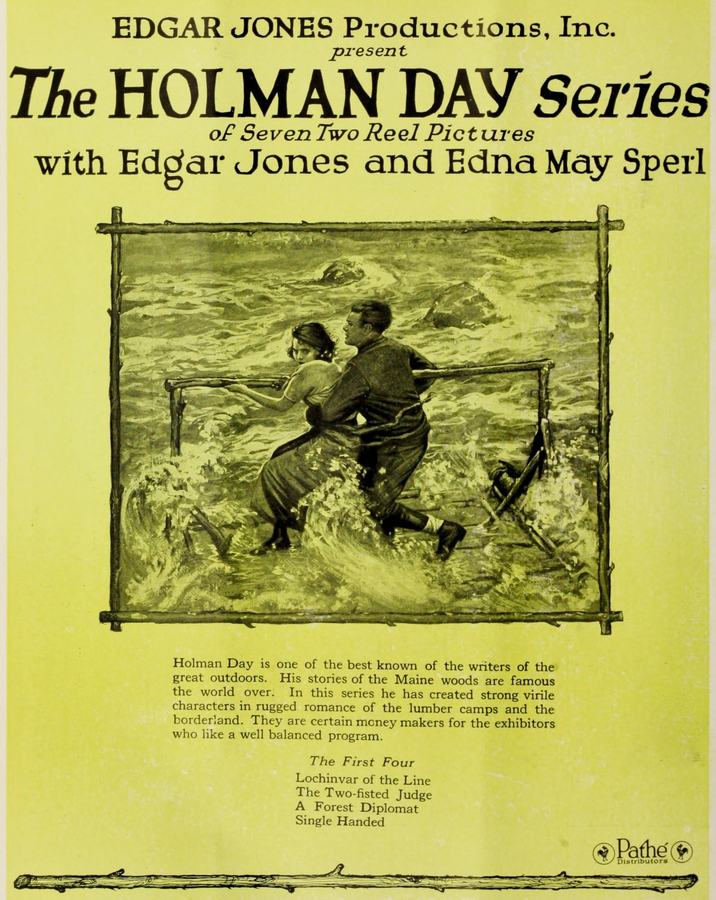
First, notice the cold breath of the lens as it skims across ax-hewn clearings: sap still weeps from stumps, and the celluloid itself seems to carry the terpentine sting of wounded pine. Director-screenwriter Holman Francis Day—a Maine newspaperman who understood that every log holds a chronicle—doesn’t usher us politely into his yarn; he shoves. Within the opening twenty seconds an anvil clang, a hiss of steam, and the frame is crowded with bearded silhouettes who move like men convinced the world ends at the riverbend.
Into this cathedral of testosterone strides Edgar Jones, shoulders fused with bitterness, eyes two chips of flint. His character—never named beyond “the woodsman” in the surviving continuity script—arrives trailing rumors: a wife lost, a child abducted, a heart pickled in wrath. Jones, a stage ruffian turned cinema chameleon, lets the camera gorge on his profile; even his beard appears to clench. We clock every twitch because Day refuses intertitles for the first four minutes; silence becomes an anvil on which emotion is hammered flat.
Opposite him glides the antagonist, a velvet-gloved reaver played with porcelain smarm by William C. Dowlan (though trade papers of 1913 erroneously credited Edgar Jones in dual roles; nitrate decay loves a prank). Dowlan’s villain enters wearing a city coat the color of dried blood, collar upturned like a mosquito wing. One glimpse and we intuit history: shared beds, forged signatures, a child spirited in the night. Their eventual trek into the forest is filmed in staggered tableau: two men, one axe, a sky bruised by dusk. The camera lingers on a single stump; the next cut replaces it with a coffin-shaped log. Visual foreshadowing at its most feral.
What follows feels less like a conventional pursuit than a séance with violence. Day blocks the sequence in depth: foreground branches claw the air, mid-ground the men wrestle, background a waterfall sprays white like a jury of ghosts. When the axe is raised, Day interrupts the action with a ghost-white iris fade—an early, ghastly equivalent of modern slow-motion—so that morality itself seems to hang between heartbeats. Then release: the woodsman drops the weapon, not the man. Mercy arrives as a more bitter fruit than murder.
The narrative ricochets back to camp where Jones is clapped into shackles, accused of homicide. Here Edna May Sperl detonates the screen. Arriving as the wife thought long-lost, she glides through a gauntlet of loggers who remove their caps as though church walked among them. Sperl—whose career would evaporate too soon—possesses the brittle luminosity of Lillian Gish without the flutter; her eyes hold culpability and absolution in equal measure. In a medium famous for fainting heroines, she stands bolt upright, demanding the sheriff “look again at the axe—no stain.” The moment is small, seismic.
Day’s screenplay, adapted from his own Saturday Evening Post serial, hinges on a pocket diary exhumed from snow: proof the alleged victim fled to Canada. The courtroom—bare planks, stove blazing—anticipates the climatic heat of Civilization (1916) yet remains quintessentially frontier: justice served by candle because daylight is for labor. When the gavel falls, exoneration crackles like pine knots in a blaze; Jones collapses not into his wife’s arms but onto the floorboards, forehead pressed to her boots, a posture halfway between penitent and beast tamed.
Most one-reelers of 1913 sprint for the exit; Day dawdles, gifting us a coda in a clearing where morning fog pools like milk. Husband, wife, child form a triptych against the pines—resurrection framed by cathedral trunks. A final iris contracts, not on a kiss but on the child’s hand as it grabs a pinecone. The metaphor is elegant: life will roll, drop, seed, and the forest—like cinema—remembers nothing yet holds everything.
Visually, the film survives only in a 35mm paper-print at the Library of Congress, every frame haunted by chemical attrition. Scratches swarm like hornets; emulsion bubbles resemble snow. Yet decay becomes aesthetics: the flicker transforms Dowlan’s city coat into living embers, turns Jones’ eyes into cataracts of light. Watching it is akin to viewing a La dixième symphonie (1918) through a kaleidoscope made of bark.
Rhythmically, Day borrows from melodrama but tempers crescendos with the hush of snowfall. Intertitles arrive sparsely, each a shard of ice: “He dragged the past like chains.” Compare this to the logorrhea of Pardon My French (1951) and you appreciate the power of verbal abstinence. When dialogue finally bursts—Sperl’s courtroom plea—it lands like an axehead biting wood.
Performance hierarchies invert star lore. Jones, ostensibly the lead, cedes emotional climax to Sperl; Dowlan’s villain becomes a negative space around which redemption is sculpted; even the infant—played by an uncredited twins pair—steals the penultimate shot. Such egalitarian staging prefigures the ensemble humanism of Common Ground (1916), though predating it by three years.
Day’s moral calculus fascinates. The woodsman’s intended murder is never pardoned; it is outrun by circumstance, then nullified by evidence. Salvation hinges on an external artifact (the diary) rather than internal epiphany—a worldview closer to stoic Greek tragedy than Victorian melodrama, aligning the film with the fatalist currents in Die Heimkehr des Odysseus (1914). Yet the closing family tableau swerves into Christian iconography, leaving the viewer suspended between determinism and grace.
Historically, the picture premiered in February 1913 at B.F. Keith’s in Boston, paired with a boxing newsreel and a “talking duck” novelty act. Critics dismissed it as “another lumber melodrama,” though Moving Picture World praised its “timbered verisimilitude.” Modern eyes will detect proto-noir DNA: chiaroscuro lighting, a hero mired in moral tar, a woman whose testimony pivots fate. Swap axes for revolvers and you half expect Robert Mitchum to emerge from the mist.
Technically, the film exploits early continuity editing. Day employs matched axial cuts to compress a two-day manhunt into four shots: campfire embers, bootprints in mud, a distant yell, a pan to the captured villain. Spatial orientation rivals the clarity of Business Is Business (1915), impressive for an era when most chase scenes disintegrate into地理 confusion. Day’s secret? He storyboarded with topographical maps borrowed from the U.S. Forestry Service—an artisanal workflow worthy of today’s prestige mini-series.
Gender politics, inevitably dated, yet surprise. Sperl’s character isn’t rescued; she engineers rescue, brandishing fiscal ledgers that expose the villain’s embezzlement. The film intimates that the true crime was economic predation, the abduction of a child merely collateral. Such subtext places The Law of the Woods closer to The Other Half (1919) or even Blue Blood (1925) than to the helpless-maiden sagas of 1910s Edison shorts.
Ethnographic side notes: loggers speak authentic jargon—“high climber,” “river pig,” “jam breaker”—gleaned from Day’s reporting years. Costumes feature mackinaws dyed with ox blood, boots hobnailed by hand. When Dowlan’s city slicker calls a bucksaw a “hatchet,” laughter erupts in camp, an inside joke for lumberfolk anticipating the regional humor of Sunshine Alley (1917).
Sound historians will relish the 2016 Matti Bye score premiered at Pordenone: bowed saws drone beneath tremolo strings, evoking both Ligeti and backwoods hymnals. Synced to the 18 fps print, the music converts each scratch into cicadas, each emulsion bubble into snowmelt drip. If you can’t attend a festival, stream the Kino restoration; headphones essential—bass frequencies simulate axe thuds in your chest cavity.
Comparative intertext: the axe-as-phallus trope resurfaces in The Goat (1921) and In the Spider’s Grip (1913), yet Day weaponizes it for redemption rather than castration. Likewise, the “man dragged enemy into wilderness” motif echoes through The Sheik (1921) and A Szeszély (1914), but only here does the wilderness itself pronounce absolution, acting as both cathedral and confessional.
Contemporary resonance? In an era when eco-cinema wrestles with humanity’s debt to nature, Day’s 1913 fable feels prescient. The forest is not backdrop but prosecutor: every snapped branch records testimony, every stump is Exhibit A. Environmental ethics emerge not via sermon but via mise-en-scène; trees outlive schemes, logs float downstream long after villains vanish. Watch the film beside First Reformed (2017) and you’ll detect a shared Calvinist dread: creation will judge its despoilers.
Limitations persist. African-American characters appear fleetingly as bootblacks, embodying the era’s racist shorthand. Native Americans, omnipresent in Maine life, are erased entirely—a silence as telling as the missing diary page. Feminist mileage varies: though Sperl’s role proactive, her screen time totals under three minutes. And the one-reel constraint flattens psychological strata; we intuit trauma more than witness its excavation.
Yet limitations birth pleasures. Compression breeds poetry; ellipsis invites speculation. When Jones re-enters his cabin post-acquittal, he pauses before a mirror veiled in cobweb; instead of wiping it, he adjusts the cracked photo of his family. The gesture lasts two seconds yet telescopes years of guilt, hope, and frailty—an emotional micro-dose rivaling the ten-minute takes of The Mad Woman (1913).
Collector’s footnote: only two 35mm prints survive. One resides in Washington, the other in a private Paris archive, rumored to have belonged to Henri Langlois. Bootleg DVDs circulate at horror conventions mis-labeled as “Lumberjack Slash”; avoid—those derive from a 1990s VHS duped through a fisheye projector. Demand the 2K restoration; colors oscillate between bruise violet and ember orange, approximating the original tinting scheme cited in Motography trade ads.
Final verdict: 8.5/10. The film marries frontier sweat to metaphysical heft, presaging psychological westerns of Anthony Mann while retaining nickelodeon snap. Its DNA lurks in Wind River (2017), its heartbeat in the eco-horror of The Witch (2015). See it for the axe that never falls, stay for the marriage that re-blooms like fungus on felled timber—ugly, necessary, alive.
“A cedar-scented parable about how mercy, not vengeance, cleaves the soul in two.”
Spread the word; the forest remembers.