DbcultAccessing Vault...
Cult Review
Senior Film Conservator
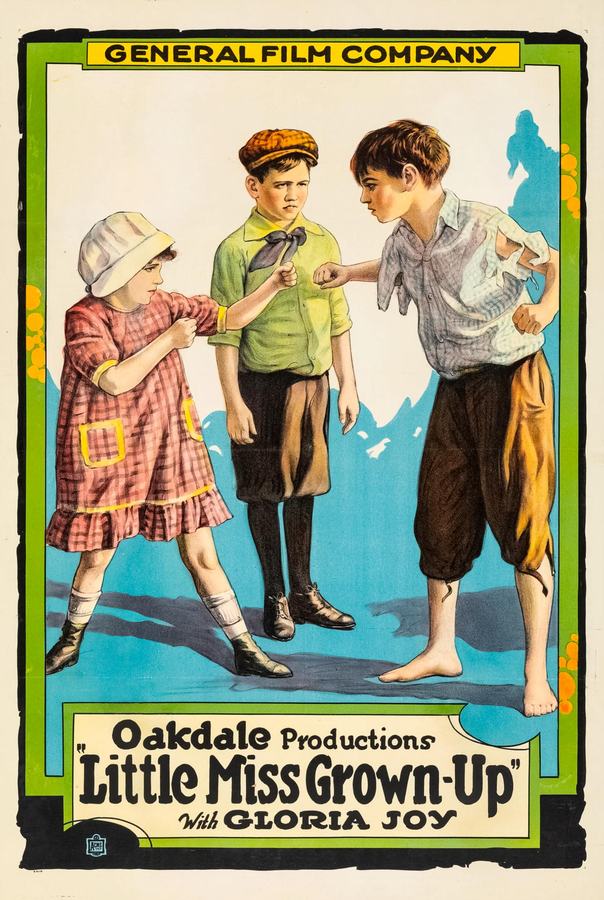
In the pantheon of silent-era cinema, few tropes are as fascinatingly ambiguous as the 'child-woman'—a figure of liminality who oscillates between the innocence of the nursery and the sophisticated posturing of the salon. Little Miss Grown-Up (1918) serves as a quintessential, if somewhat forgotten, exploration of this psychological territory. Starring the effervescent Gloria Joy, the film operates as a dual-natured narrative: part bucolic idyll, part urban cautionary tale. It challenges the viewer to consider whether maturity is a biological inevitability or a social performance forced upon the unwilling.
The film opens in a landscape of almost Rousseauian purity. Nan Griffing’s life on the farm is one of unmediated experience, shared primarily with Simple Simon Magee. Played with a nuanced, tragicomic physicality by Charles Dudley, Simon is the 'holy fool' of this narrative. His presence provides a radical counterpoint to the 'grown-up' world; he is a man whose mind has refused to leave the garden of childhood. This relationship is not merely a plot device for comic relief but a profound statement on the nature of the human spirit before it is crushed by the gears of industrial-era societal expectations. Unlike the more grit-laden realism found in The Stain, this film leans into a dreamlike, almost folkloric quality in its early acts.
The catalyst for Nan’s transformation is found in the attic—a space that, in the cinematic language of the 1910s, often represents the subconscious or the buried history of the family. The discovery of Ethel’s stage costume is an archaeological unearthing of maternal identity. When Ethel (Ethel Pepperell) agrees to teach Nan to dance, the film briefly transforms into a celebration of kinetic energy and artistic expression. However, this is swiftly met with the cold splash of Puritanical reality. The 'church society'—a group of local moral arbiters—arrives to stifle this nascent creativity. Their horror at the sight of a child dancing reveals the era's deep-seated anxiety regarding the female body and the perceived 'danger' of the theatrical arts, a theme also explored with varying intensity in Diane of the Follies.
The shift from the farm to the city marks a tonal rupture in the film. Accompanied by Simon, Nan enters the domain of her grandmother Anna and Aunt Grace. Here, the cinematography (though limited by the technology of 1918) manages to convey a sense of claustrophobia. The city is a place of walls, servants, and rigid hierarchies. The sequence where Simon is mistaken for a ghost in the orchard is particularly telling; the urbanites are so detached from the natural world that they can only interpret the 'natural man' as a supernatural aberration. It is a moment of levity that masks a deeper critique of modern alienation, similar to the class-based observations in Amarilly of Clothes-Line Alley.
Nan’s infatuation with Morgan Thornton (Neil Hardin) is the emotional fulcrum of the second half. This is where the title Little Miss Grown-Up takes on its most ironic meaning. Nan’s proposal to Morgan is a heartbreakingly sincere misunderstanding of romantic love. She treats the concept of elopement as if it were another game played in the hayloft. Morgan’s reaction—summoning her family—is the ultimate betrayal of her fantasy, yet it is also the most compassionate act he could perform. It forces Nan to confront the reality that she cannot simply step into her mother’s shoes and inhabit an adult life. The choice she demands Morgan make between her and Grace is a moment of high melodrama that underscores the film’s central thesis: the rush to grow up is a race toward disillusionment.
"Joy’s performance is a masterclass in silent-era gestural language, capturing the agonizing gap between a child's perception of power and the reality of her social impotence."
When Morgan inevitably chooses Grace, Nan’s decision to return to the farm is not presented as a defeat, but as a reclamation of self. She rejects the 'vain desires' of the city—a sentiment echoed in the thematic resonance of The Market of Vain Desire—and chooses the authenticity of her rural roots. The film suggests that the city is a performance that requires a mask Nan is not yet ready to wear. In this regard, it shares a certain DNA with Happiness, where the simplicity of character is pitted against the complexities of social climbing.
Technically, the film utilizes the grammar of the time effectively. The pacing is deliberate, allowing the character dynamics to breathe before the next plot point intervenes. While it lacks the high-stakes espionage of Inside the Lines or the grand adventure of The Adventures of Kathlyn, its strength lies in its domestic intimacy. The direction creates a clear visual dichotomy between the open, sun-lit spaces of the farm and the shadowed, ornate interiors of the city. This visual storytelling is essential in a medium where dialogue is relegated to title cards.
One cannot discuss this film without mentioning the supporting cast. Mollie McConnell as the grandmother provides a grounding presence, representing the weight of tradition. Daniel Gilfether and Mary Northmore round out a cast that understands the subtle requirements of the genre. The film’s narrative structure, though linear, feels like a series of vignettes that build toward a singular psychological realization. It avoids the convoluted plotting of Den tredie magt, opting instead for a purity of emotional arc.
The comparison to Mrs. Wiggs of the Cabbage Patch is perhaps the most logical, as both films deal with the resilience of the marginalized and the inherent dignity of the simple life. However, Little Miss Grown-Up is more focused on the internal evolution of its protagonist than on external poverty. It is a story about the poverty of the imagination that often accompanies adulthood. Nan’s return to her parents is a return to a world where she is allowed to be 'little' again, a sanctuary from the harsh light of adult responsibility.
Final Critical Thoughts
Ultimately, Little Miss Grown-Up is a vital artifact of a time when cinema was still figuring out how to depict the inner lives of children. It doesn't patronize its young lead, nor does it overly sentimentalize her plight. By placing her alongside a character like Simple Simon, the film asks uncomfortable questions about what it means to be 'normal' and 'mature.' It is a film that lingers in the mind, much like the haunting atmosphere of Spellbound (the 1916 version) or the rugged emotionality of The Spell of the Yukon. For those interested in the evolution of the coming-of-age genre, this 1918 gem is an essential viewing experience. It reminds us that while we all must eventually grow up, the 'little' person we once were remains in the attic of our memories, waiting for the right costume to bring them back to life.
In a landscape often dominated by the patriotic fervor of films like America Is Ready, this intimate character study offers a refreshing focus on the individual soul. It stands alongside The Man Who Took a Chance as a testament to the diverse storytelling capabilities of the late 1910s. Whether you are a fan of The Heiress at Coffee Dan's or the whimsical charm of Liliomfi, there is something deeply resonant in Nan Griffing’s journey from the orchard to the altar—and back again.
IMDb —
1920
Community
Log in to comment.