DbcultAccessing Vault...
Cult Review
Senior Film Conservator
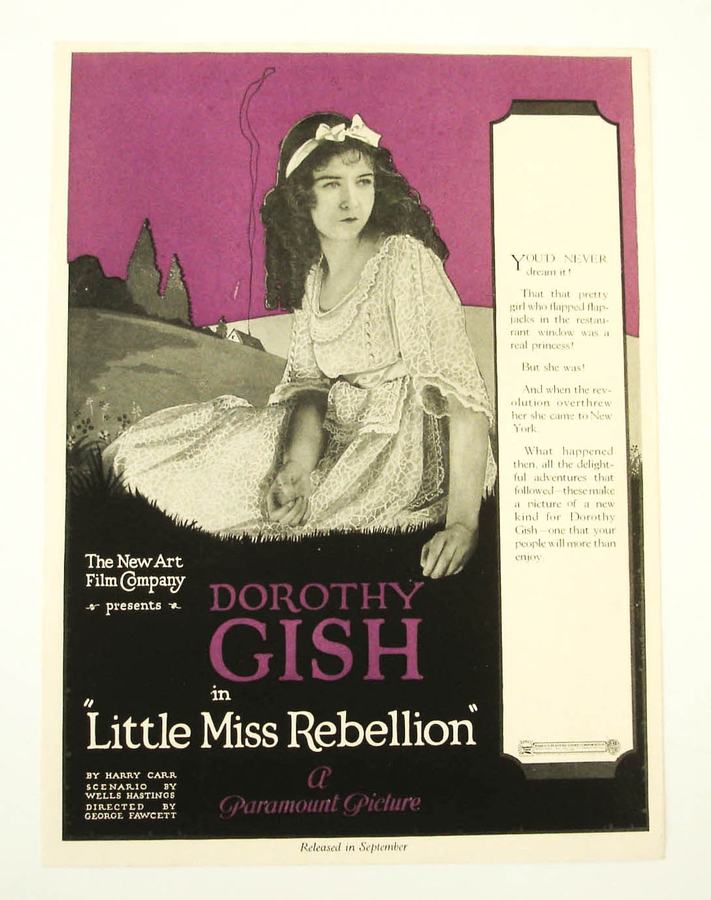
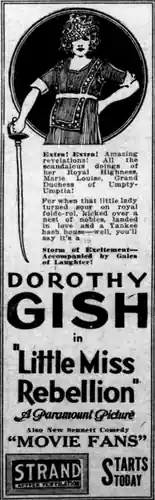
A bored grand duchess roots for the rebels who will dethrone her—because abdication is the fastest ticket to Coney Island.
Director Harry Carr understands that monarchy on celluloid is usually gilt-edged tedium: sceptres, coronets, and stilted proclamations. He flips the trope by staging sovereignty as a gilded cage so claustrophobic that even the audience yearns for a coup. Every palace corridor is over-exposed, blooming with halation, as though the camera itself were gasping for oxygen. By contrast, the fleeting inserts of New York—glimpsed only in Marie Louise’s daydreams—are tinted amber and sea-blue, the colors of possibility. The montage is economical yet euphoric: a trolley bell, a gum-chewing lift attendant, a parade of straw boaters. Molvania’s snow-blinded baroque interiors feel like a museum after closing time; Manhattan’s skyline flickers like a jukebox that never last-calls.
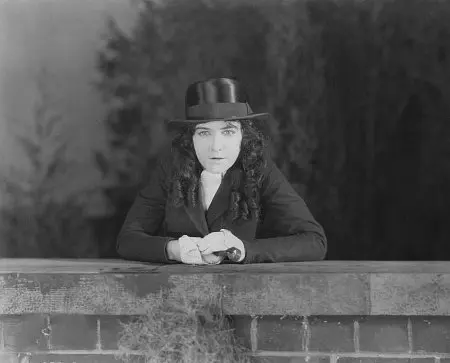
As the grand duchess, Dorothy Gish pirouettes between regal poise and vaudeville clowning. Watch her eyes when the rebel manifesto is shoved beneath her nose: two quick blinks, a half-smile, and—blink again—she’s the cat who just located the canary. Gish spent years in D.W. Griffith’s troupe perfecting micro-gesture; here she weaponizes it. She elongates her neck for court portraits, then contracts into Chaplinesque shoulder-rolls when alone. The performance is silent, yet you hear the internal hiccup of glee every time a minister utters the word “uprising.”
Graves plays Lt. Donald Merrick, the doughboy who haunts Marie Louise’s memory. He appears only in flashback—sun-drenched Argonne trenches where he taught her to chew gum and swear in Brooklynese. With his lantern jaw and toothpaste grin, Graves is the living promise that democracy can be sexy. Their flirtation is staged in two-shot against a painted sunrise so artificial it borders on surrealism, yet the chemistry is potent enough to make you root against monarchy itself.
Siegmann’s General Stroganoff embodies counter-revolutionary brutality with a whiff of cologne. Every mustache twitch telegraphs conspiracy; his saber scrapes the parquet like a fingernail on slate. Carr shoots him from a low angle, boots astride the royal seal, shadow stretching like spilled tar. The performance is silent-film villainy, yes, but calibrated: he believes order and monarchy are synonyms, and that conviction chills more than any Snidely Whiplash snarl.
Cinematographer: Frank B. Good’s interplay of frostbitten whites and cigarette-ember oranges renders the palace a snow-globe dystopia. Windows become picture-postcards of rebellion: torch-bearing silhouettes march past frosted panes, transforming stately interiors into flickering nickelodeons.
If The Despoiler revels in revolution’s carnage and The Little Yank sanitizes it into musical-comedy frosting, Little Miss Rebellion splits the difference: bloodless coup as romantic escapade. The tonal DNA overlaps with Pigtails and Peaches—both swap tragedy for whimsy—but Carr’s film is fleeter, more irreverent. Where The Star Rover contemplates liberty via cosmic reincarnation, here liberation is purely geographic: get me off this continent.
Though Production Code enforcers are still a decade away, the film flirts with pre-code sass. Marie Louise disrobes behind a screen; silhouettes reveal corset-less modernity. She trades lip-prints with a female confidante in a chaste yet electrically queer beat. And those ostrich-feather pajamas—equal onesie and battle standard—swish through marble halls like a Jazz-Age middle finger to protocol.
Intertitles crackle with Wildean zip: “A throne is a chair with the blues.” Or, as the duchess quips, “Revolution is the steamer trunk that fits under destiny’s bed.” Such bon mots arrive just often enough to flavor, never clutter, the visual banquet.
Surviving prints are often screened sans orchestration, which is criminal. One longs for a ragtime ensemble to chase Gish’s footwork with washboard syncopation. Picture xylophone glissandos when she tosses diadems into a suitcase, or muted trumpet as the palace gates slam shut. Cue the house-band into a foxtrot the instant she steps onto Ellis Island soil.
The film refuses to pledge allegiance. Marie Louise’s last gaze could herald immigrant hustle or naïve disillusionment; Carr lets the iris close on possibility, not prophecy. That open-ended wink is what vaults the picture from divertissement to durable art: it trusts the audience to finish the fairy tale.
Technically audacious, politically puckish, and front-loaded with Gish’s luminous slapstick sovereignty, Little Miss Rebellion is an effervescent curio that makes monarchy look like the ultimate first-act plot twist. Seek it in 2K restoration if possible; the tints should shimmer like bruised peaches against gunmetal dusk. And when the lights rise, you may find yourself scanning the nearest exit—not to flee, but to chase whatever horizon promises fewer thrones and more hot-dog cart symphonies.
Runtime: 68 min | Tinted B&W | Aspect ratio 1.33:1 | Restored by EYE Filmmuseum & Library of Congress
IMDb 5.6
1935
Community
Log in to comment.