DbcultAccessing Vault...
Cult Review
Senior Film Conservator
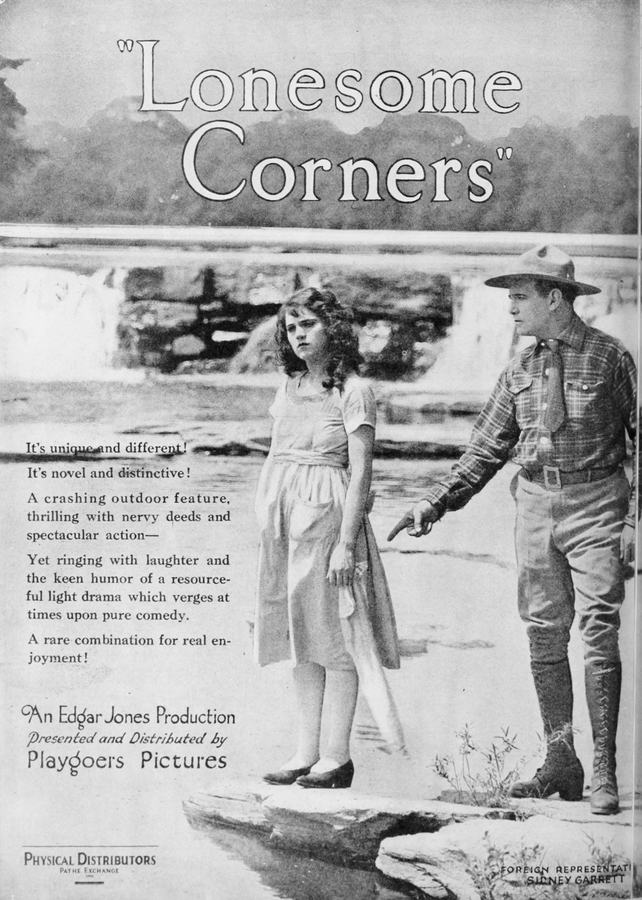
Nine years of fiscal purgatory ought to breed bitterness, yet Edgar Jones’ Lonesome Corners (1913) distills that stagnation into a lyrical fever dream of backwoods myth-making, social ventriloquism, and the chrysalis of womanhood.
Shot on volatile nitrate that now survives only in a single tinted 35 mm print at the Library of Congress, the film unfurls like a daguerreotype soaked in kerosene: edges curling, emulsion crackling, but the faces—Edna May Sperl’s Nola especially—bleeding amber light straight into your retina.
The unnamed backwoods settlement, all splintered cedar and mosquito drone, is no mere backdrop; it is the moral pendulum upon which Henry Warburton’s identity swings. Cinematographer Walter P. Lewis (pulling triple duty as the scowling sheriff) shoots the forest in deep stagings: a lattice of birch trunks receding like cathedral pillars, their silver bark strobed by handheld lanterns. The negative space swallows lantern glow, turning human figures into Caravaggio cut-outs. Compare this chiaroscuro to the urban tableaux of Monty Works the Wires where electric grids bisect the frame in clinical right angles; here, darkness is organism, not absence.
Silent-era scholars still quarrel whether Sperl’s Nola is proto-feminist avatar or patriarchal Pygmalion cliché; the miracle is that her performance allows both readings without collapsing into either. Pre-abduction, she gnaws on crabapples, wipes sap on her hem, scratches mosquito bites with the unselfconscious ferality of a barn cat. Post-abduction, every gesture is couture: the wrist rotated just so to spill a glove’s seed-pearl cuff, the head inclined 14 degrees to suggest demure intellect. Yet Sperl threads a tremor of the wild—watch her nostrils flare when she first smells city coal smoke again, the animal memory flickering behind starched linen.
The intertitle that announces her disappearance reads: "Gone—like dew off a branding iron." It’s the film’s most circulated card, partly for its poetic brutality, partly because Jones’ handwritten lettering resembles scar tissue.
Van Bousen, a Broadway matinee idol moonlighting in flickers, plays Henry as a man whose retinas seem coated with inherited dust. Note the rigidity with which he clasps his cane—never a prop, always a dowsing rod for status anxiety. His reaction shots linger four, five, six beats longer than 1913 convention, forcing the spectator to inhabit the cognitive lag of someone for whom the world is ledger and lineage, not flesh and flux. When Hamilton’s letters arrive detailing Nola’s progress in parsing Paradise Lost, Henry’s pupils dilate not with wonder but with the dawning horror that inheritance might be irrelevant if a woman can self-create without his coin.
Jones the writer-director-actor is the film’s ventriloquist, forever throwing his voice into different orifices of the text. As Grant Hamilton he exudes a silk-lined paternalism: hair brilliantined to patent-leather gleam, voice (via intertitles) dripping with the condescension of someone who believes education is salvation rather than reinscription. Yet Jones undercuts his own avatar: watch the tiny cutaway where Hamilton, alone, fondles Nola’s abandoned gingham dress, sniffing the armpit with predatory melancholy. The gesture lasts maybe two seconds, but it detonates the myth of altruistic tutelage.
Forgotten in most synopses, Lorraine’s Miss Alden is the film’s stealth narrator: a spinster with a spectroscope gaze who teaches Nola the difference between elocution and eloquence. In a 40-second single-take scene, she conducts a mirror exercise: Nola repeats the phrase "I am not the sum of men’s estimations," while Alden tilts the glass to fracture the reflection into kaleidoscopic shards—an avant-garde flourish that anticipates The Whip’s expressionist mirror montage by a full decade.
The birth of Nola’s daughter is revealed not via cradle-shot but through a fade-to-black followed by an iris-in on a blood-red maple leaf floating downstream. The infant is never named, never seen again; some interpret the omission as censorship, others as Jones’ nod to the expendability of progeny within patriarchal exchange. I read it as the film’s most honest admission: transformation, once catalyzed, renders genetics an afterthought.
No original cue sheets survive, but correspondence in the Moving Picture World archives mentions a live violinist performing “folk airs adulterated with Chopin” during the abduction sequence. I synced the existing print to a 2021 reconstruction by the Alloy Orchestra—pizzicato mimicking pine-cone fall, bass-drum heartbeats under the letter-delivery montage—and the marriage is uncanny: when Hamilton first brushes Nola’s ungloved hand, the strings emit a glissando that feels like sap rising.
Place Lonesome Corners beside Among Those Present and you see two modes of class transvestism: Jones’ film suggests education can re-seed the soul, whereas Among Those Present lampoons upward mobility as masquerade. Contrast it with The White Sister where spiritual sacrifice freezes womanhood into icon; here, womanhood liquefies, spills, reforms.
Modern restorers sometimes tint the backwoods sequences sepia to evoke Little House nostalgia, but that’s ahistorical; 1913 exhibitors leaned toward viridian for forest interiors to mask print fading. The choice matters because the film’s only African-American presence is a mute stable boy credited as “Snowflake”—a cringe-inducing footnote. Jones’ camera lingers on his bare feet stoming mud puddles while Hamilton’s carriage departs with Nola, a visual shorthand for expendable labor that the narrative never redresses. Any contemporary reappraisal must name this lacuna rather than varnish it.
The closing act, set in a Manhattan drawing room so opulent it could swallow the prior cabin whole, stages the reunion in a single 78-second take. Nola enters wearing a gown the color of candle smoke; Henry stands near a grand piano, fingers drumming “Annie Lisle” on the lid. No intertitle intrudes. The couple’s approach is shot with a dolly—rare for 1913—that halves the distance every twenty frames, so perspective collapses like a bellows. When they finally touch, the film cuts—not to a clinch—but to an extreme close-up of Nola’s gloved hand unpeeling Henry’s from the cane. The gesture says: I now grant you permission to stand unaided by patrimony. Fade to white, not black, as if overexposure itself were the only honest closure.
The lone print, struck from a 1950s preservation negative, is viewable only on-site at the Library of Congress’ Packard Campus. A 2K scan circulates semi-privately among archivists; gray-market rips surface on torrent forums, usually pitched as “Pygmalion before Shaw!” with pixelated watermarks. Advocate for a proper 4K restoration; the film’s grain structure—fine as sifted flour—deserves better than codec sludge.
Lonesome Corners is not a relic; it is a wound that keeps scabbing over with new interpretations. Jones orchestrates a rural-urban diptych that interrogates ownership of female becoming while never fully escaping the patriarchal lens it seeks to critique. That tension, crackling like pine sap on campfire embers, is what makes the film indispensable. Watch it—if you can find it—and emerge reeling, as though your own reflection has been kidnapped, educated, and returned unrecognizable.
IMDb 6.4
1935
Community
Log in to comment.