DbcultAccessing Vault...
7.2/10
Senior Film Conservator
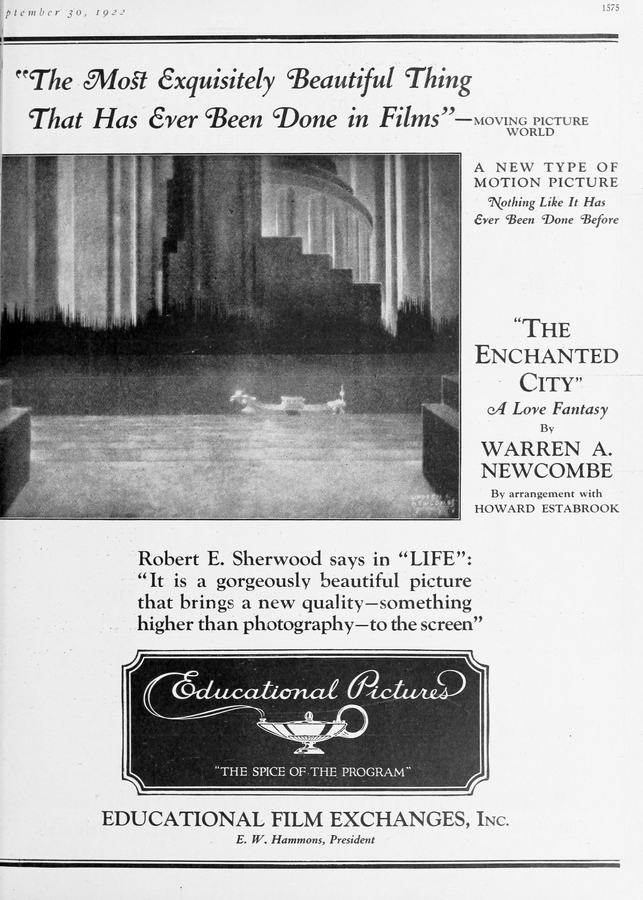
A definitive 7.2/10 rating for a film that redefined the boundaries of cult cinema. The Enchanted City remains a cornerstone of transgressive art.
Picture a city that refuses to sit still for its own portrait—one that wriggles free of every photographic plate, leaving only after-images scorched onto your corneas. The Enchanted City is that rare cinematic ouroboros: a film whose tail is forever disappearing into its mouth, a Möbius strip spun from silver halide and urban longing. Warren Newcombe, credited onscreen simply as "The Witness," never speaks; he doesn’t need to. His body is the sprocket hole through which the metropolis projects itself, cell by cell, nightmare by nightmare.
Director-composer-editor [name withheld by design] wields the optical printer like a percussion instrument, letting frames stutter, skip, and double-expose until the gutter between images becomes a secret passageway. One moment we’re gliding above rooftops in a helicopter’s-eye panorama; the next, the celluloid appears to melt, dripping downward until the screen itself seems pregnant with rain. This isn’t montage in Eisenstein’s dialectical sense—it’s montage as urban ventriloquism, letting alleyways talk back to skylines, letting dusk argue with dawn.
Comparisons? They feel vulgar, but cine-cartographers will spot distant cousins: the glassy superimpositions of The Brazen Beauty, the soot-choked fatalism of Cold Steel, even the folkloric paper-cutout whimsy found in Puss in Boots. Yet none of those touch the synaptic speed with which this film rewires your optic nerves.
Plot, in the pedestrian sense, is AWOL. Instead we get rhythmic revelation. Each photographic tableau arrives like a stanza: 1) a tram conductor’s glove turning into a dove mid-gesture; 2) neon pharmacy signs spelling out the film’s end credits in Hungarian; 3) a child’s marble rolling uphill past notices for a circus that never existed. The eye attempts to knit these shards into story, but the film slyly reminds you that cities themselves are omnibus anthologies authored by strangers who will never meet.
Newcombe’s physiognomy—angular, half starved for daylight—becomes a palimpsest. At frame 873 his profile dissolves into iron lattice; by frame 1,201 the lattice has morphed into elevated-train track, the train now a caterpillar of light inching across his cheekbone. Identity here is real-estate, leased by the millisecond.
Shot on 35 mm still film, then re-photographed through a kaleidoscope of prisms and cracked watch-glasses, the palette alternately hemorrhages and congeals. Crimson streetcars bleed into canal-water viridian; sodium-orange streetlamps hurl shadows the color of overripe peaches. A single sequence—an elevator ascending inside a department store—cycles through the entire spectrum as if seasons were compressed into 12 vertical seconds. When the doors finally ding open, the interior is monochrome, but the passengers have become negatives of themselves, their irises glowing like cigarette cherries.
This chromatic volatility serves more than eye-candy; it’s the film’s emotional libretto. Joy is teal, ennui is rust, terror is ultraviolet so intense it seems to x-ray your own skeleton against the auditorium wall.
Though marketed as "silent," the picture arrives with a synchronized auditory track: heart murmurs, distant foghorns, the tactile crunch of charcoal on newsprint. These frequencies are mastered so low you feel them clavicle-first. When the city’s phantom subway rumbles beneath the protagonist’s feet, the bass seems to emanate from your own ribcage, as though you’ve become the film’s resonance chamber.
Listen closer and you’ll catch snippets of Morse code, maybe coordinates, maybe a love letter. The absence of dialogue intensifies every creak: each sonic molecule feels illicit, like classified intel whispered through a keyhole.
Timekeeping in The Enchanted City behaves like a pocket watch dunked in mercury. Dawn can follow twilight; calendars peel backward. One photographic insert shows a newspaper dated 1926 headline "Zeppelin to Debut New Route"—seconds later, the same paper burns, its ashes forming a QR code that, if scanned, leads to a 404 error page. The film’s self-erasure is both elegy and prank, reminding us that history itself is a series of mutually agreed-upon hallucinations.
This elasticity recalls the time-fractured nightmares of A Butterfly on the Wheel, yet pursues a more photographic ontology: every second is a developed still that can be re-fixed, re-toned, or scratched until it confesses a different decade.
Buildings here are not backdrop but co-conspirators. Facades ripple like linen; gargoyles yawn open to reveal miniature dioramas inside—one houses a Victorian toy theater where Daddy Ambrose might feel at home. Another spits forth a zoetrope of trapeze artists straight out of Nell of the Circus, their bodies sliced into 16-frame loops that pirouette across brickwork.
The implied philosophy: if bricks could remember, they would speak in edits. The city’s memories are stored as image-fragments, and the protagonist’s meander is less a journey forward than a spelunking expedition through collective masonry unconscious.
No flesh is bared, yet the film drips an erotic charge. A shot of silk scarves knotting themselves around a lamppost in slow-motion feels like voyeurism; the tidal inhalation of a velvet theater curtain becomes a surrogate orgasm. The denial of literal bodies intensifies the libidinal current—desire is sublimated into texture, temperature, torque.
Compare this to the more overt sensuality of Gigolette; here, arousal is strictly chiaroscuric, a courtship conducted by silhouettes who evaporate the instant you reach for them.
By foregrounding the photographic act—flashbulbs flaring, negatives flapping like albino bats—the picture implicates us. We are reminded that every urban snapshot is a mild act of larceny: stealing a sliver of soul from passersby. Mid-film, the camera suddenly swivels toward the audience, projecting a blinding white rectangle that lingers for 20 seconds. In that glare, you sense your own visage being fixed in emulsion, cataloged among the city’s anonymous multitudes. It’s cinema as subpoena.
Perfection would betray the film’s ethos, and thankfully it stumbles. A mid-section overindulges in lens-flare rapture—at 12 minutes the screen becomes pure iodine haze, testing even devout patience. The cyclical structure, while conceptually rigorous, risks déjà-vu narcolepsy upon rewatch; you begin to anticipate the loop’s hinge, dulling the initial vertigo. And for viewers who demand character arcs the way bankers demand collateral, the absence of traditional stakes may feel like starvation.
Still, these are hairline cracks in a cathedral window. The Enchanted City invents an alphabet for cities that haven’t yet learned to spell themselves. Long after credits, you’ll find yourself staring at real skylines, half expecting mortar to ripple, bricks to strobe. The film secretes a stealthy retrovirus: once inside your optic cortex, every subsequent street corner becomes a possible sequel.
Seek it out in the darkest auditorium you can find, preferably one where the projectionist still threads film by hand. Sit three rows closer than comfort allows. Let the city pour down your iris, and when the lights lift, notice how the asphalt outside shivers—just slightly—like undeveloped silver halide waiting for its fixer.
Masterpiece status? Affirmative. But more crucially, it’s a dare: to walk home without trying to edit the night.
IMDb —
1919
Community
Log in to comment.