DbcultAccessing Vault...
Cult Review
Senior Film Conservator

In the annals of early silent cinema, few works attempt to grapple with the intersection of Victorian morality and the untamed wilderness of the British Raj with as much visceral intensity as The Leopard's Bride. Directed with a keen eye for the atmospheric pressures of the Indian subcontinent, this 1916 relic transcends its era's penchant for melodrama to deliver a somber meditation on the cost of empire and the fragile nature of the human heart. It is a film that breathes through its shadows, utilizing the stark contrasts of black-and-white cinematography to mirror the moral dualism of its protagonists.
The narrative begins in the manicured social theater of Simla, a location that serves as a microcosm for the rigid hierarchies of the British military. Here, Captain Morey and Major Carr represent the two faces of colonial authority: one governed by a sense of honor and the other by a predatory sense of entitlement. When Carr discovers Marjorie Lansdown’s preference for Morey, his reaction is not one of gentlemanly resignation but of calculated, bureaucratic malice. By deploying Morey to a 'desolate outpost,' Carr effectively weaponizes the geography of India against his subordinate.
This theme of institutionalized betrayal is a recurring motif in the cinema of the decade, often seen in works like The Murdoch Trial, where the legal and social structures are bent to the will of the powerful. In The Leopard's Bride, however, the courtroom is replaced by the jungle—a place where the rules of 'civilized' society are supposedly suspended, yet where Carr’s influence still reaches through the interception of letters. The psychological torment of the 'missing letter' is a trope used to perfection here, creating a vacuum of silence that both Marjorie and Morey fill with their respective despair.
Once Morey is relocated, the film shifts its aesthetic palette from the structured interiors of Simla to the chaotic, overgrown textures of the jungle district. This transition is handled with remarkable visual flair. The jungle is not merely a setting; it is an active antagonist, a place of 'fever mists' and 'fanatic priests.' It is here that Morey encounters Nadje, a character who embodies the 'other' in the colonial imagination. His rescue of her from a human sacrifice ritual is a classic heroic beat, yet the film complicates this by making Nadje the architect of his survival later on.
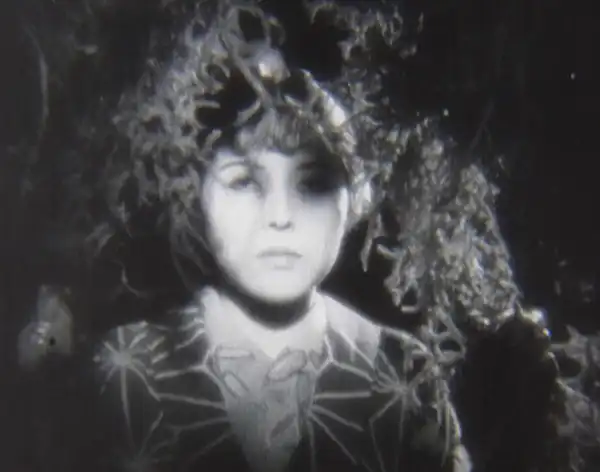
When the jungle fever claims Morey, the film leans into a hallucinatory quality. We see the Captain at his most vulnerable, stripped of his military poise and reduced to a shivering shell. Nadje’s use of herbal remedies and her 'tender nursing' represent a bridge between the two cultures, yet the film remains painfully aware of the 'morganatic' barriers that prevent their union from being viewed as legitimate by the Simla elite. This dynamic of the caregiver and the convalescent echoes the emotional vulnerability found in His Wife, though here it is heightened by the exoticized peril of the setting.
The climax of the film—the leopard hunt—is a masterpiece of suspense and symbolic resonance. The leopard itself serves as a manifestation of the untamed forces that the British attempt to hunt and categorize, much like the 'native' population they seek to rule. Marjorie’s separation from her party and her subsequent encounter with the beast is a moment of pure cinematic terror. It is Nadje, the woman she has been taught to fear or dismiss as a 'morganatic wife,' who becomes her savior.
This intersection of the two women’s lives is where the film’s emotional core truly resides. Witnessing the reunion of Morey and Marjorie, Nadje realizes that her devotion, however absolute, cannot overcome the ingrained social and racial prejudices of the era. The realization that 'death enters her own soul' is portrayed with a haunting subtlety by Patricia Palmer. Unlike the more domestic tragedies of Enoch Arden, where the sacrifice is one of quiet withdrawal, Nadje’s choice is explosive and mythic.

Nadje’s decision to bind herself to a tree in the lair of the leopards is a scene that lingers long after the credits roll. It is a sequence steeped in fatalism. She commends her soul to her idols—a stark contrast to the Christian morality of the English officers—and embraces the very predators her 'master' sought to kill. This act of self-sacrifice is not merely a plot device to clear the path for the lovers; it is a profound indictment of the colonial presence that disrupted her life and the lives of her people.
The film’s conclusion, where Morey and Marjorie read the 'sacrifice in her dying eyes,' avoids the saccharine happy endings typical of the period. There is a palpable sense of 'grief and repentance.' The 'harp of love' may be struck again in Simla, but as the narrator notes, it is played in a 'minor of memories.' This lingering sadness elevates The Leopard's Bride above the status of a mere adventure yarn. It shares a thematic kinship with Helene of the North in its exploration of women surviving in harsh, unforgiving landscapes, yet it carries a more cynical edge regarding the possibility of cross-cultural understanding.
From a technical standpoint, the film’s use of location shooting (or impressively realized sets) creates a sense of place that is almost tactile. The way the light filters through the jungle canopy, creating a dappled, leopard-like pattern on the actors, shows a sophisticated understanding of visual metaphor. The performances are equally noteworthy. William Clifford as Morey brings a rugged, yet emotionally porous quality to the role, while Fred Montague as the Major is a study in calculated villainy, reminiscent of the upper-class scoundrels in The Social Highwayman.
However, it is the writing of Theodosia Harris that provides the film with its structural integrity. Harris avoids the easy path of making Nadje a simple victim or a simple hero. Instead, she is a woman caught between two worlds—her ancestral traditions and her devotion to a man who represents the force occupying her land. This complexity is rare for 1916 and suggests a screenwriter who was deeply engaged with the nuances of character psychology.
As we look back at The Leopard's Bride from a modern perspective, we can see the seeds of the post-colonial critique that would emerge decades later. While the film is undoubtedly a product of its time, its focus on the 'minor of memories' suggests a recognition that the colonial project was built on a foundation of personal and cultural tragedies. It lacks the simplistic optimism of One Million Dollars or the straightforward morality of The Traffic Cop.
Instead, it stands alongside more complex silent dramas like La Gioconda or I my kak liudi, films that understand that human desires are often at odds with the social roles we are forced to play. The final image of the film—the lovers back in the relative safety of Simla, yet forever altered by the jungle—is a powerful reminder that we never truly leave our ghosts behind.
In conclusion, The Leopard's Bride is a vital piece of cinematic history. It is a film that demands to be seen not just for its adventurous plot, but for its willingness to dwell in the uncomfortable spaces between love and duty, civilization and the wild. It is a haunting, beautifully rendered tragedy that proves that even in the earliest days of the medium, film was capable of capturing the full, messy spectrum of the human experience. The sacrifice of Nadje remains one of the most poignant moments of the silent era, a testament to the power of a story well told, regardless of the passage of time.
Reviewed by the Editorial Team. For more deep dives into the shadows of early cinema, explore our archives of silent era masterpieces.
IMDb 6.8
1932
Community
Log in to comment.