DbcultAccessing Vault...
Cult Review
Senior Film Conservator
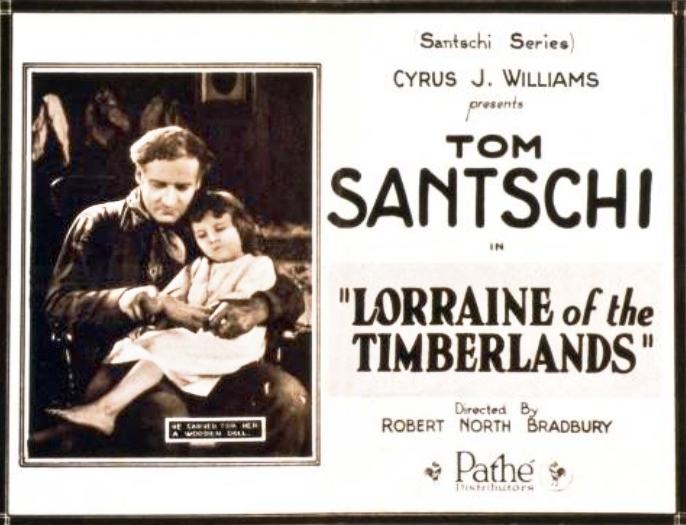
Picture a nitrate print flickering inside a clapboard church in 1921: the projector hiccups, the audience gasps, and somewhere in the beam a gaunt silhouette named Tom Santschi looms like a cedar cross come alive. Lorraine of the Timberlands—a title now half-erased from celluloid memory—was never destined for the gilded palaces of Los Angeles; it was carved for back-road tents where rain drummed on canvas and every cough echoed like a gunshot. Yet within that humble flicker lies a revenge aria so electrically overwrought it feels modern, as though the film were spliced with live wire.
The plot, stripped of its moss, is primal: a father returns, a child is found, a villain named Black Bart stalks through the underbrush like a bedtime monster who refuses to stay inked on the page. But director Scott R. Dunlap—a journeyman who could coax menace from a pinecone—layers the tale with flashbacks that bleed through the present like sap from an axe wound. One moment we are in soggy dawnlight, watching Ruth Stonehouse’s Lorraine split kindling; the next, nitrate burns white and we are hurled fifteen years rearward, watching her mother leap from a cliff rather than submit to Bart’s grinning appetite. The temporal whiplash is silent-era Vertigo before Hitchcock ever bruised his knees on a San Francisco rooftop.
Santschi, all cheekbones and doom, plays the wanderer-father with the stoic ferment of a man who has swallowed a storm. Watch him in medium shot as he recognizes the grown daughter: his left hand trembles, barely, near a frayed suspender; the right hand clenches, not into a fist but into a plea. No intertitle is needed—the gesture is a silent scream of “I failed you once; not again.” Compare that to Earl Hughes as the accused lover: youthful shoulders that still expect the world to be fair. When the townsfolk rope him for Bart’s crime, Hughes curls inward like a book slammed shut, and the camera—suddenly cruel—lingers so we can count every heartbeat twitching below his thin shirt.
Then there is Andrew Wilson’s Black Bart, a villain who seems carved from petrified smoke. Wilson eschews moustache-twirling; instead he smiles the way a wolf does before it decides whether to eat. In a startling close-up, moonlight glints off his teeth while his eyes stay matte-black, two holes punched through the print. The effect is uncanny: we perceive depth where none exists, an abyss wearing human skin. When he slashes the sheriff’s throat off-screen, Dunlap cuts to a shadow on a wall—Bart’s arm, a blade, a spurt of ink-black splatter—and the image lingers longer than comfort allows. Censors snoozed in 1921; modern viewers will flinch as though the knife grazed their own jugular.
But the film’s true protagonist is climate itself. Cinematographer Jack Smith lenses the timberlands as a living cathedral: trunks soar like Gothic pillars, fog pools like incense. When the final storm erupts—an orgy of wind machines, flash powder, and trip-wire branches—every frame crackles with elemental fury. Lightning (animated by scratching the print) forks across the sky, striking the prison and blasting stone as though Thor himself petitioned for the father’s release. The liberation sequence, all handheld chaos and whip-pans, predates the kinetic frenzy of She Couldn't Help It by a full decade. One can trace a jagged line from this tempest to the hurricane shack sequence in For France—proof that early filmmakers already knew weather could be character, chorus, and catharsis.
Gender dynamics, meanwhile, tangle like Virginia creeper. Lorraine is no fainting ingenue; she wields an axe, pilots a dugout canoe, and rescues her lover as often as he rescues her. Yet the narrative still demands her father’s sacrifice for masculine honor—a thematic knot the film never unties. One senses screenwriter William E. Wing wrestling with the emerging flapper ethos: his heroine chops wood in trousers, but the plot must ultimately hinge on patriarchal redemption. The tension electrifies every scene she shares with Bart; their showdown in a half-subverted logging mill feels less like good vs. evil than past vs. future, timber vs. gasoline.
Visually, the palette is tungsten and ash. Dunlap tints night sequences indigo, day-for-night amber, and bloodlust a sickly ochre. Notice how the cliff from which the mother leaps is framed: low angle, sky blown-out white, so the precipice becomes a guillotine blade against nothingness. Later, when the father scales that same cliff to confront Bart, the camera peers downward, revealing a river far below like a serpentine ribbon of sea-blue malice. The symmetry is cosmic—two men dueling on the lip of the same grave that once swallowed the woman they both, in their twisted ways, loved.
Sound, though absent, is implied. During the jailbreak, the film’s rhythmic flicker syncs with the viewer’s pulse until you swear you hear chains snap. When Lorraine sings to calm her injured lover, the intertitle reads merely “A lullaby…” yet Stonehouse’s lips quiver with such tremulous breath you can almost hear the cradle song Santschi lost in the forest fifteen years prior. This synesthetic hallucination is silent cinema’s greatest trick: it makes the audience collaborate, co-authoring audio in the skull.
Comparative context enriches the experience. Viewers who relish the moral swamps of Other Men's Shoes will recognize a similar willingness to let guilt stain every character; those stirred by the flag-waving fervor of The Colonel may find Timberlands refreshingly skeptical of heroic myth. Conversely, fans of Dangerous Curve Ahead’s cliffside thrills will swoon at the timberlands’ vertiginous grandeur, while the fairytale darkness of Gólyakalifa resonates in Bart’s ogre-ish silhouette.
Yet the film is not flawless. Its intertitles sprout purple prose (“The tempest’s tongue licked the sins of the land…”) that clangs against the visual austerity. Comic relief arrives via a moonshiner named Hickey (Clark Comstock) whose pratfalls feel grafted from a Mack Sennett two-reeler; each appearance punctures the dread. And the coda—father imprisoned again, albeit unjustly—smacks of studio moralism: crime must be seen to be punished, even when the audience knows justice miscarried.
Still, these flaws feed the artifact’s charm. The tonal whiplash mirrors the cultural vertigo of 1921, a nation nursing war wounds while tap-dancing into jazz-age abandon. The film’s uneasy closure—Bart dead, father jailed, lovers reunited yet haunted—anticipates the cynical denouements of late noir. One can even detect pre-echoes of Without Benefit of Clergy in its treatment of colonial guilt, or the domestic surrealism of The General's Children.
Restoration status: only two 35mm prints survive—one at the Library of Congress, vinegar-baked but salvageable; another in a private Parisian archive, riddled with nitrate creep that resembles frostbite along the edges. Digital scans reveal swirl marks where projectionists long ago hand-painted lightning bolts, evidence of audiences so desperate for spectacle they augmented the negative itself. Each blemish is a tattoo, a reminder that film is not merely recorded but lived-in, scarred by every viewer who once gasped in the dark.
So is Lorraine of the Timberlands a masterpiece? By auteurist metrics, perhaps not—Dunlap lacks the obsessive signature of a Lang or a Murnau. Yet as a folk artifact it sears: a cautionary ballad about land, blood, and the price of return. It reminds us that American cinema’s roots are not merely in Griffith’s neoclassical ballets but in pulp fires told around logging camps, where every shadow might be a wolf, every thunderclap a mother’s final scream. Watch it, if you can, on a stormy night when the roof rafters creak like old celluloid. Let the wind shear the power lines; let the room go black except for the projector’s guttering bulb. Then, as lightning forks outside your window, imagine the film’s own frame bursting apart—liberation not just for a shackled hero, but for every ghost that ever howled across the timberlands of forgotten cinema.
If you hunt for more rediscovered silent thunder, detour through No Parking’s urban anarchy or the phantasmal afterlife romance of The Undying Flame. But start here, with Lorraine, where every splinter still drips sap and every shadow wears a wolf’s grin.
IMDb 6.6
1933
Community
Log in to comment.