DbcultAccessing Vault...
Cult Review
Senior Film Conservator
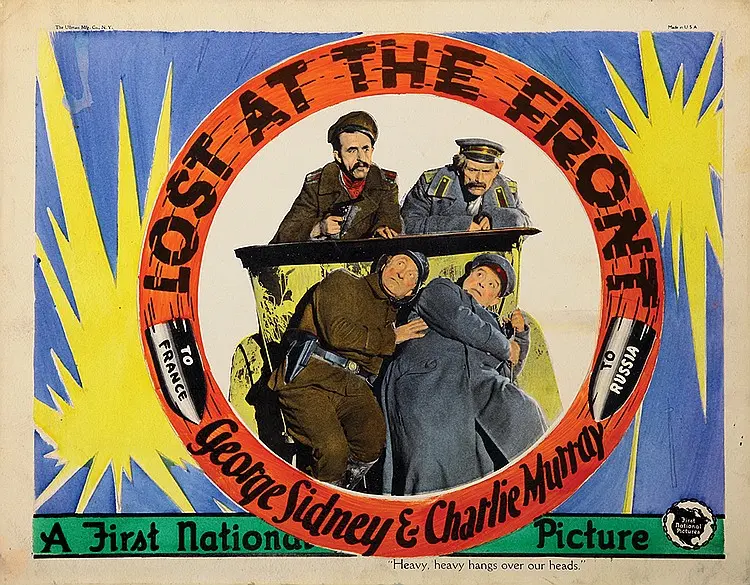
Is Lost at the Front worth watching today? Short answer: yes, but with significant caveats. This 1927 silent comedy is a fascinating historical artifact, a rare glimpse into early war humor, and a surprisingly progressive take on friendship, making it essential viewing for silent film aficionados and comedy historians.
However, general audiences seeking modern comedic timing or profound dramatic depth will find its pacing and humor challenging. It's a film for those willing to engage with cinema as a historical document, not just as entertainment.
This film works because of its audacious premise, pairing an Irish cop and a German saloon keeper in a wartime comedy that prioritizes human connection over nationalistic divides. Its pioneering use of absurdity to diffuse the gravity of war was remarkably forward-thinking for its era.
This film fails because its specific brand of physical comedy and episodic structure, while groundbreaking for 1927, can feel dated and repetitive to contemporary viewers. The humor, reliant on broad strokes and cultural caricatures, doesn't always translate seamlessly across nearly a century.
You should watch it if you are deeply interested in the evolution of cinematic comedy, silent film performance, or the social commentary embedded in early Hollywood productions. It's a testament to the power of character chemistry over plot sophistication.
The year 1927 stands as a pivotal moment in film history, straddling the silent era's peak and the dawn of sound. Amidst this transition, Lost at the Front emerged, promising “the funniest war story ever screened.” This bold claim, found in its original promotional material, sets a high bar for a film that dares to find humor in the grim reality of World War I. Directed by Hampton Del Ruth, with a screenplay by Frank Griffin, Ralph Spence, and Del Ruth himself, the film presents a unique comedic lens on conflict, focusing less on the battlefield and more on the chaotic journey to get there.
At its core, the film is a buddy comedy, a genre that has proven timeless. But its specific pairing—an Irish policeman and a German saloon keeper—is what truly elevates its initial concept. In an era still grappling with ethnic stereotypes and post-war sentiments, casting such a duo as protagonists, united in a shared, if comically inept, quest for patriotism, was a subtle yet profound statement. It suggested that common humanity and shared experience could transcend nationalistic divides, even in the context of war.
The film’s genius, or at least its ambition, lies in its subversion of expectations. Audiences, accustomed to dramatic war narratives, were instead offered a series of slapstick misadventures. The promotional material explicitly states, “they had more fights getting to the front than they had when they got there.” This line perfectly encapsulates the film’s irreverent spirit, prioritizing the absurdities of the journey over the solemnity of combat.
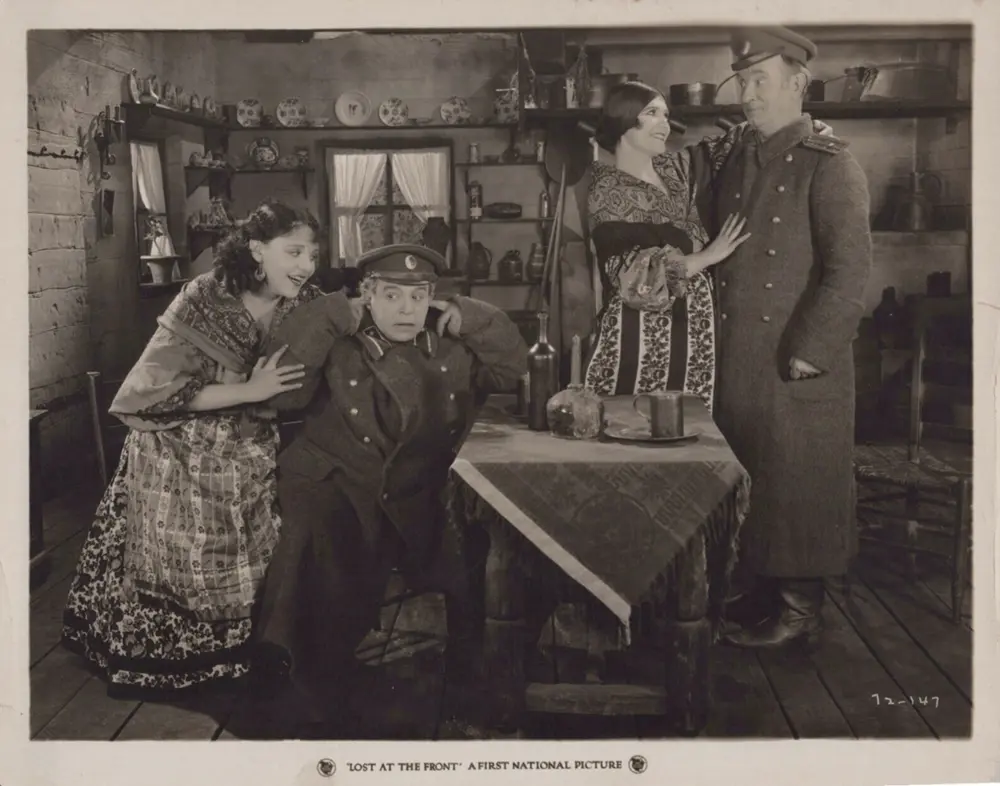
Central to the film’s comedic success are its lead actors, Charles Murray and Ed Brady. Murray, a veteran of numerous silent comedies, often brought a robust, everyman physicality to his roles. His presence here as the Irish policeman would have resonated with audiences familiar with his boisterous persona. He embodies the kind of well-meaning but often clumsy protagonist that silent comedy thrived upon.
Ed Brady, playing the German saloon keeper, provides the perfect foil. Brady, known for his character acting, likely delivered a performance that balanced Murray’s exuberance with a more grounded, perhaps slightly bewildered, demeanor. The dynamic between these two actors is crucial; without believable chemistry, the premise—no matter how clever—would fall flat.
Consider, for instance, a hypothetical scene early in their journey: Murray’s character, perhaps attempting to navigate a crowded train station, might inadvertently cause a pile-up of luggage and people, with Brady’s character caught in the middle, his stoic exasperation a perfect counterpoint to Murray’s frantic apologies. This kind of physical interplay, a hallmark of silent film, would have been the engine of their comedic partnership. It’s not about witty dialogue, but about expertly choreographed chaos.
Hampton Del Ruth, as director, faced the challenge of translating a script full of comedic potential into purely visual terms. Silent film directing required a nuanced understanding of staging, pacing, and exaggerated performance to convey emotion and humor without spoken words. Del Ruth, with his experience in short comedies, was well-equipped for this task.
The film would have relied heavily on visual gags: mistaken identities, slapstick falls, and rapid-fire reactions. Imagine a sequence where Murray and Brady, attempting to blend in or perhaps secure passage, don ill-fitting uniforms, leading to a series of comedic misunderstandings with authority figures. The humor would derive from their earnest efforts clashing with their inherent ineptitude, all communicated through expressive facial contortions and broad gestures.
Cinematography, while not always as flashy as in dramatic epics, played a vital role in silent comedies. Clear framing, effective use of close-ups for comedic effect (like a sudden, wide-eyed stare from Brady), and dynamic editing to control the rhythm of a chase or a chaotic sequence would have been paramount. Del Ruth would have needed to ensure that every visual cue contributed to the laughter, making the audience feel the absurdity rather than just observe it.
Perhaps the most unconventional and intriguing element of Lost at the Front is the introduction of “Russian women” and the subsequent romantic entanglements. The promotional material’s phrase, “And the way those Russian women made love to them, made them wish they were in 'No Woman's Land',” hints at a significant departure from typical war narratives. This isn't just a comedy about getting to the front; it's a comedy about getting sidetracked by passion.
This element could be viewed as surprisingly progressive for its time, injecting a dose of human desire and connection into a genre often devoid of it. It suggests that even amidst the chaos of war, life—and love—finds a way to blossom, often in the most inconvenient and humorous circumstances. Nita Martan and Nina Romano, listed in the cast, likely played key roles in these romantic subplots, adding glamour and comedic tension to the duo’s misadventures.
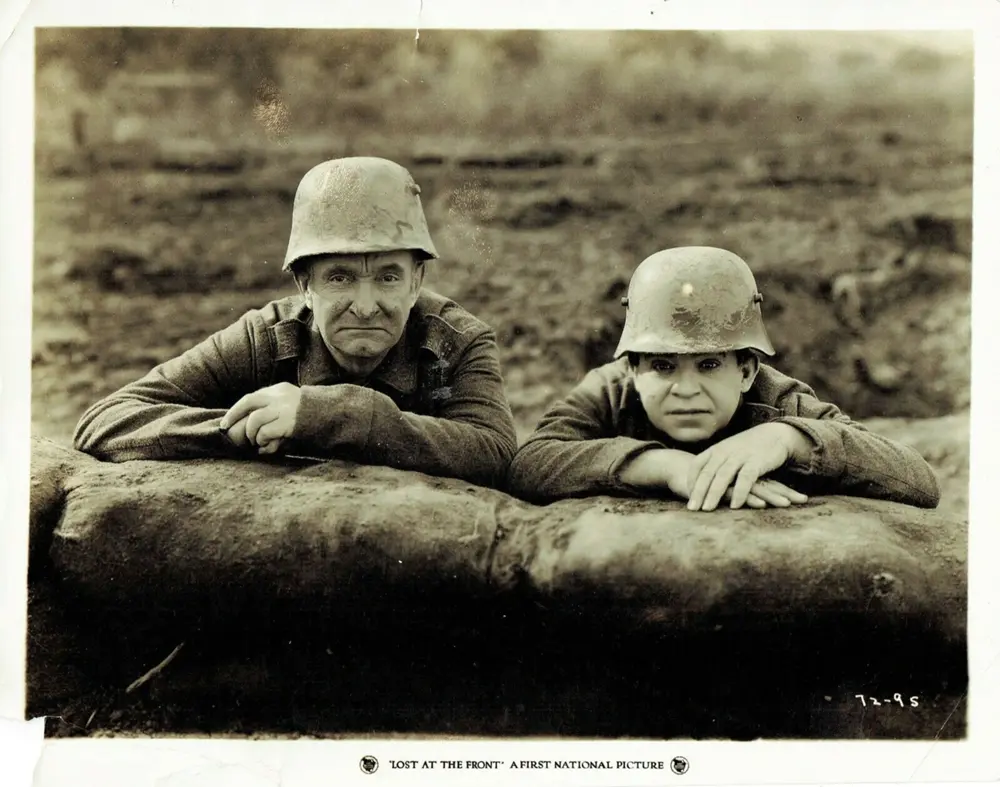
However, one could also argue that this portrayal might lean into exoticism, a common trope in early cinema. The phrase “the way those Russian women made love to them” could be interpreted as reducing complex characters to instruments of romantic diversion. My unconventional observation here is that the film, in its pursuit of laughter, inadvertently touches upon a deeper truth: that human connection, even fleeting romantic ones, can be a powerful antidote to the dehumanizing forces of war. It's a surprisingly sensual and humanizing touch for a war comedy from 1927.
The pacing of silent comedies often feels different to modern viewers. Gags might be extended, reactions exaggerated, and the overall rhythm less frenetic than contemporary humor. Lost at the Front would have relied on this deliberate pacing to build its comedic scenarios, allowing audiences to fully absorb the visual humor before moving to the next beat. The tone, despite its wartime setting, is relentlessly lighthearted, a conscious decision to offer escapism rather than grim reflection.
Does this humor still land today? For many, the answer is probably no. The specific cultural references, the broad physical comedy, and the episodic nature can feel archaic. However, for those with an appreciation for the mechanics of silent film comedy, there's a certain charm and ingenuity to be found. The underlying themes of friendship, adventure, and the absurdity of bureaucracy are, in fact, timeless, even if their execution is dated. It’s a film that demands an active, historically informed viewership.
Comparing it to other films of the era, Lost at the Front shares a lineage with character-driven comedies like The Bluffer, where the humor springs from the personalities and predicaments of its leads. It also stands in contrast to more dramatic war films of the period, offering a much-needed comedic counterpoint to the prevailing serious narratives. It works. But it’s flawed.
For silent film enthusiasts, historians, and those curious about the evolution of cinematic comedy, Lost at the Front is absolutely worth seeking out. It offers a fascinating glimpse into a specific moment in film history, showcasing pioneering comedic talent and a surprisingly bold narrative approach to a sensitive subject. Its value lies in its historical significance and its brave attempt to find laughter in unexpected places.
However, if you're looking for a film that will deliver laugh-out-loud moments by modern standards, or a narrative with contemporary pacing and sensibilities, this 1927 production might prove a difficult watch. Its appeal is niche, but profound within that niche.
Lost at the Front is more than just a forgotten silent film; it's a testament to the enduring power of comedy to challenge norms and find light in the darkest of times. While it may not induce uproarious laughter from every modern viewer, its historical significance and its brave narrative choices make it a compelling watch for the right audience.
It’s a film that asks you to meet it halfway, to appreciate its context and its pioneering spirit. For those willing to make that journey, much like its protagonists, you’ll find that the true value isn’t always in the destination, but in the wonderfully chaotic and unexpectedly human journey itself. It’s not a masterpiece, but it’s an important piece of the cinematic puzzle, and one that deserves to be rediscovered by those who truly appreciate the art of silent cinema.
IMDb 7.1
1933
Community
Log in to comment.