DbcultAccessing Vault...
Cult Review
Senior Film Conservator
Cinema has long fetishised the chiaroscuro of fortune—how a single telegram, a lottery ticket, or an unrepeatable stock tip can tilt a life from gutter to stratosphere. Lost in Darkness, released in the autumn of 1920 when Europe still coughed up the soot of war, distils that obsession into a cautionary phantasmagoria shot on the brittle orthochromatic stock of early Italian studio work.
The film arrives like a half-remembered aria: you can almost taste the metallic tang of nitrate in the air as the projector rattles. Director Ugo Gracci, never canonised alongside Pastrone or Ambrosio, nonetheless brandishes a visual lexicon steeped in Gothic tableaux and social satire. His camera stalks the provincial foundry where our unnamed engineer—played with angular earnestness by Umberto Mozzato—calculates vectors by lamplight, sleeves rolled to reveal forearms corded like mooring ropes. Every frame vibrates with the tactile grime of industry, the hiss of steam valves, the clank of iron against iron. It is a world where class mobility feels as improbable as alchemy.
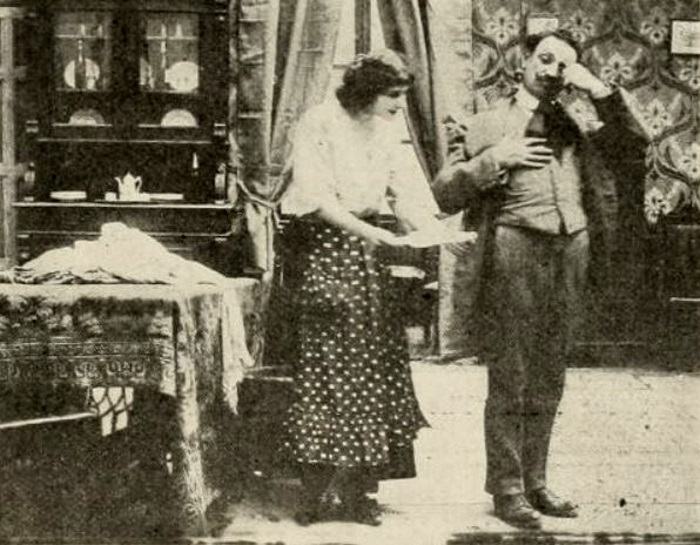
Then the telegram slips beneath the workshop door: a summons to the capital, a salary swollen to grotesque proportion, and the engineer’s face undergoes a microscopic riot—brows ascend, pupils dilate, a smile fractures the soot. Gracci jump-cuts to the couple’s attic bedroom, moonlight slicing across peeling wallpaper, and we watch ambition metastasise into delusion. He sketches mansions on the misted windowpane; his wife, portrayed by Italia Almirante-Manzini with the dove-eyed gravitas of a Renaissance Madonna, folds and refolds the single cotton dress she owns as though rehearsing for a life of endless costume changes.
The metropolis, when it erupts onto the screen, is a vertiginous collage of Art-Nouveau façades, humming tram cables, and nightclubs where saxophones bleat like sacrificial calves. Production designer Ettore Ranaldi allegedly scavenged genuine electrical fair signage to create the inventor’s new laboratory: a cathedral of copper coils and Jacob’s ladders that spit cerulean sparks into the rafters. In long shot the machinery resembles a monstrous pipe organ; when it explodes later, the image rhymes with the destruction of Babel, tongues of fire spelling every unkept promise.
But first comes seduction. Enter the woman of fashion—listed only as “La Contessa” in intertitles—slipping through soirées in beaded gowns that slither like liquid mercury. Actress Rina De Liguoro invests the part with a languid carnivory: every sidelong glance seems to strip gears from the male gaze itself. She circles the inventor as though he were a freshly minted coin still warm from the press. His resistance, already eroded by champagne and flattery, collapses into an extended montage of assignations: rowboats gliding through studio-tank reeds, carriage rides where her gloved hand inches up his thigh, a final tryst in an enclosed wintergarden where tendrils of ivy frame their coupling like an emerald proscenium.
Gracci’s narrative strategy here is mercilessly symmetrical. Each gift the engineer bestows upon his mistress—an ivory fan, a rope of pearls, a coupe clasped with silver panthers—reappears later as an instrument of humiliation. The pearls, snatched from the blind man’s bedside table, become the glittering evidence of La Contessa’s moral bankruptcy; the fan, snapped shut with a sound like a collarbone breaking, signals the moment she abandons him to anonymity.
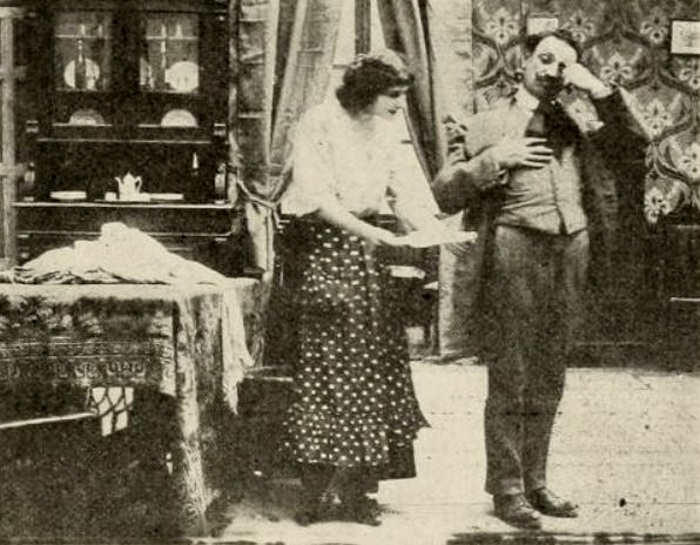
Mid-film, the betrayed wife descends from marital limbo. Almirante-Manzini modulates her performance with minimalist precision: a downward flutter of eyelids, a fractional tightening of the mouth. She confronts the husband beneath a gas lamp, rain needling the cobblestones, and offers forgiveness with such unforced grace that the scene irradiates the entire melodrama with something close to grace. Yet the husband, drunk on self-mythology, backslides. Cue the detonation.
The accident sequence—often excerpted in compilations of early Italian spectacle—deploys overlapping exposures, handheld panic, and a percussive score (restored recently by the Cineteca di Bologna) that slams timpani against silence. One reel is dyed crimson so that smoke, flesh, and brick dust coalesce into a single wound. When the debris settles we find the inventor’s eyes bandaged, his pupils cooked to an opalescent stare. Mozzato, now robbed of his most expressive feature, must act through clenched knuckles and a voice pitched to a tremor the intertitles can only approximate. It is a tour-de-force of physical restraint.
From here the film pivots into gothic nursing-ward noir. The wife, donning the grey pinafore of a hospital orderly, pads through corridors that Gracci lights like a cathedral—arches of darkness buttressed by single candles. She bathes her husband’s scorched face, spoon-feeds him broth, reads him stock-market figures that now belong to a vanished life. Their scenes together ache with dramatic irony: we recognise her by the locket she cannot remove; he remains oblivious, grasping at her wrist one midnight and murmuring his mistress’s name. The camera lingers on Almirante-Manzini’s profile: a tear sliding to the bow of her lip, caught like a bead of mercury on obsidian.
La Contessa’s return is staged as Grand Guignol farce. Slipping into the ward beneath a lace mantilla, she rifles the strongbox at the foot of the bed, only to be intercepted by a cruciform shadow—the wife barring the doorway. The ensuing scuffle is shot from a high angle, bodies flailing like marionettes cast in chiaroscuro. When the mistress flees, the inventor’s hearing sharpens in proportion to his blindness: off-screen footsteps ricochet down the stairwell, a sonic afterimage of abandonment.
Spoiler-phobes, look away: vision is restored via a specialist whose spectacles glint like twin moons. The bandages unwind in a single, unbroken take—Gracci’s camera inches forward so that the first thing the protagonist sees is his wife’s reflection silhouetted against a window. Recognition dawns not through dialogue but through a match-cut to their wedding photograph, superimposed over the present moment. Time folds; the prodigal tear he sheds is tinted amber by the restoration lab, a literalised drop of honeyed remorse.
Does the ending satisfy? Contemporary critics carped that reconciliation arrives too glibly, yet the film’s final tableau complicates absolution. Outside the hospital gates the couple embrace while, across the street, a newsboy hawks broadsheets blazoned with the inventor’s fall. Headlines flutter like wounds stitched too late. Gracci holds the shot until the pair recede into a crowd—two anonymous figures reabsorbed by the city that once hoisted them into incandescence. The implication: wealth, sight, even love itself are merely on loan from capricious Fortune, who sooner or later demands her interest.
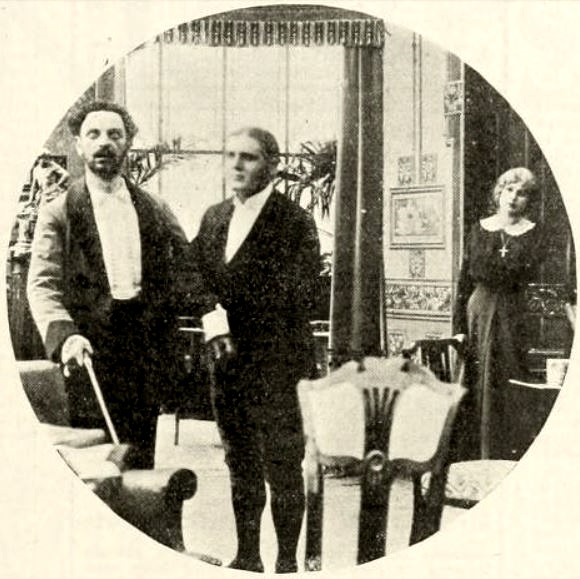
If you hunger for a continental counterpoint to this parable, seek out Der Millionenonkel (Austria, 1913), where the uncle’s windfall corrodes familial bonds through broad satire rather than sulphurous melodrama. Closer in tone, Schuldig (Germany, 1918) likewise weaponises guilt as a corrosive, but its Expressionist corridors tilt toward psychological horror rather than social critique. Meanwhile From Gutter to Footlights (UK, 1916) rehearses the rags-to-riches arc, yet its showbiz backdrop pirouettes into comic exuberance, blind neither to irony nor to the footlights’ glare.
The 2022 2K restoration scanned the last-known surviving nitrate print from the Museo Nazionale del Cinema, Turin. Grain remains coarse as pumice, but the new colour grading teases out amber skin tones against Prussian shadows. Particularly revelatory: the nightclub sequence’s hand-coloured confetti—each scrap dyed cerise, viridian, sulphur—now pops like a pointillist canvas. Accompanying the disc, a commentary by archivist Loredana Monaco situates the film within Italy’s post-WWI inflation, arguing that the inventor’s vertiginous income mirrors the lira’s own bipolar spasms.
Mozzato’s descent from swagger to supplication is calibrated in millimetres: watch how his gait widens once wealth arrives, shoulders cantilevered back as though balancing an invisible yoke of coin. Conversely, Almirante-Manzini wields stillness as weapon and balm; her forgiveness feels less like passive martyrdom than a strategic act of moral warfare. In a single close-up she communicates the exhaustion of a heart that continues to beat out of contractual obligation to the body that houses it.
Though originally released with a live score for trio, the restoration commissioned a new electronic suite by minimalist composer Elisa Luu. Sparse pulses, reminiscent of Geiger-counter clicks, echo the inventor’s laboratory sparks. During the blindness arc, she removes nearly all treble, leaving sub-bass drones that vibrate in the viewer’s ribcage—an a analogue for the protagonist’s sensory deprivation.
Is Lost in Darkness a neglected masterpiece? Not quite. Its gender politics grate; the wife’s inexhaustible charity risks idealising feminine self-erasure. Yet as a celluloid treatise on capital as both aphrodisiac and corrosive, the film sears the retina. Gracci orchestrates set-pieces with a bravura that anticipates the operatic crescendos of later Visconti, while his moral pendulum—riches to ruin to redemption—swings with the inexorability of Greek tragedy.
Seek this print not for comfort but for the vertiginous chill of watching fortune’s wheel rotate in real time, each spoke a gleaming coin that blinds as it enriches.
IMDb —
1933
Community
Log in to comment.