DbcultAccessing Vault...
Cult Review
Senior Film Conservator
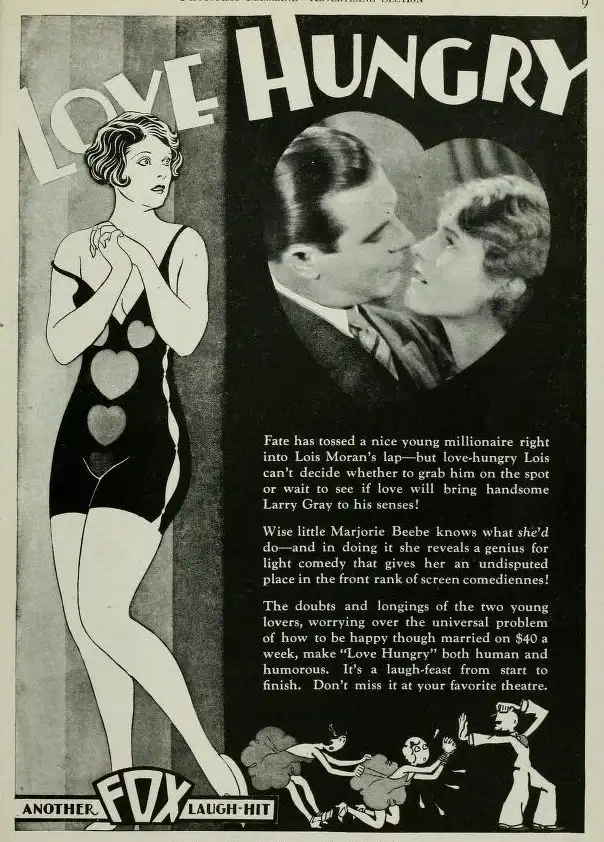
Alright, let’s be straight: Love Hungry isn't going to be everyone's cup of tea, especially not today. If you're a film student on a deep dive into early cinema, or someone who genuinely enjoys the unhurried pace and often melodramatic acting of the era, then yes, it’s got moments. But if you’re looking for anything resembling modern pacing, sharp dialogue, or even particularly high stakes, you’ll probably find yourself checking the clock. It's a curiosity, a quiet slice of a very different kind of filmmaking.
The premise is simple enough: Joan, played by Marjorie Beebe, is a 'discouraged chorus girl' returning home. The discouragement mostly manifests as a sort of general malaise, an almost permanent slight frown. She’s not exactly radiating the energy of someone who just spent years on stage, even a bad stage. More like she’s tired from a long bus ride. Her entrance into the family home feels less like a dramatic homecoming and more like someone just… entering a house. Her mother, played by Edythe Chapman, is there, and the initial reunion is oddly muted. No big hugs, no real sense of longing. Just a few nods and a cup of tea, it seems.
Then we meet Tom (Lawrence Gray), the impoverished author. He occupies one of the rooms as a boarder. Gray has this boyish earnestness that’s actually pretty endearing. He looks less like a starving artist and more like a perpetually optimistic college student who just misplaced his tuition money. His writing setup, a small desk with some scattered papers, feels exactly right for someone who probably daydreams more than he actually writes.
The film takes its sweet time establishing the dynamic between Joan and Tom. There's a long sequence where Tom is trying to write, and Joan keeps interrupting him, first with some casual conversation, then by just sitting there. You can feel the movie trying to build a 'meet cute' out of very little. The glances exchanged are meant to be loaded, I think, but mostly they just feel like two people trying to figure out if they should speak or not. It’s not bad, just slow. Really slow.
One thing that really sticks out is the way the film handles emotion. There’s a scene where Joan is feeling particularly down, and the camera just holds on her face for what feels like an eternity. Marjorie Beebe tries her best, but the prolonged close-up turns what should be a moment of quiet despair into something almost comical. You start wondering if she’s just forgotten her line, or if the director just walked off set for a coffee break. It’s a very particular kind of silent film acting where 'sad' is communicated by holding a specific expression for an extended period, which can be unintentionally funny now.
Tom, in his wisdom, encourages Joan to marry a wealthy man. This is where the plot mechanics start to click in, but not exactly with a bang. The wealthy suitor character feels a bit like a cardboard cutout. He's rich, he's polite, he's utterly uninteresting. There's almost no effort made to make him a compelling alternative. He’s just… the rich guy. His scenes feel functional, designed solely to push Joan back towards Tom. The chemistry, or lack thereof, between Joan and this wealthy man is palpable, but not in a good, 'she clearly loves Tom' way. More in a 'these two actors have never met before' way.
There are some really nice, small visual touches though. The way light falls through the window in Tom’s room, for example, gives it a certain cozy, if a bit dusty, charm. And the costumes, while not spectacular, feel lived-in. Joan's outfits, especially after she leaves her chorus girl life, are simple but tailored, a subtle hint at her character's underlying refinement, even when discouraged. You see her in a simple dress, ironing, and it feels real, less like a movie set prop.
The pacing throughout is uneven. Some scenes zip by, like a quick montage of Joan and Tom spending time together, which feels almost jarringly fast after the drawn-out emotional beats. Other times, a conversation that could be handled in two lines stretches into multiple intertitles and lingering shots. It makes the whole experience feel like a series of short sprints interrupted by long, leisurely strolls.
When Joan finally chooses Tom, despite his poverty, it’s not exactly a shocking revelation. The film has telegraphed it pretty clearly from the moment they first exchanged those awkward glances. The resolution feels sweet, if a little naive. The poverty aspect, which is supposed to be a major hurdle, seems to just… fade away in the face of true love. It's a very romantic, very early-Hollywood take on 'love conquers all,' where the 'all' often includes practical concerns like, you know, rent and food. You just have to accept it for what it is.
Ultimately, Love Hungry is a film for those with patience and a fondness for cinematic history. It's not going to set your world on fire, but it offers a quiet glimpse into early romantic storytelling, complete with its charming quirks and its occasionally baffling directorial choices. It’s the kind of film you might put on a rainy afternoon, half-watching, half-thinking about how much movies have changed. It certainly doesn't have the punch of something like The Three Godfathers or the straightforward action of The Phantom Bullet, but it has its own peculiar, gentle rhythm.
IMDb —
1931
Community
Log in to comment.