DbcultAccessing Vault...
5.2/10
Senior Film Conservator
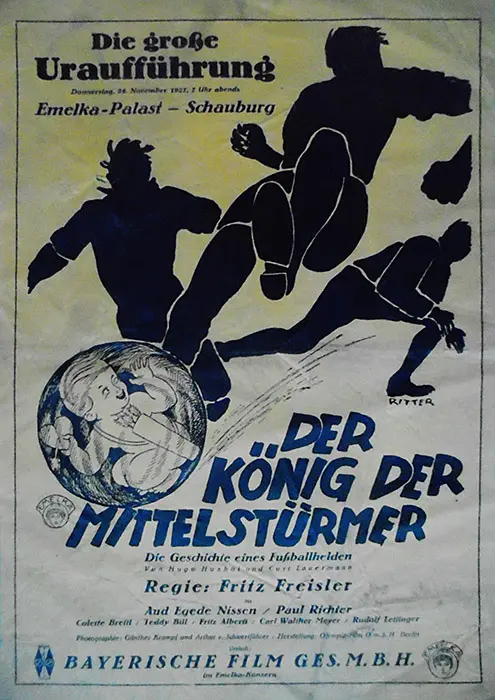
A definitive 5.2/10 rating for a film that redefined the boundaries of cult cinema. Der König der Mittelstürmer remains a cornerstone of transgressive art.
Is Der König der Mittelstürmer worth your time in the 21st century? Short answer: Yes, but only if you appreciate the historical DNA of sports movies and the aesthetic of silent-era social drama. It is a fascinating look at the moment football transitioned from a fringe hobby to a national obsession.
This film is for the cinema historian who wants to see the roots of the 'disapproving father' trope and the sports fan interested in the pre-professional era of the game. It is definitely NOT for those who require high-octane action or can't stomach the slower, pantomimic acting style of the late 1920s.
1) This film works because it captures the genuine, unpolished energy of 1920s football, using real stadium atmosphere that feels more authentic than many modern green-screen productions.
2) This film fails because the family melodrama is remarkably thin, relying on repetitive arguments between Tull and his father that lose their sting by the third act.
3) You should watch it if you want to witness the exact moment German cinema realized that athletes could be as big as movie stars, a theme also explored in different contexts in films like Saturday.
If you are looking for a masterpiece of Expressionism, look elsewhere. However, as a social document, it is invaluable. The film provides a rare window into the leisure culture of the Weimar Republic. While many films of the era, such as An Alien Enemy, focused on external threats or internal psychological rot, this movie is about the joy of movement. It is worth watching for the stadium sequences alone, which show a version of football that is unrecognizable compared to the hyper-commercialized sport of today.
The core of the film is the conflict between Fritz Alberti’s Consul Harper and Paul Richter’s Tull. Alberti plays the father with a rigid, almost statuesque stiffness. He represents the 19th-century view that physical exertion is for laborers, not gentlemen. Richter, fresh off his success in major epics, brings a surprising lightness to Tull. He doesn't look like a typical leading man of the era; he looks like someone who actually spends time outdoors.
One specific scene stands out: the moment the Consul finds Tull’s training gear hidden in his office. The way the camera lingers on the leather ball—treating it like a piece of scandalous evidence—is hilarious to a modern viewer but was deadly serious at the time. This clash of values is a common thread in silent cinema, often seen in dramas like The Web of the Law, where tradition and new-age morality collide.
The cinematography by Friedl Behn-Grund and Werner Brandes is the real star here. They had to solve the problem of how to film a moving ball with heavy, static cameras. Their solution was to use wide, sweeping shots that capture the geometry of the game. It’s a far cry from the intimate, handheld style we see in modern sports films, but it gives the matches a sense of epic scale.
The lighting in the office scenes is worth noting too. It uses high-contrast shadows that suggest the suffocating nature of Tull’s expected career. Contrast this with the bright, flat, and airy lighting of the football pitch. The film tells its story through these visual cues long before the title cards explain the plot. It’s a sophisticated use of the medium that many lesser films of the time, such as Burnt Wings, failed to master.
I’ll be blunt: most silent sports movies are terrible. They usually treat the sport as a gimmick. Der König der Mittelstürmer is different because it treats the mechanics of the game with respect. The actors actually seem to know how to play. There is a visceral quality to the mud and the sweat that you don’t see in the more polished 'society' films of the decade.
However, the film is flawed. The pacing in the second act is sluggish. We get it—the father is mad. We don't need four separate scenes of him staring at a clock while Tull is at practice. The film could have easily cut twenty minutes of boardroom posturing without losing an ounce of its emotional weight. It’s a common issue in films like The Price of Pleasure, where the 'message' is hammered home long after the audience has understood it.
Here is a surprising thought: the football itself is the most disruptive character in the film. In every scene it appears, it breaks the social order. In the office, it represents chaos. In the street, it represents a new kind of community. The film isn't just about a son; it's about how an object can redefine a culture. It is almost a proto-documentary about the birth of the fan-base.
Pros:
- Excellent location shooting that brings 1927 Germany to life.
- Paul Richter gives a performance that feels surprisingly modern.
- The film avoids the overly 'theatrical' acting of earlier silent films.
Cons:
- The female characters are given almost nothing to do except look concerned.
- The ending is wrapped up too neatly, ignoring the deep ideological rift established earlier.
- Some of the title cards are overly verbose.
Der König der Mittelstürmer is a solid, if predictable, piece of early sports cinema. It doesn't have the psychological depth of the great German masterpieces, but it has a heart that is hard to ignore. It is a story about the transition of a society, told through the lens of a leather ball and a dusty pitch. It works. But it’s flawed. If you can handle the silence, you’ll find a surprisingly relatable story about finding your own path. It scores, even if it doesn't quite win the championship.
IMDb —
1930
Community
Log in to comment.