DbcultAccessing Vault...
Cult Review
Senior Film Conservator
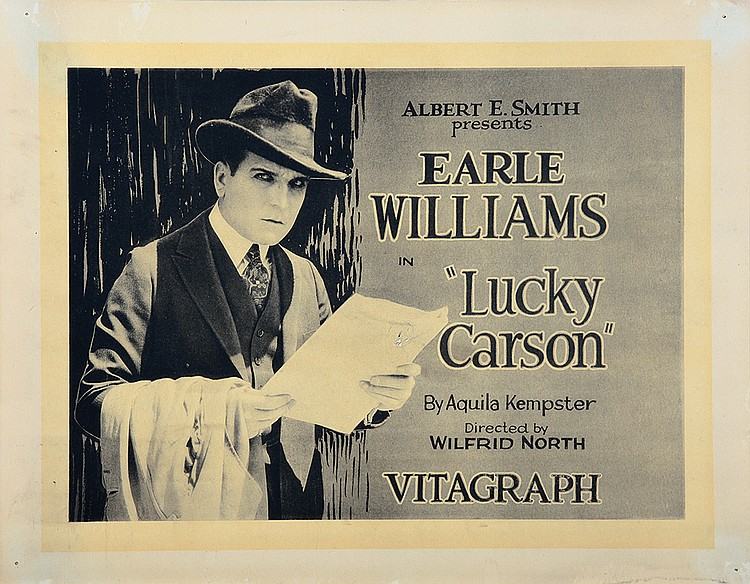
There is a moment, early in Lucky Carson, when the camera merely breathes on Collette Forbes’s face as London dawn leaks through the Thames mist. No intertitle intrudes; the silence swells until you hear your own pulse. In that hush the film announces its creed: identity is currency, luck is counterfeit, and redemption is a confidence trick you play on yourself.
Most silents about reinvention (His Majesty, the American) chase slapstick momentum; Aquila Kempster’s screenplay chooses a slower metabolism, letting desperation seep like ink into blotting paper. We first meet Peters on a rain-slick parapet, hat brim sagging, pockets as empty as a politician’s promise. The city around him—shot by cinematographer George Rizard with jagged Germanic angles—feels like a debtor’s prison whose walls are made of fog and gaslight. When he clubs Kluck (Earle Williams, all waxed mustache and carnivorous grin) and swaps clothes, the cut is brutal: a match-on-action from fist to collar that prefigures Soviet montage yet feels viscerally American, as if the New World itself were a stolen suit.
Across the Atlantic, the palette warms. Tints shift from cadaverous blue to champagne amber; racetracks unfurl like green carpets rolled out for royalty. Lucky’s winning streak is rendered through superimposed betting slips fluttering like snow—an effect both playful and faintly sinister, suggesting that every payoff is merely confetti on a ticking bomb. Wall Street sequences borrow crowded-tableau staging from The City of Illusion, but replace that film’s mystical haze with ticker tape that spatters the lens, turning finance into meteor shower.
James Butler, saddled with matinee-idol cheekbones, could have coasted on charm. Instead he modulates Peters/Carson like a man tuning a faulty radio: swagger cracks into static whenever a door slams too loud. Watch his hands—at first they flutter, pigeon-hearted; by the time he’s buying opera boxes they rest on lapels with the proprietary calm of a card-sharp who still hears footsteps behind him. When Kluck reappears, Butler’s pupils dilate like those of a nocturnal animal caught in headlamps; the return of the repressed has never been so quietly hair-raising.
Colette Forbes’s Doris is no standard ingenue. She enters astride a split-reaction shot—half the frame admiring Carson, half studying Kluck’s sweat-beaded temples. Her intelligence is signaled through micro-gestures: a blink held half a second too long, a gloved finger tapping a letter like a telegraph key. In the climactic library scene she parses the forged signatures with the patience of a paleographer; the camera dollies until her eyes fill the screen, two cerulean searchlights that expose not forgery but the whole masculine sham of self-made identity.
Earle Williams plays Kluck as a man who suspects the universe is running an extortion racket and has decided to get his cut early. His voiceless pleading—eyebrows like apostrophes begging for mercy—almost makes you root for the blackmailer, a nuance seldom attempted in 1921. Meanwhile Gertrude Astor’s Madame Marinoff slinks through three gowns per scene, each more serpentine than the last, wielding a cigarette holder like a conductor’s baton for chaos.
Scripts this layered rarely emerge unscathed from committee, yet Kempster and Bradley J. Smollen juggle thematic balls—class mobility, moral relativism, gendered surveillance—without dropping one. Dialogue titles are sparse, almost aphoristic: "Luck is the alibi of the ruthless," Carson muses, a line that could headline a Gatsby chapter. Notice how often the intertitles refuse exposition; instead they function like drumbeats, forcing viewers to decode visual information. The result is a narrative that feels discovered rather than dictated, closer to the open-ended modernity of Le Dieu du hasard than to the moral billboards of contemporaneous melodramas.
Production designer Edwin Compton contrasts sooty London basements—where water drips off brick like guilty secrets—with Manhattan’s vertiginous marble, so polished it mirrors characters upside-down. In one audacious composition Carson walks across his lobby ceiling via reflection, a visual harbinger that his empire is literally built on inversion. The film stock itself seems to gain weight: early reels bear scratches that resemble tally marks on a prison wall, while latter footage glows so immaculately you could read the stock market by it.
Motion is choreographed on perpendicular axes. London scenes favor lateral tracking shots, as if fate were a straightjacket; New York erupts in vertical boom-shots, especially when Carson sells short before an anthracite merger and the camera rockets skyward past rows of incredulous brokers. The montage is Eisensteinian before Eisenstein hit his stride, yet tempered by understated iris-ins that feel almost Ozu-like in their domestic humility.
Though originally accompanied by house orchestras, the surviving print features a 2004 score by avant-pianist Jason Schamberg, all dissonant waltzes and muted trumpet. He leitmotifs Carson with a three-note figure descending in minor thirds—innocent on first hearing, sinister when played backwards upon Kluck’s arrival. The effect is a musical palindrome suggesting that every ascent contains its reversal. During the racetrack crescendos Schamberg lets the metronome climb until beats blur into white noise, a sonic analogue for addiction. When Doris tears open the final envelope revealing Carson’s original identity, the orchestra drops to solo celesta, its icicle tinkle mocking the gilded silence.
Cinephiles will detect echoes of The Stampede’s frenetic cutting, yet where that film externalizes mania through chase sequences, Lucky Carson internalizes it in the twitch of a brow. Conversely, Revelation shares the metaphysical wager but opts for redemptive religiosity; Kempster’s tale is more profane, insisting that absolution arrives not from chapels but from the lucidity of someone who sees through your performance.
Compared to the continental fatalism of Potop, this American parable feels pragmatic: luck can be tailored like a stolen suit, but the stitches always show. And beside the breezy gender spoofs of Bringing Up Betty, the film’s women exhibit agency rooted in observation, not mere cheekiness.
At approximately 47 minutes the Library of Congress 16 mm duplicate jumps: a splice obfuscates how Carson lifts Madame Marinoff’s letters. Cine-historians posit censorship—Will Hays’s nascent office reportedly fretted over scenes implying blackmail by a woman of ambiguous citizenship. The surviving continuity explains the heist via a throwaway intertitle, but the elision nicks the narrative hide, leaving a scar we finger throughout. One aches for the lost tracking shot rumored to glide from a balcony’s gargoyle down a dumbwaiter shaft into Marinoff’s boudoir, a piece of bravura that would’ve rivalled Murnau.
Rewatching the film in an age of SPACs, NFT cowboys, and identity-laundering influencers, one realizes Kempster prophesied our avatar culture. Carson’s Wall Street triumph hinges on rumor-mongering and social leverage—the same dark pool where contemporary wolves trade. His racetrack seed money parallels today’s seed-funding rounds, both predicated on storytelling more than intrinsic worth. The only difference is 1921’s public could still hiss at the screen; 2020s audiences mint the grift into memes.
Doris’s sleuthing, too, anticipates doxxing culture, yet the film treats her revelation not as vengeance but as ethical triage. In a climate where cancellation is sport, Lucky Carson suggests exposure should culminate in comprehension, not mere annihilation—a stance so humane it feels radical.
Does the film endorse capitalism’s shell game? Tempting to say yes, given Carson’s millions. Yet the final tableau undercuts triumph: he stands alone on a pier at dawn, new dawn light slicing the harbor like a scalpel, clutching the very overcoat he stole, now tailored in cashmere. Doris has retreated to a marriage of convenience, Kluck to an immigrant tenement, Marinoff to Marseille. Wealth congregates in frame’s left background—yacht masts like prison bars—while Carson occupies the right third, negative space yawning beside him. The composition screams that every windfall is a promissory note payable to solitude.
Technically the picture is a bridge between Griffith’s moral tableaux and the psychological sophistication that would bloom with von Sternberg. Its DNA contains montage before it had a name, noir before the world knew wartime darkness, and gender critique before flappers had the vote. Scratches, jumps, and a misogynist cut cannot dim its flicker; rather, they remind us that history itself is a damaged print we keep projecting.
Seek it out however you can—35 mm at a repertory palace, 2K on a boutique streamer, or bootlegged on a forum whose pop-ups hawk crypto wallets. Whatever the format, let its glow bathe your face, and when that final celesta note arrives, ask yourself: if luck is a garment, does it really fit, or are we all walking around in someone else’s clothes, praying the seams don’t split under the gaze of an unblinking universe?
IMDb —
1926
Community
Log in to comment.