DbcultAccessing Vault...
Cult Review
Senior Film Conservator
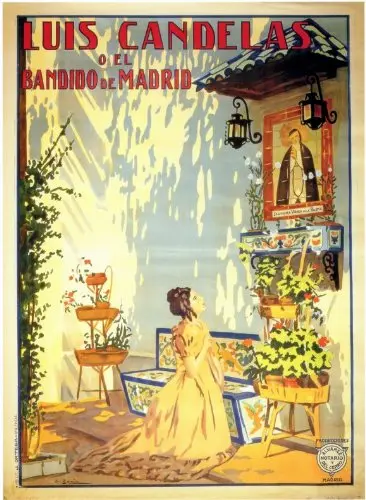
Is Luis Candelas o El bandido de Madrid a hidden gem of silent cinema? Short answer: yes, but primarily for those who appreciate the slow-burn evolution of European folk-hero narratives and the specific cultural history of Spain.
This film is for the cinematic archaeologist and the lover of Spanish folklore. It is definitely not for anyone seeking the high-octane pacing of contemporary heist movies or even the kinetic energy of late-period silent masterpieces.
1) This film works because it bridges the gap between traditional Spanish oral history and the emerging grammar of early 20th-century narrative film.
2) This film fails because its narrative structure is frequently interrupted by title cards that over-explain actions already visible on screen, stalling the visual momentum.
3) You should watch it if you want to see the genesis of the gentleman thief archetype in Spanish culture, specifically how it differs from the Anglo-Saxon Robin Hood.
Luis Candelas is a name that carries a weight in Madrid similar to Jesse James in the American West. Armand Guerra’s 1926 treatment of this figure is fascinatingly polite.
The film presents Candelas not as a desperate criminal, but as a social provocateur. He is a man who steals with a bow and a smile. It is a romanticized view that ignores the darker realities of 19th-century poverty.
In one specific scene, Candelas interacts with a group of wealthy socialites. The way Adolfo Bernáldez carries himself—stiff, yet elegant—perfectly captures the performance of class. It is a performance within a performance.
Compare this to the more visceral depictions of social struggle in Hypocrites. Where that film uses allegory to bite, Luis Candelas uses charm to soothe. It is a decidedly safe film for its era.
Armand Guerra’s direction is surprisingly static. While Hollywood was experimenting with camera movement in films like The Isle of Lost Ships, Guerra remains rooted in the theatrical tradition.
However, the location shooting—or at least the meticulously designed sets that mimic the old quarters of Madrid—provides a sense of place that is undeniable. You can almost smell the dust of the Castilian roads.
The cinematography relies heavily on wide shots. This allows the viewer to take in the elaborate costumes of Florencia Bécquer and the rest of the cast. The detail in the period attire is the film's unsung hero.
There is a sequence involving a tavern meeting that stands out. The lighting is low, creating sharp shadows that hint at the danger of the bandit life. It is the only moment where the film feels truly noir.
The acting in Luis Candelas o El bandido de Madrid is a curious mix. You have the older Bernáldez, who leans into the broad, pantomime gestures of the 19th-century stage.
Then you have Florencia Bécquer. Her performance is more restrained, using her eyes to convey the anxiety of a woman tied to a man with a price on his head.
This stylistic clash can be jarring. It makes the film feel like it’s pulling in two directions: the past and the future of cinema. It’s a transition piece, much like A Girl at Bay.
I found the chemistry between the outlaws to be the most engaging part. There is a sense of camaraderie that feels genuine, even if the script by Francisco Díaz Alonso is a bit too formal.
The pacing is the film's greatest enemy. At times, it feels as though the directors were afraid to cut away from a scene, fearing they might lose the historical accuracy of the moment.
This results in sequences that drag. A simple conversation at a gate can feel like an eternity. It lacks the rhythmic editing found in avant-garde works like Kino Pravda No. 16.
Yet, the film is technically competent for a Spanish production of the mid-20s. The print quality (depending on the restoration) often reveals a sharp eye for composition.
The use of depth is particularly notable. Guerra often places characters in the foreground and background to create a sense of scale in the narrow Madrid streets. It works. But it’s flawed.
Yes, if you view it as a cultural document. It provides a window into how Spain wanted to remember its own outlaws during the 1920s—a period of significant political tension.
If you are looking for entertainment in the modern sense, you will likely be bored. The film requires patience. It asks you to sit with its characters and appreciate the texture of the era rather than the plot.
It is an essential watch for students of Spanish film history. It captures a specific moment before the arrival of sound changed everything. It is a relic, but a polished one.
Luis Candelas o El bandido de Madrid is a fascinating, if occasionally tedious, journey into the heart of Spanish myth-making. It lacks the punch of Open Your Eyes or the mystery of The Carter Case, but it makes up for it with sheer sincerity.
The film is more interesting as a fashion icon’s biography than a revolutionary’s manifesto. Candelas is too well-dressed for a man dodging the gallows, and that’s precisely why the film is so charming.
"A polite, theatrical, and visually rich exploration of a legend that refuses to die, even if the film's pacing occasionally feels like it's stuck in the mud of the 1800s."
Ultimately, this is a movie about the power of the image. Candelas knew that his reputation was his greatest weapon, and Guerra captures that perfectly. It’s a slow burn, but for the right audience, the embers are still glowing.
IMDb —
1920
Community
Log in to comment.