DbcultAccessing Vault...
Cult Review
Senior Film Conservator
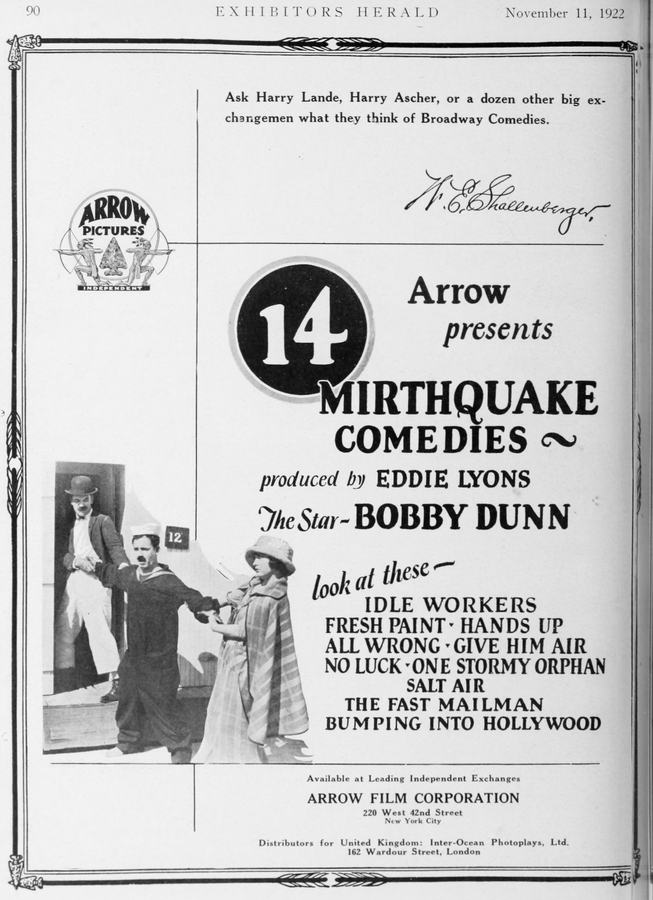
The silent era of cinema often functioned as a laboratory for the absurd, a space where the laws of physics and the whims of fate conspired against the common man with a mathematical precision. In No Luck, directed by the prolific Ralph Ceder, we witness a quintessential manifestation of this ontological dread masked as slapstick. Bobby Dunn, a performer whose physicality often bordered on the elastic, portrays a protagonist whose very existence is defined by a lack of spatial and social permanence. The film opens not with a grand gesture, but with the indignity of eviction—a narrative trope that resonates with the peripatetic anxieties of the early 20th century, much like the thematic undercurrents found in Artless Artie.
Ceder’s direction utilizes the urban landscape as a labyrinthine character in its own right. As Bobby navigates the streets, his suitcase—a vessel of his entire worldly identity—becomes the pivot point for a cosmic joke. The accidental exchange of luggage with a jewel thief is handled with a deftness that avoids the cloying sentimentality of his contemporaries. Here, the suitcase is not merely a prop; it is a malevolent anchor. When Bobby discovers the stolen gems, his reaction isn't one of avarice, but of sheer, unadulterated panic. This subversion of the 'get-rich-quick' fantasy provides a sharp contrast to the darker moral quandaries presented in films like The Phantom Carriage, where the weight of one's burden is spiritual rather than literal.
The recurring motif of the 'unwelcome return' elevates the film from simple comedy to a proto-existentialist commentary. Every attempt Bobby makes to divest himself of the jewels—flinging them onto trolleys, leaving them in the wake of speeding trucks—is thwarted by a universe that demands his complicity. The introduction of the small dog, a creature of relentless fidelity, serves as a comedic 'hound of heaven.' The dog’s persistence in returning the suitcase is both adorable and terrifying, illustrating the inescapable nature of one's 'luck.' This relentless pacing mirrors the frantic energy of Some Baby, yet Ceder anchors it in a more grounded, albeit cynical, reality.
The entrance of the female detective introduces a fascinating dynamic to the narrative. In an era where female roles were often relegated to the damsel or the vamp, as seen in the melodramatic textures of The Woman in the Web, the 'charming young lady' in No Luck is a figure of agency. Bobby’s immediate alliance with her shifts the film’s momentum from evasion to pursuit. However, the irony remains thick; even when Bobby attempts to do the right thing, the universe refuses to grant him the satisfaction of a clean victory. The reveal that the first suitcase returned to Smith and Co. contained only his old clothes is a masterstroke of bathos. It highlights the inherent worthlessness of his own life when measured against the cold, hard value of the stolen jewels.
The chase that ensues to recover the actual jewels from the dog is a sequence of pure cinematic adrenaline. Dunn’s performance here is peak physical comedy, utilizing every inch of the frame to convey a man at the end of his tether. Unlike the romanticized heroism of The Scarlet Pimpernel, Bobby’s 'heroism' is born of necessity and fear. He isn't seeking glory; he is seeking an end to the madness. The capture of the crook should, by all traditional narrative logic, be the moment of his redemption. Yet, Ceder has a more biting conclusion in mind.
The final act of No Luck is a jarring departure from the lightheartedness that preceded it, offering a critique of institutional jealousy and the arbitrary nature of the law. When the male detective arrests Bobby simply to satisfy his own ego and justify his presence on the case, the film transcends slapstick and enters the realm of social satire. It echoes the themes of wrongful incarceration and the fallibility of justice explored in In for Thirty Days. Bobby’s journey, which began with the loss of his home, ends with the loss of his freedom, all while he holds the 'success' of having caught the real criminal.
This cynical ending suggests that 'luck' is not a fluctuating currency but a fixed state of being. For Bobby, the jewels were never a blessing; they were a curse that masqueraded as opportunity. The film’s refusal to provide a 'happily ever after' is what makes it stand out in the crowded field of 1920s shorts. It possesses a bite that is often missing from the more whimsical offerings of the time, such as The Ghost of Rosy Taylor. Ceder and Dunn create a portrait of a man who is a permanent victim of circumstance, a theme that would later be explored with more gravity in No Trespassing.
Technically, the film is a testament to the efficiency of silent storytelling. The editing is crisp, ensuring that the visual gags land with maximum impact. The use of the suitcase as a recurring visual motif creates a rhythmic quality to the film, almost like a musical composition where the 'theme' (the suitcase) keeps returning in different keys. The cinematography captures the gritty reality of the streets, providing a stark backdrop for the heightened reality of the comedy. This aesthetic choice aligns the film with the more grounded works of the era, such as The Polish Dancer, which similarly used its environment to reflect the internal struggles of its characters.
Furthermore, the interaction between the human actors and the dog is choreographed with a precision that suggests hours of patient training. The dog isn't just a gimmick; he is the ultimate foil to Bobby’s desires. In many ways, the dog represents the 'good' that Bobby cannot afford to have in his life. Every time the dog brings back the suitcase, he is performing an act of loyalty that inadvertently seals Bobby’s doom. This complex interplay of intentions—the dog’s loyalty versus Bobby’s desperation—adds a layer of sophistication to the film that belies its short runtime.
To understand No Luck, one must view it through the lens of a post-war society grappling with the mechanization of daily life. The trolley, the auto truck, and the bureaucratic detective are all symbols of a world that is becoming increasingly indifferent to the individual. Bobby Dunn’s character is the 'clog in the machine,' the man who doesn't fit into the neatly packed suitcase of society. His struggle is a precursor to the more overt social critiques found in What Women Will Do or the historical anxieties of Barnaby Rudge.
While many silent comedies from this period have faded into obscurity, No Luck remains a fascinating artifact because of its tonal complexity. It refuses to be just one thing. It is a chase film, a mystery, a satire, and a tragedy all rolled into one. The sheer variety of its influences—from the slapstick of the Keystones to the more narrative-driven works like Chop Suey & Co.—makes it a rich subject for cinematic deconstruction. It doesn't shy away from the darker side of the human condition, even as it makes us laugh at a man being chased by a dog with a suitcase.
Ultimately, the film asks a poignant question: can one ever truly escape their lot in life? For Bobby, the answer is a resounding no. Even when he does everything right—captures the crook, returns the jewels, assists the law—he is still the one in handcuffs. It is a reminder that in the grand theater of life, some roles are fixed, and no amount of suitcase-swapping can change the script. This sense of predestination is a common thread in silent cinema, from the religious overtones of La crociata degli innocenti to the domestic traps of Should Brides Marry?.
In the pantheon of Bobby Dunn’s work, No Luck stands as a testament to his ability to convey profound frustration through simple gestures. His face, a roadmap of minor defeats, tells a story that words could never fully capture. Ralph Ceder’s direction ensures that every frame serves the narrative, creating a lean, mean comedy machine that still manages to punch you in the gut with its final revelation. It is a film that deserves to be remembered not just for its laughs, but for its uncompromising look at the unfairness of the world.
As we look back at this 1923 gem, we see the early blueprints of the 'loser' archetype that would become a staple of American cinema. Bobby is the spiritual ancestor of every well-meaning protagonist who finds themselves crushed by the very systems they try to uphold. Whether it's the Prohibition-era irony of The Sweet Dry and Dry or the modern-day dark comedy, the DNA of No Luck is everywhere. It is a brilliant, bitter, and beautifully executed piece of silent film history that proves, once and for all, that luck is a fickle mistress, and she usually has a suitcase full of trouble waiting for you just around the corner.
IMDb 5.4
1920
Community
Log in to comment.