DbcultAccessing Vault...
6.1/10
Senior Film Conservator
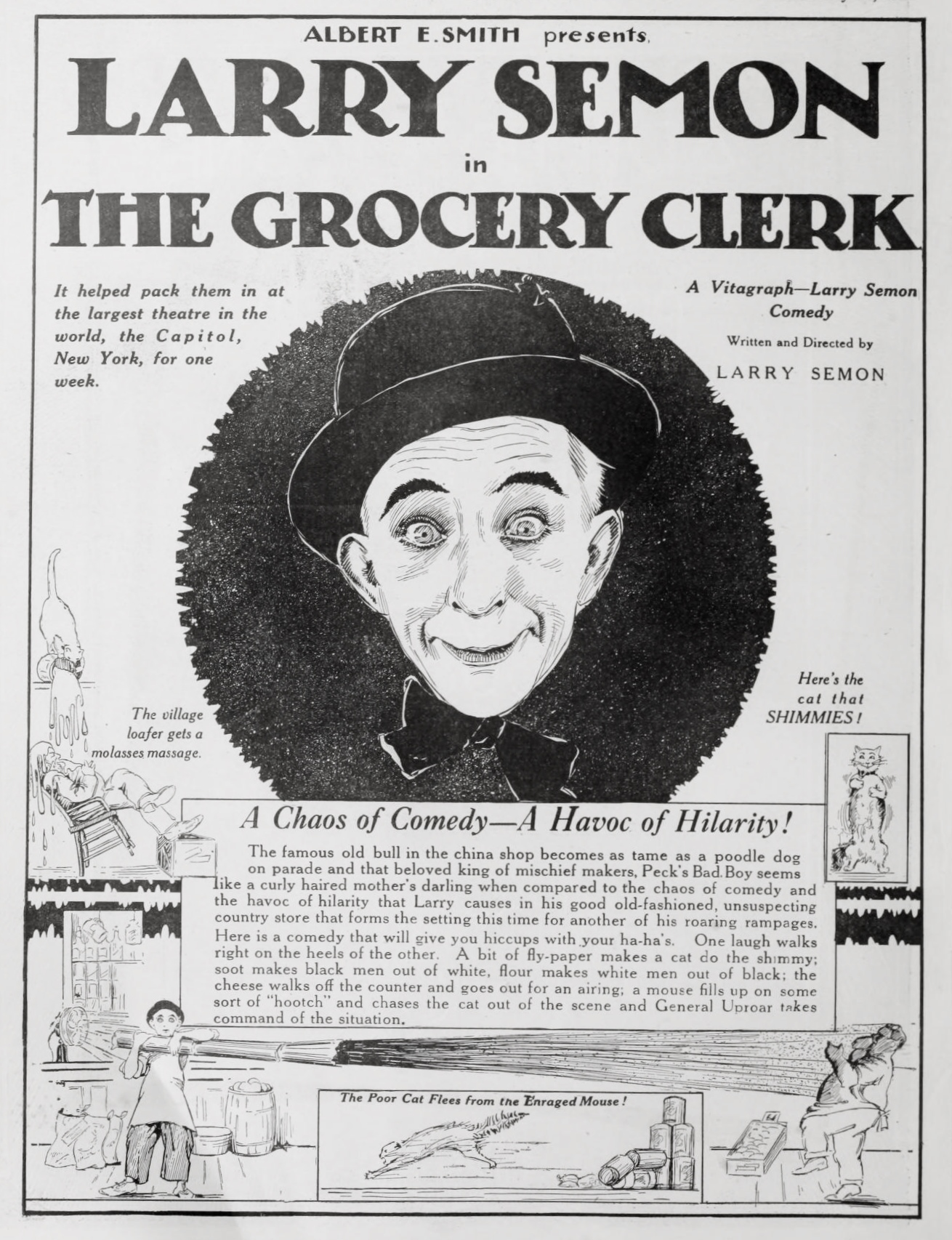
A definitive 6.1/10 rating for a film that redefined the boundaries of cult cinema. The Grocery Clerk remains a cornerstone of transgressive art.
Stepping back into the raucous, often bewildering world of early 20th-century silent cinema, one invariably encounters the distinctive, rubber-faced antics of Larry Semon. His films, a vibrant tapestry of elaborate gags, improbable stunts, and a relentless pursuit of comedic chaos, carved out a unique niche in an era teeming with legendary clowns. Among these cinematic excursions into pandemonium, The Grocery Clerk, released in 1921, stands as a quintessential example of Semon's particular genius, both as a performer and as a nascent auteur. This isn't merely a film; it's a meticulously orchestrated symphony of slapstick, a grand ballet of pratfalls and mistaken identities set against the deceptively quaint backdrop of a small American town.
The narrative, deceptively simple on its surface, quickly unravels into a complex web of romantic entanglements and nefarious schemes. At its heart is Big Ben, portrayed with a certain blustery authority, the proprietor of New Ralgia's largest and, presumably, most essential general store. This establishment, a nexus of community life, serves as the primary stage for much of the unfolding drama. Overseeing its daily operations, often with a bewildered expression that belies a deeper romantic yearning, is Big Ben's chief clerk, played, of course, by the inimitable Larry Semon himself. Semon's character, a figure of earnest if often futile endeavor, finds himself hopelessly smitten with the town's postmistress. This blossoming romance, a delicate bloom amidst the hustle and bustle of commerce and communication, forms the emotional core of the film, providing a grounding human element to the otherwise escalating absurdity.
However, the path of true love, especially in a Semon picture, is never smooth. Their courtship is continually disrupted, not just by the usual comedic mishaps inherent in a grocery store setting – spilled goods, unruly customers, the general chaos of retail – but by a far more insidious presence. Enter the town's ladies' man, a character whose superficial charm conceals a truly sinister purpose. This antagonist, a master of dissimulation, initially appears as a mere romantic rival, a suave, if slightly oily, impediment to the chief clerk's affections. Yet, as the plot thickens, his advances are revealed to be but a smokescreen for a deeper, more nefarious plot, plunging our unsuspecting trio – Big Ben, the chief clerk, and the postmistress – into a labyrinth of peril and comedic misadventure. The transition from lighthearted romantic rivalry to genuine peril is a hallmark of Semon's storytelling, often blending broad comedy with moments of surprisingly effective suspense, a tonal tightrope walk few silent comedians attempted with such regularity.
Larry Semon, credited not only as the star but also as the writer, brings his unique brand of physical comedy to the forefront. His chief clerk is a whirlwind of flailing limbs, exaggerated facial expressions, and an almost superhuman capacity for enduring pain and humiliation, only to bounce back for the next gag. Semon's style, often described as more aggressive and prop-dependent than that of his contemporaries like Chaplin or Keaton, is on full display here. He leverages the environment of the grocery store to its absolute maximum, turning sacks of flour into explosive clouds, crates into precarious platforms, and aisles into treacherous racetracks. The ingenuity of his gags, while perhaps lacking the poetic subtlety of Chaplin or the architectural precision of Keaton, possesses an undeniable, visceral energy that is uniquely Semon's own. His character's earnestness, coupled with his spectacular ineptitude, creates a delightful dichotomy that audiences found irresistible.
The supporting cast, a crucial element in any successful silent comedy, rises admirably to the occasion. Jack Duffy, William Hauber, and Pete Gordon provide robust comedic foils and collaborators in chaos, often bearing the brunt of Semon’s elaborate contraptions and explosive reactions. Lucille Carlisle, as the postmistress, embodies the gentle romantic interest, often finding herself the unwitting catalyst for much of the chief clerk's frantic heroics. Her presence provides a touch of grace amidst the widespread destruction. Monty Banks, a significant comedic talent in his own right, often seen in rival productions, here lends his particular brand of suavity to the proceedings, likely in the role of the deceptive ladies' man, though the specific character assignments can sometimes blur in the whirl of silent film production. Frank Hayes, Dorothy Vernon, Frank Alexander, and Al Thompson round out the ensemble, each contributing to the vibrant tapestry of New Ralgia's eccentric populace, their reactions and interactions often serving as crucial setup or payoff for Semon's meticulously planned mayhem.
Semon's approach to filmmaking was distinct. He was known for his large budgets, ambitious sets, and a penchant for stunts that often put his actors, and himself, in genuine peril. The Grocery Clerk showcases this ambition, with sequences that escalate in scale and danger, culminating in a grand finale that is as thrilling as it is humorous. The film's pacing is relentless, a rapid-fire succession of gags that leaves little room for contemplation, instead demanding a constant engagement with the visual spectacle unfolding onscreen. This kinetic energy is a defining characteristic of Semon’s work, distinguishing it from the more character-driven narratives of his peers. While some critics of the time occasionally found his films a bit too chaotic, lacking the emotional resonance of a Chaplin tramp or the stoic resilience of a Keaton, there’s no denying the sheer inventiveness and technical prowess behind Semon’s meticulously constructed comedic set pieces.
The film's exploration of small-town life, while primarily a backdrop for comedic antics, offers a fascinating glimpse into early 20th-century Americana. The general store itself, a hub of community gossip and commerce, reflects a bygone era where local businesses were the lifeblood of rural and semi-rural towns. The interactions between customers, the postmistress, and the store staff paint a vivid, if caricatured, picture of social dynamics. Even the villain's motivations, often rooted in greed or illicit gain, speak to the undercurrents of ambition and moral ambiguity that existed beneath the veneer of small-town quaintness. Semon, through his exaggerated lens, captures not just the humor but also the subtle anxieties of a society in transition, where old traditions met new challenges.

Comparing The Grocery Clerk to other films of its era highlights its unique position. While some silent films, like The Carpet from Bagdad, might have explored exotic locales and grand adventures, Semon grounded his spectacle in the everyday, albeit an everyday that quickly spiraled into the extraordinary. Unlike the dramatic intensity of a film such as Wenn das Herz in Haß erglüht, which delved into profound emotional conflicts, Semon's conflicts were primarily physical, externalized through elaborate, often destructive, gags. His work shares a certain anarchic spirit with earlier, more primitive chase films, but elevates it with a level of production value and narrative complexity that was increasingly common in the 1920s. One might even draw a parallel to the intricate Rube Goldberg-esque contraptions seen in some of his contemporaries' work, though Semon often favored human-powered chaos over mechanical precision.
The influence of Semon's directorial choices, especially in his self-written vehicles, is palpable. He understood the visual language of silent comedy inherently, employing dynamic camera angles, rapid cutting, and a keen eye for physical comedy that maximized the impact of every pratfall and explosion. His films were designed for maximum audience engagement, eliciting gasps and guffaws in equal measure. While the critical re-evaluation of silent comedians often places Chaplin, Keaton, and Lloyd at the pinnacle, Semon's contribution, particularly in the realm of large-scale, stunt-heavy comedy, is undeniable. His films were immensely popular in their day, and watching The Grocery Clerk, it's easy to see why. The sheer energy and inventiveness are infectious.
In terms of thematic depth, while not overtly philosophical like some later dramas such as Satan's Rhapsody, The Grocery Clerk still touches upon universal human experiences: the awkwardness of young love, the struggle against villainy, and the inherent absurdity of everyday life. The chief clerk's relentless pursuit of his beloved, despite constant setbacks and dangers, is a testament to the enduring power of romantic aspiration, albeit filtered through a comedic lens. The film, in its own boisterous way, celebrates resilience and the triumph of good over evil, even if that triumph involves a good deal of accidental destruction and a few bruised egos.
The visual aesthetic of The Grocery Clerk, typical of its era, relies on clear, often brightly lit sets and expressive performances. The use of intertitles, while functional, is subservient to the physical action, allowing the performers' pantomime and Semon's elaborate gags to tell the story. The costumes and set designs are period-appropriate, grounding the fantastical stunts in a recognizable reality. One can imagine the bustling atmosphere of the store, the clatter of goods, the murmur of customers, all conveyed through the dynamic visual storytelling. The film's enduring appeal lies precisely in this ability to transport the viewer to a simpler yet more frenetic time, where a chase through a grocery store could become an epic adventure.
Reflecting on the legacy of films like The Grocery Clerk, one realizes their immense importance not just as entertainment, but as historical documents. They capture the comedic sensibilities of an age, the technological limitations and innovations of early cinema, and the societal norms of the time. While perhaps not as widely known today as some of its more celebrated contemporaries, Semon's work, particularly this film, deserves renewed attention for its sheer audaciousness and its unwavering commitment to delivering pure, unadulterated hilarity. It’s a testament to a comedian who, like a mad scientist of laughter, constantly pushed the boundaries of what was possible in a silent film. Much like a hidden gem, perhaps not as prominently displayed as a grand jewel, but possessing an undeniable sparkle for those willing to seek it out.
Ultimately, The Grocery Clerk is more than just a series of gags; it's a meticulously crafted comedic experience, a testament to Larry Semon's singular vision as a multi-hyphenate talent. It showcases his remarkable ability to blend broad physical comedy with a surprisingly intricate plot, all while maintaining a breakneck pace. For anyone interested in the foundational elements of screen comedy, the evolution of silent film, or simply in enjoying a truly wild ride of laughter and mayhem, this film remains an essential viewing. It’s a vibrant, often explosive, reminder of an era when cinematic storytelling was still finding its voice, but already knew how to make an audience roar with laughter. Its energy is contagious, its gags timeless, and its place in the annals of silent comedy, while perhaps less gilded than some, is nonetheless firmly cemented by its sheer, unadulterated entertainment value.
Essential Viewing for Silent Comedy Aficionados
Do yourself a favor and seek out this riotous piece of cinematic history. It's a joyful, chaotic journey into the mind of one of silent film's most inventive, if sometimes overlooked, comedic architects. And while it doesn't delve into the supernatural like The Ghost of Old Morro, or the dramatic depths of Sins of Her Parent, its unique brand of domestic pandemonium is a spectacle all its own. The film serves as an excellent benchmark for understanding the range and diversity present in early 20th-century cinema, showing that even within the confines of a small-town grocery store, grand narratives of humor and peril could unfold. Its intricate design of escalating gags and character-driven chaos truly sets it apart, confirming Semon's lasting legacy in the realm of the absurd and the uproarious.
IMDb —
1926
Community
Log in to comment.