DbcultAccessing Vault...
Cult Review
Senior Film Conservator
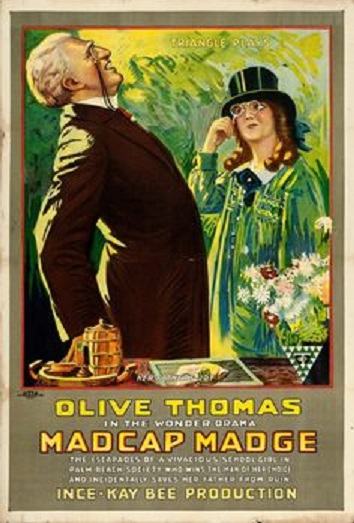
A nitrate fever-dream unearthed from 1919, Madcap Madge pirouettes along the cliff-edge where farce and social crucifixion kiss. Olive Thomas, all spitfire pupils and velocious ankles, incarnates the id that every corseted flapper of the post-Great-War moment secretly wished to unleash.
Picture the standard-issue society comedy: chandeliers, dowager gasbags, marriage as leveraged buyout. Now detonate it with a heroine who treats etiquette like taffy—stretch, snap, chew. Director Robert Z. Leonard, working from R. Cecil Smith’s scenario, refuses to let the camera simper; instead he sends it rampaging after Madge as though the celluloid itself were late for a riotous assignation.
The plot’s hinge—an American creditor masquerading as British peer—feels less like contrivance than prophecy: a nation poised to repossess the very Old-World titles its dollars fetishize.
Jack Livingston’s faux-earl exudes the bland, sun-cream handsomeness of a yachtsman in a cigarette ad, yet the performance crackles with capitalist menace; every time he smiles, IOUs flutter like moths. Opposite him, Olive Thomas operates at a faster metabolic rate than the film itself, her darting glances compiling a manifesto of mischief. Watch her in the moonlit palm grove: she lifts her childish pinafore as though testing the tensile strength of the social fabric, then vaults over the stone balustrade—an image that, once seen, brands the retina.
The supporting ensemble supplies a grotesque frieze. Aggie Herring’s matriarch wields a lorgnette like a saber; J. Frank Burke’s bankrupt banker sweats through his wing collar until the celluloid seems to mildew. Julia, essayed by Dorcas Matthews, is a study in petrified aspiration—every eyelash calibrated to snag a coronet, her spine so rigid you could level a picture frame with it.
Shot on the frosted fringes of Palm Beach—verandas, breakers, and one surreal sequence in a miniature coconut-grove—Madcap Madge brandishes location like a character. The tinting strategy flirts with synesthetic delirium: amber parlors, aquamarine seascapes, and a fuchsia ballroom that throbs like a migraine. When Madge commandeers a children’s donkey cart during the charity fête, the image burns onto the negative in crimson, as though the film itself were blushing at its own gall.
Leonard’s blocking is proto-screwball: deep-focus tableaux stuffed with peripheral gags—footmen pilfering canapés, an ostrich-plume deflating mid-waltz—while the foreground barrels forward. Intertitles, penned with Wildean snap (“A title is like a tattoo—indelible, regrettable, and usually acquired while drunk”), pop in yellow tint, momentarily turning the screen into a silent-era meme.
Under the bouffant buffoonery lurks a trenchant audit of post-war liquidity. Mr. Flower’s IOUs circulate like erotic currency; daughters are bundled securities. Madge’s rebellion is not mere tomfoolery—it is a hostile takeover executed with whoopee-cushion artillery. Her forced regression to childhood (Julia’s insistence on sailor suits and sausage curls) literalizes the era’s infantilization of women, yet Madge weaponizes the masquerade: she eavesdrops, pickpockets, and finally commandeers the marital escape pod.
Scholars often trace the DNA of 1930s screwball back to It Happened One Night, but the chromosomes are visible here—particularly the trope of the heiress on the lam who inadvertently redistributes wealth while chasing orgasmic autonomy.
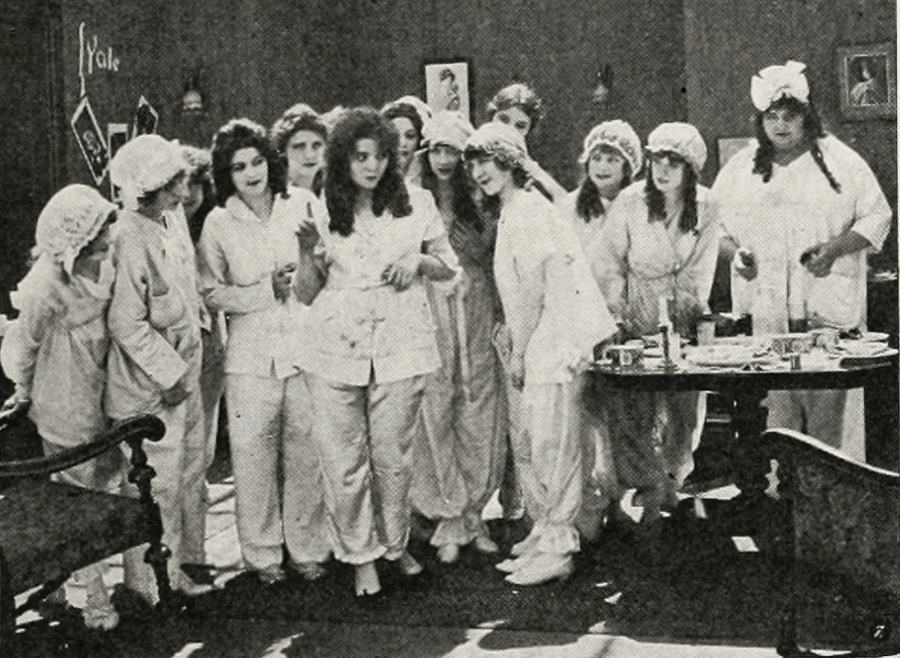
Compare the film to contemporaneous morality tales like Where Are My Children? or The Martyrdom of Philip Strong, and you’ll find Madcap Madge gleefully vaulting over the cautionary rubble. Its heiress does not perish of syphilis or penitence; she absconds with solvency and libido intact.
Olive Thomas—tragically dead within a year of this release—possesses the kinetic charisma of a firecracker fused to a thought. Her gestures operate on split-second timing: a nose-wrinkle that preludes a prank, a half-second pause before she vaults into a hedge. It is impossible to watch her without sensing the historical ache of potential never realized.
Jack Livingston, saddled with the straight-man arc, nevertheless threads menace through his toothpaste grin. In the climactic exposure scene—set aboard a moving trolley car—his voiceless confession vibrates through clenched jaw and white-knuckled grip on the overhead strap; you can almost hear the rustle of mortgage parchment.
Among the matrons, Gertrude Claire’s dowager Countess of Larsdale (a glorified cameo) steals a frame or two simply by lowering her eyelids with the solemnity of a hanging judge.
Rewatching Madcap Madge after the 2008 implosion feels like peering into a fun-house mirror. The Flowers’ speculative bubble—built on derivatives of daughters and dowries—rhymes with collateralized marriage obligations. When Madge’s elopement retroactively revalues the family’s debt, the film stages a proto-bailout executed by libido rather by lobbyists.
What is Madge if not the original too-big-to-fail brat, whose reckless merger saves the systemic whole?
A 4K restoration by the EYE Filmmuseum premiered at Il Cinema Ritrovato, revealing textures previously mummified in mildew: the lamé flecks in Madge’s drop-waist gown, the coral glint in Palm Beach sand. The tinting schema was reconstructed via photochemical analysis rather than digital guesswork, so the fuchsia ballroom now glows with authentic arsenic sweetness. Streaming rights are fractured, but the film can be rented on Classix and occasionally screens on TCM Silent Sundays.
Madcap Madge is more than a curio; it is a kinetic manifesto smuggled inside a matrimonial romp. It skewers the ruling class with a hatpin disguised as a feather. It forecasts the liquidity crisis. It gives us Olive Thomas mid-cartwheel, suspended between frame and mortality. Watch it for the gags, rewatch it for the shudder of historical vertigo, then watch it once more to remember that rebellion, like champagne, is best served effervescent and ice-cold.
Verdict: 9/10 — a nitrate champagne flute brimming with subversive bubbles.
IMDb —
1925
Community
Log in to comment.