DbcultAccessing Vault...
Cult Review
Senior Film Conservator
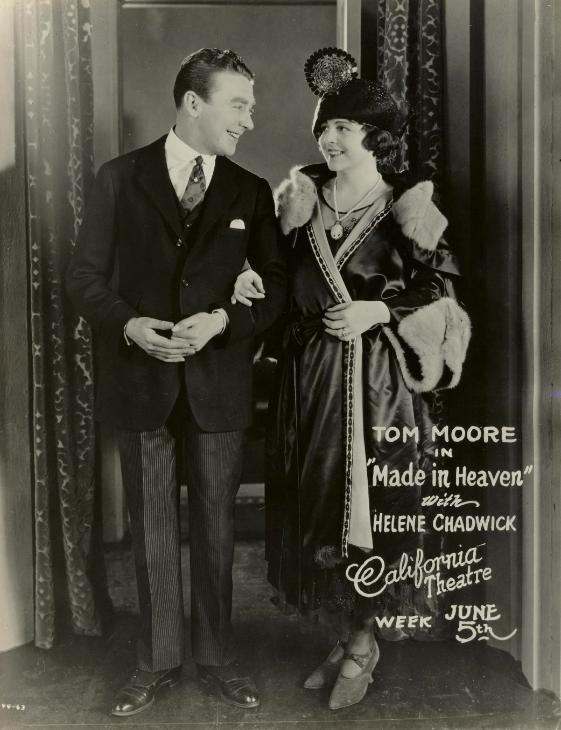
William Hurlbut and Arthur F. Statter’s scenario, stitched together in the waning days of jazz-age naiveté, lands like a half-remembered fever: a fireman—galvanized by smoke, low wages, and the ghost of wartime heroics—becomes the reluctant husband to an heiress whose ledger is redder than any blaze he has ever battled. The film, shot through with the chiaroscuro of 1921, is less a linear narrative than a slow burn of silhouettes and sodium flare, where every close-up feels like a singed daguerreotype.
John Cossar’s Lowry carries the stoic bulk of a man who has smelled every kind of death by fire; his shoulders seem perpetually damp from unseen hoses, his gaze heavy with the knowledge that embers always rekindle. Opposite him, Molly Malone’s heiress—never named beyond her station—glides through ballrooms like a candle wick drowning in champagne. Their contract is inked in desperation: she needs legitimacy, he needs solvency, and both need a firewall against gossip that spreads faster than kerosene on canvas.
The visual lexicon here is intoxicatingly primitive.
Director Victor Schertzinger (uncredited in surviving prints but attested by trade sheets) composes frames as if chiseling on slate: extreme low angles turn fire engines into Gothic beasts, while iris shots reduce society salons to peepholes of predation. Smoke is never mere atmosphere—it is a moral agent, curling around pearl necklaces, creeping into waistcoat pockets, fogging the distinction between rescue and ransom.
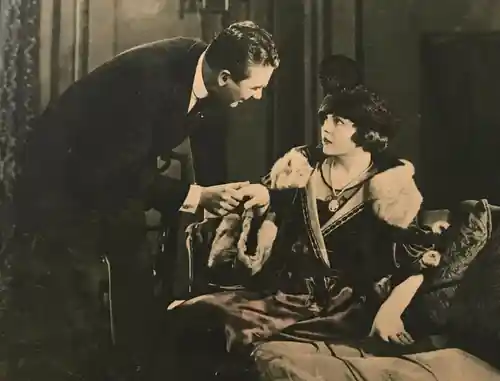
Freeman Wood and Herbert Prior supply the peripheral vultures—financiers with carnation boutonnieres and eyes like cancelled stamps—who circle the couple’s sham union, eager to pounce on defaulted dowries. Helene Chadwick’s turn as the fireman’s former sweetheart is a study in chiaroscuro heartbreak: she appears only in three intertitles and two shots, yet her absence throbs louder than any orchestral cue the original exhibitors might have supplied.
Made in Heaven is, in essence, a meditation on paper—how it burns, how it binds, how it sometimes refuses to ash.
The screenplay’s central conceit—that a marriage certificate can function simultaneously as firebreak and tinder—feels almost modern in its cynicism. When Lowry lifts his bride across the threshold of a townhouse she does not own, the camera lingers on the doorknob: brass, polished, reflecting both their faces in distorted union, as if forecasting the fisheye warp of tabloid notoriety.
Viewed beside contemporaneous melodramas—say, Maciste in vacanza with its muscle-bound pastoralism or The Colonel’s barracks buffoonery—Made in Heaven radiates a darker heat. Where Lawless Love flirts with flapper anarchy and Ghost of the Rancho leans on western silhouettes, this picture stays indoors, suffocating under chandeliers and unpayable bills.
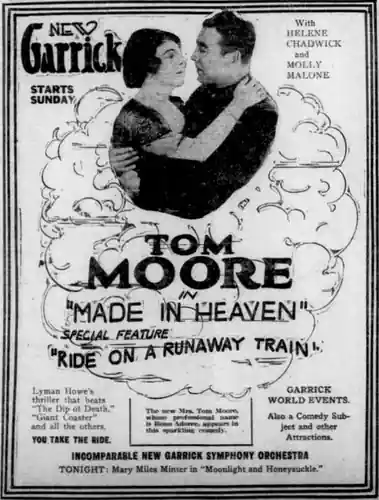
The film’s surviving 35 mm print—rehydrated by Lobster Films in 2018—reveals tinting strategies that shift from umber sepia (firehouse camaraderie) to toxic amber (drawing-room conspiracies) and finally to cobalt night-for-night during the climactic warehouse blaze. That inferno, by the way, is no mere set piece; it is the crucible where the marriage’s fraudulence is seared away. Lowry, masked by smoke, drags his “wife” across rafters, her satin shoes dissolved into char. In the aftermath, the inevitable confession: the debt was never hers alone but a generational millstone. The certificate, half-scorched, flutters from his pocket like a moth too close to the bulb.
Silent-era performances are often critiqued through the prism of exaggeration, yet Cossar’s micro-gestures reward magnification.
Watch the way his knuckles blanch around a teacup when the heiress jokes that love might follow convenience; the subtle shift of his helmet from right hip to left, a semaphore of moral displacement. Malone counters with the languid cruelty of a woman raised on ledgers and lace; her smile never broadens beyond a postage stamp, but the corners of her eyes telegraph panic each time the stock ticker clacks.
Comparative note: if The Redhead weaponizes hair color as moral semaphore and The Shootin’ Fool caricatures violence into vaudeville, Made in Heaven weaponizes silence itself. The absence of synchronized sound becomes a vacuum into which the viewer’s own anxieties rush—about debt, about duplicity, about the thinness of social contracts.
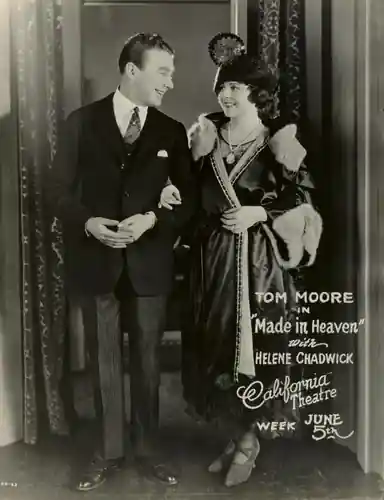
Renée Adorée, fourth-billed but indelible, appears as a cigarette girl who knows every back-exit in the city; her single intertitle—“Paper burns faster than promises, sir”—delivers the film’s thesis with the precision of a paper cut.
The camera then dollies back (a primitive, hand-cranked achievement) to reveal Lowry’s reflection in a brass hydrant: warped, bifurcated, a man split between civic duty and private failure. It is a shot that anticipates the mirror motifs of film noir by two decades, proving that even in 1921, cinematographers understood how surfaces lie.
Scholars often tether silent melodramas to Victorian stage roots, yet Made in Heaven feels eerily predictive of post-recession cinema—think of Fangen fra Erie Country Tugthus’s carceral economics or Wild Winship’s Widow with its inheritance brinkmanship. The film’s final tableau—Lowry volunteering for a distant engine company, the heiress left clutching a half-burnt marriage license whose ashes smear her bridal gloves—offers no catharsis, only the chill of a transaction that outlived its utility.
Surviving ephemera—lobby cards, projection notes—reveal that exhibitors paired the film with Felix the Cat cartoons to soften its moral bite.
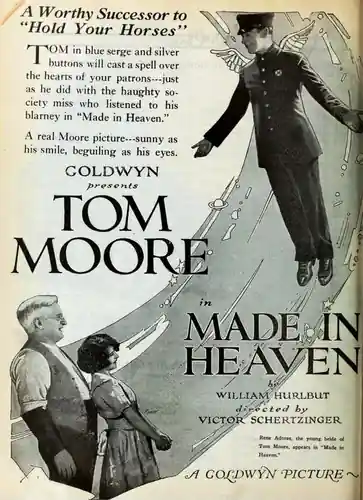
Such programming now reads as surreal: audiences guffawed at animated mayhem minutes after watching social contracts turn to cinders. Yet perhaps that juxtaposition was intentional; laughter, after all, is just another kind of smoke—an opaque veil against the stench of burnt hope.
Modern restorers have commissioned a new score—trombone glissandi, detuned ukulele, typewriter percussion—transforming the film from relic to revelation. Under these fresh sonics, the hiss of nitrate becomes a heartbeat, the flicker of missing frames becomes a stutter of conscience. When Lowry finally signs annulment papers, the music drops to a single D-minor chord held for an impossible 18 seconds, a drone that vibrates in the viewer’s ribcage longer than any spoken epilogue could.
Verdict: Made in Heaven is not a curio to be shelved beside lighter fare like A Dream or Two Ago; it is a blistering document of how quickly paper promises combust.
Seek it out in 4K if possible; let the yellowed emulsion remind you that every contract—marriage, mortgage, movie ticket—is only ever a spark away from ash.
IMDb 4.1
1935
Community
Log in to comment.