DbcultAccessing Vault...
Cult Review
Senior Film Conservator
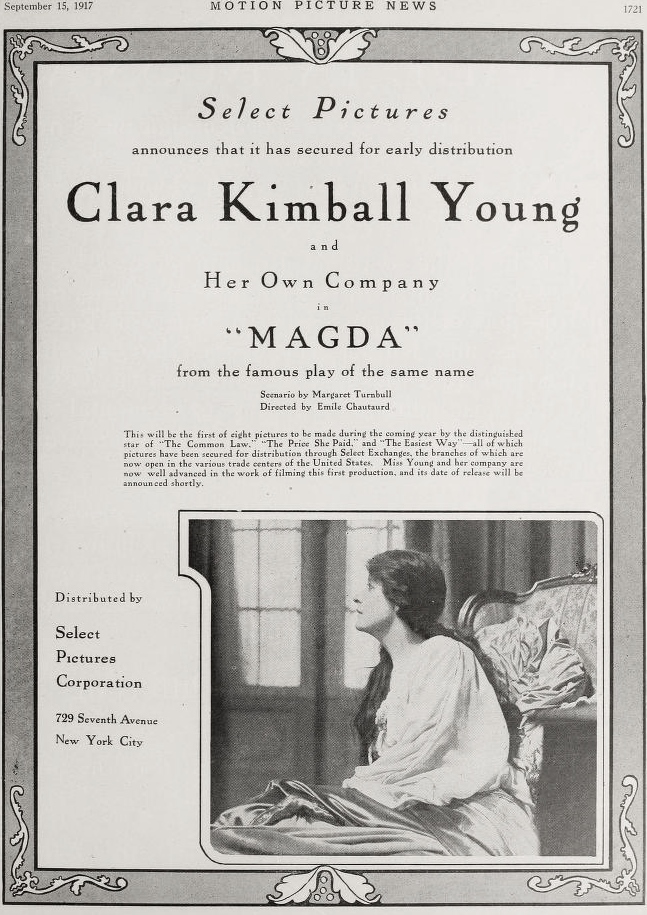
You feel the village before you see it: a bruise of steeples and manure-smudged snow where every shuttered window blinks like a reprimand.
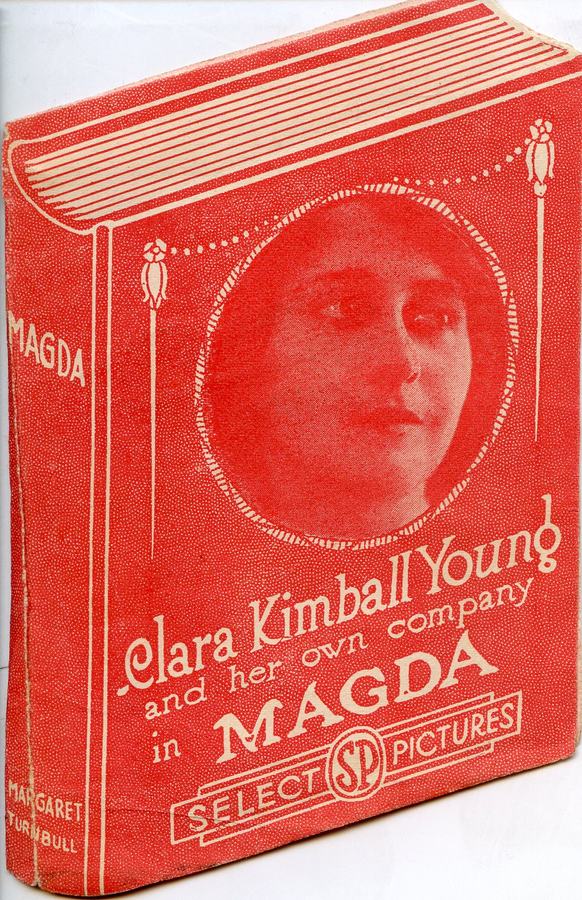
Into this choke-hold of piety saunters Magda—hair unplaited, gaze already halfway to Vienna—her soprano bursting out of corseted seams like a bird that refuses to be stuffed back into the theological cage. The film, shot in the bruised twilight of 1917 while Europe chewed its own limbs in war, distills every provincial crucifixion of womanhood into flickering nitrate. Hermann Sudermann’s play Heimat—once a thunderclap on German stages—here becomes a ghost that Clara Kimball Young wears like second skin. She is all contradictions: shoulder blades sharp as exclamation points, mouth soft as repentance, yet each close-up insists she might laugh, spit, or sing the wallpaper off the set.
Director Edward Fielding (doubling as Magda’s estranged sire) never tilts the camera; instead he tilts the world—furniture skewed, candlefire trembling—so that when Magda is expelled, the threshold itself seems to exhale sulfur. Note the cut: one moment the parlour door slams, next moment a locomotive lunges across the frame, its pistons hammering in the same rhythm as her pulse. Cinematic grammar, 1917 vintage, distilled to locomotion-as-liberation, yet the irony scalds: every ticket away is also a ticket toward new predators.
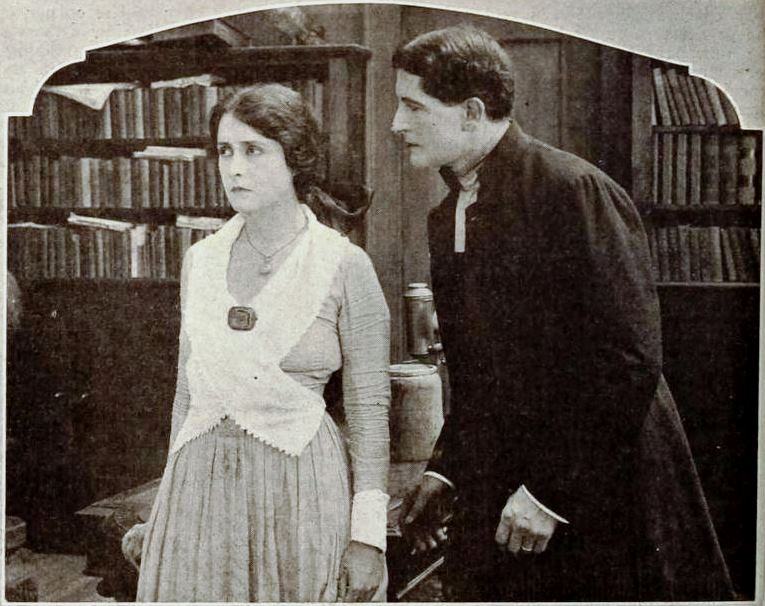
The metropolis—nameless, boundless—arrives in electric shards. Intertitles shrink, letters jitter like Morse code on cocaine. Magda’s first lodging is a garret whose wallpaper peels in the shape of her father’s scowl; her second is Kellner’s embrace. Thomas Holding plays the cad with patent-leather charisma: part poet, part pimp, all circumference and no centre. Their wedding is staged in a tenement hallway, a handheld mirror doubling the priest, so when the camera reveals the mirror empty we understand the marriage’s ontological status: reflection without referent. Margaret Turnbull’s scenario, razor-thin yet diamond-hard, wastes no ink on moralising; it simply lets the void yawn.
Cue pregnancy—shot through a prism of superimpositions: Magda on stage, belly swelling like a crescendo impossible to sustain; Kellner’s silhouette dissolving into coins that clink, clink, then evaporate. The child arrives, but the husband has already ghosted, leaving only a pawn ticket tucked inside a bouquet of wilted violets. Note how the infant’s cry is never heard; we see only Magda’s mouth forming an O while the orchestra in the pit provides a muted trumpet, turning maternity into a silent scream. The film here edges toward horror: woman-as-commodity stripped so bare that even her womb becomes a tradable asset.
Salvation wears a monocle and a hearing trumpet: Edward Kimball as the aged singing master, Herr Vering. In the universe of An Innocent Magdalene salvation comes cloaked in religiosity, but in Magda it is aesthetics that redeems. Vering discovers his former pupil busking under a gas-lamp, her voice frayed but the timbre—that celestial core—still molten. Close-up on his ear: the auricle quivers like a divining rod. Match-cut to Magda’s throat, beads of sooty sweat sparkling. The edit whispers: talent is a fossil fuel, waiting to be re-ignited by the spark of witness.
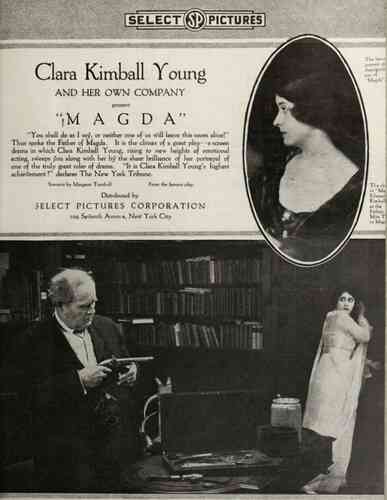
Montage obeys musical logic: rehearsal rooms dissolving into concert halls, pawn tickets fluttering into bouquets now fresh. Yet the film refuses montage-as-panacea. Magda’s return to the footlights is shot in a single, merciless take: she strides toward the camera, curtain rising behind her, but the lens dollies back at equal speed so the distance between desire and fulfilment remains constant. Stardom—like Kellner’s love—keeps receding at the rate you approach it.
Fame magnetises the detritus of yesterday. First comes the father, still draped in pastoral black, clutching a Bible swollen with brimstone. Their confrontation occurs in a drawing room so cavernous their silhouettes graze opposite walls. Dialogue is spare; instead, shadows duel on the wainscot. He demands repentance in exchange for paternal benediction. Magda’s reply—an aria transposed into silence—lifts her chin by a mere inch, but that inch is Everest. The camera cuts to her hands: she snaps a pearl necklace, beads scattering like miniature planets off their orbit. Patriarchal authority, once a solar system, now reduced to marbles underfoot.
Enter Kellner again, this time with the law in one pocket and blackmail in the other. The film’s tonal hinge creaks toward noir: letters slid under doors, signatures forged, the child held economic hostage. Watch how Holding lets his urbane mask slip—lips twitch leftward, a tic that suggests he’s tasting his own venom. The suspense sequence borrows from The Perils of Pauline but inverts gender: the imperilled star is no longer plucky ingénue but compromised diva, her peril internalised as custodial dread.
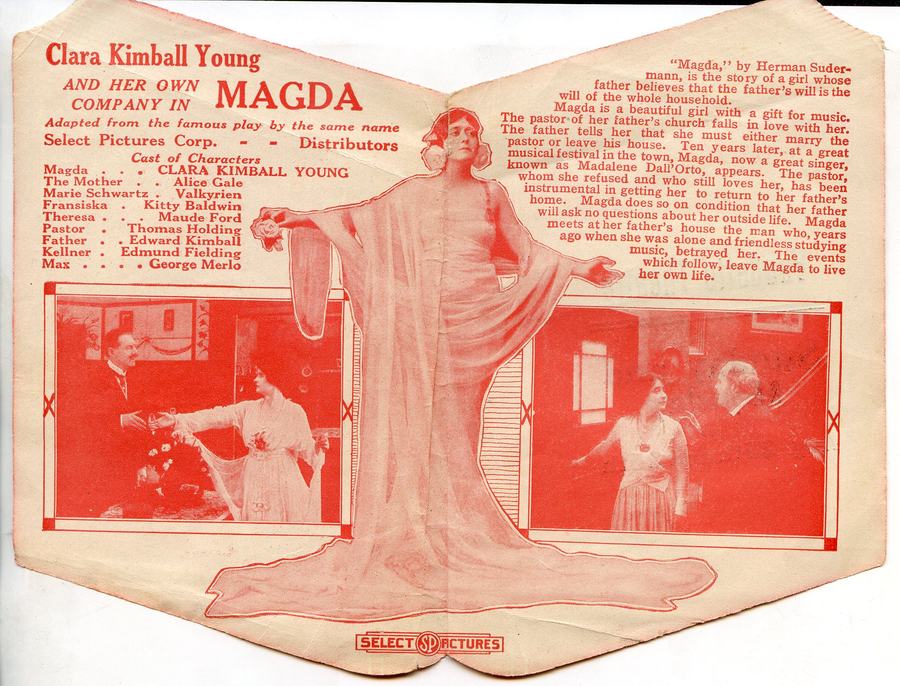
Tinting in silent exhibition was never mere ornament; it was emotional notation. The surviving prints of Magda favour three washes:
The eye learns to read chromatic emotional chords: when amber intrudes into cyan scenes (Kellner’s reappearance at the opera house), the viewer’s stomach contracts—shame has trespassed into art.
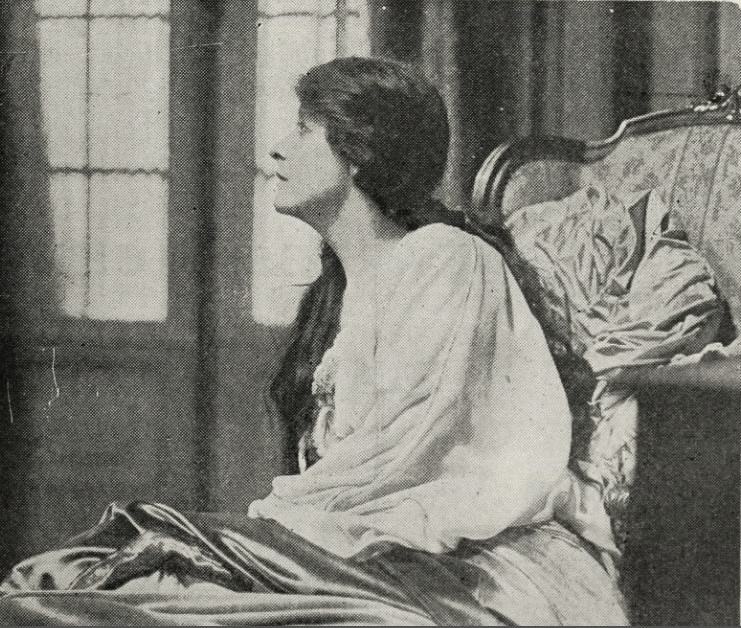
Modern viewers, spoiled on method excess, may need to recalibrate to silent-era minimalism. Young’s instrument is eyebrows and clavicles. Observe the moment she realises the marriage is void: pupils dilate exactly two millimetres, throat flexes, then her gloved hand crushes the bouquet so slowly that sap seeps onto satin. No tears—just a single spasm of the nostril. The restraint inflates the pathos; we supply the interior monologue, becoming co-authors of her anguish.
Supporting cast orbit like moons of varying albedo. Kitty Baldwin as the rival soprano delivers a masterstroke of pettiness: during Magda’s comeback performance she powders her nose in the wings, each puff a tiny mushroom cloud of envy. Maude George’s brothel madam—trimmed with ostrich feathers and moral ambiguity—could stroll into A Woman’s Triumph without changing wardrobe, suggesting a cinematic universe of scarlet women prefiguring today’s anti-heroines.
Place Magda beside The Return of Eve and you detect a subgenre: the femme-fugue—woman flees hearth, is flayed by urban blades, yet re-stitches herself into new skin. Sudermann’s source Heimat ends with Magda victorious but childless; the film, bowing to censorship, keeps the child alive, thereby trading nihilism for moral compromise. The result is less Greek, more Judeo-Christian: suffering earns survival, not absolution.
Contrast with Ireland, a Nation where exile is political, not sexual; or Marrying Money where marriage is cynically transactional. Magda occupies a liminal wavelength: marriage is both con and sacrament, city both boudoir and abattoir.
Cinematographer George Merlo employs mirrors the way later noir will employ Venetian blinds. In the seamy dance-hall number, Magda’s reflection multiplies into infinity, each iteration slightly more fractured, suggesting identity as kaleidoscope. Sets by Alice Gale flirt with German expressionism: doorframes lean inward, as though breathing. Yet the exteriors—shot on location in Fort Lee, New Jersey—retain a documentary grit: trolley cars, laundry lines, actual soot. The tension between stylised interior and verité exterior externalises Magda’s split psyche.
Archival notes reveal the 1917 release shipped with a cue sheet favouring Hearts and Flowers for the abandonment scene—an 1893 weeper now hopelessly maudlin. A contemporary restoration (if some philanthropist would fund) might juxtapose Hildegard of Bingen against prepared piano: medieval female mysticism colliding with modernist dissonance, mirroring Magda’s anachronistic rebellion.
Magda’s predicament—single mother, wage gap, predatory masculinity—reads like today’s Twitter feed. Yet the film refuses to package her as hashtag icon. Her victories are partial, her complicity real (she signs the initial duplicity by eloping). In an era when U.S. women would wait three more years for suffrage, the film’s refusal to sanctify its heroine feels almost punk-rock.
Opening at New York’s Strand Theatre in October 1917, Magda earned $46,000 in its first week—sterling for a non-war picture. Critics praised Young’s “electric suffering” (Variety) while moral councils clutched pearls over the bastard-child subplot. In Minneapolis the film was retitled Homeless to dodge Teutonic associations; Sudermann’s surname alone was deemed unpatriotic. By 1921 only 17 prints survived the distribution grinder, most exported to South America where censorship was laxer. Today, one partial 35mm and a 9.5mm Pathescope reside at MoMA, awaiting the kindness of archivists.
Garbo’s Anna Christie borrows Magda’s waterfront vulnerability; Crawford’s Mildred Pierce lifts the mother-as-entrepreneur arc. Even Agnès Varda’s Vagabond ends on a structurally similar freeze-frame of uncertain survival. Young’s performance is the missing link between 19th-century theatrical pathos and 20th-century cinematic naturalism.
Great art is not a mirror but a blade. Magda slices open the perennial wound: how does a woman own her gift when every corridor—domestic, economic, legal—conspires to own her? The film answers ambivalently: applause is currency, maternity is leverage, but neither guarantees sovereignty. That the blade is forged in 1917 only sharpens its edge; we have not healed the wound, merely accessorised it.
Watch Magda for Clara Kimball Young’s face—an epic etched in half-light. Watch it for the city’s predatory glamour, for the way tinting makes emotion legible, for the shiver when you realise how little has changed. But do not watch it for comfort; comfort here is as counterfeit as Kellner’s vows. What remains is a voice lifted against night—a fermata that defies resolution, a woman demanding the next impossible note.
Verdict: 9.3/10—A rediscovered tinderbox of proto-feminist melodrama, as incendiary now as the day it was forged.

IMDb —
1934
Community
Log in to comment.