DbcultAccessing Vault...
Cult Review
Senior Film Conservator
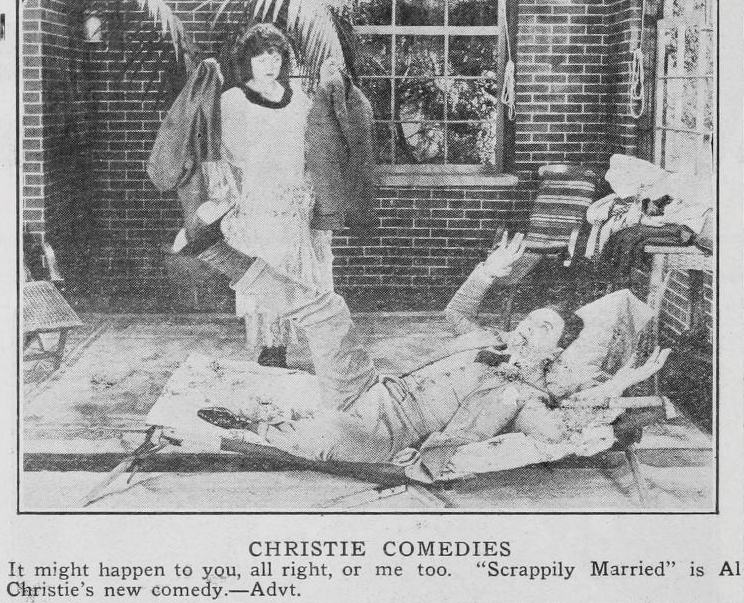
The first miracle of Scrappily Married is tonal: it arrives as a brittle marital farce and departs as a jazz-age fugue on identity, a twenty-minute sleight-of-hand that makes the bourgeois parlour feel like a speakeasy where every lamp casts two shadows. Viewed today, the film crackles like a carbon arc—sharp, brief, incandescent—leaving scorch-marks on the retina of anyone who assumes silent comedy peaked with Keaton’s stone-face or Lloyd’s skyscraper dangle.
Harry Gribbon, pulling double duty as scribe and beleaguered hubby, weaponizes his own rubber-kneed physique. He enters frame hunched against an imaginary storm, umbrella clutched like a shield, eyes swivelling as though the wallpaper might sprout talons. The gag is not simply that he fears his mother-in-law; he fears the very chromosome that might connect them. Gribbon’s script distills this dread into pure kinetic neurosis—every doorknob becomes a potential garrote, every footstep the rumble of a matriarchal Panzer division.
Enter Margaret Cullington’s burglar: a flapper phantom in a cloche hat tilted at the angle of a question mark. She doesn’t steal; she liberates. Jewellery slips into her pockets as though the pearls yearn for a more adventurous clavicle. Cullington plays the role like a woman who has read all the rules and eaten the paper they were printed on. Her smile, caught in a sliver of iris-in close-up, is both promise and threat—an expression that would not look out of place on a young Dietrich, if Dietrich had ever tangoed through someone’s pantry in a silk chemise.
What follows is a masterclass in spatial comedy. The living-room set, no larger than a postage stamp, is re-zoned into quadrants of escalating impropriety: the husband offers cocktails he doesn’t know how to mix, the burglar dances barefoot on an ottoman, a Victrola crank becomes a phallic prop. Each new object—an afghan, a cigarette case, a framed photo of the wife’s church group—becomes a lit fuse. Gribbon’s blocking is so precise that when the real wife (Lois Leslie, all fluting indignation) finally bursts in, the room looks like a crime scene painted by Matisse.
Leslie, armed with the angular gait of a marionette whose strings have been yanked heavenward, is the film’s secret weapon. Where the burglar glides, the wife stabs the parquet with stiletto heels, her voiceless shrieks rendered in intertitles that detonate like shrapnel: “So this is your business meeting, is it?” The line arrives beneath a two-shot that frames both women—wife and impostor—like rival suns in a binary star system, the husband a hapless planet wobbling between gravitational pulls.
Helen Darling’s mother-in-law, when she finally trundles through the door, is a gorgon in gabardine, a woman whose hatpin could defuse a bomb. Darling underplays magnificently; she simply stands, allowing the silence to pool around her like quicksand. The comedy tilts from bedroom farce to absurdi-gothic: the mother-in-law becomes the embodiment of every ancestral judgment the husband has ever hallucinated, yet she has arrived too late to be anything but a coda. Gribbon’s coup de grâce is to turn her into the deus ex machina of her own exit—framed for larceny she never committed, escorted out by a cop whose badge appears with the convenient timing of a vaudeville hook.
Technically, the film is a fossilized firecracker. Cinematographer (uncredited, as was the custom) shoots through diffused gauze, lending skin tones the pallor of porcelain lit from within; shadows bloom like bruises. The print survives in 16-mm, gate-scarred and nitrate-scented, yet the grain becomes part of the texture—each fleck a pixel of history. The tinting—amber for interiors, cyan for exteriors—feels less like nostalgia than like synesthesia; emotions colourised.
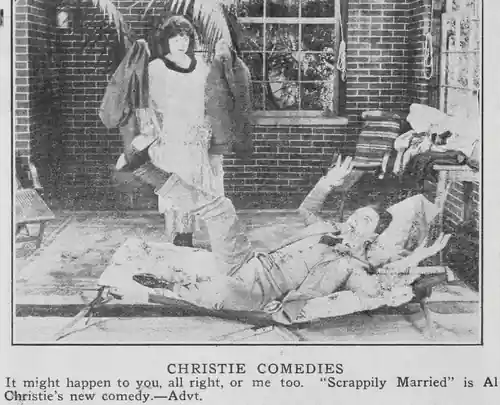
Compare it to the marital skirmishes in The Perils of Divorce or the small-town nostalgia of The Girl from His Town, and you’ll notice how Scrappily Married refuses catharsis. No one learns empathy; the marriage does not deepen. Instead, the film posits marriage as an ongoing confidence trick, a vaudeville duo who must nightly improvise new endings to keep the ticket holders from rioting. The burglar exits richer, the mother exits banished, the husband exits grinning—yet all three are still locked inside the same social contract, the same flicker of celluloid that loops ad infinitum.
Scholars of silent-era gender politics will note how the picture flips the usual predator–prey dynamic. The intruder is female, the homeowner male, yet power oscillates not on who can physically overpower whom but on who can weaponize likability. Cullington’s thief prevails because she is agreeable, a social lubricant in human form. The wife regains dominion by weaponising respectability itself. Between them, the husband is simply the stage upon which they pirouette—an object lesson in how masculinity, stripped of institutional armour, becomes a pantomime costume one can shrug on or off.
A cinephile Easter egg: watch for the moment the burglar lifts a cigarette case monogrammed “A.F.”—a sly nod to Adolph Zukor’s Famous Players, the production entity that distributed the short through Paramount’s conveyor belt. It’s the kind of in-joke that would resurface a century later in Tarantino’s foot fetish arcs or the Marvel post-credit stingers. Even in 1920, metadata was destiny.
Restorationists at Elephant Archives scanned the sole surviving print at 4-K, then artificially slowed certain shots to 18 fps to accentuate the choreography—an intervention that would make purists howl, yet the result feels uncannily modern. When the burglar twirls, her skirt flares like a parasol opening in reverse, the hemline tracing a perfect Fibonacci spiral. You half expect the Stranger Things synth to drop.
Is the film flawless? Hardly. The racial gag involving a frightened Black elevator operator—blink-and-it’s-gone though it is—lands with the thud of a relic best left in the ashcan. The mother-in-law’s comeuppance hinges on a plot contrivance so brazen it makes Dickensian coincidences feel like documentary truth. Yet the brevity is its alibi: at a whisker over twenty minutes, the picture doesn’t ask for absolution; it simply barrels past before your conscience can clear its throat.
Contemporary comedies that attempt the same screwball velocity—think Game Night or Date Night—drown in third-act sincerity. They must reassure us that the couple really loves each other beneath the mayhem. Scrappily Married harbours no such delusion. Its final shot: husband and wife perched on opposite ends of a settee, a victrola scratching out a foxtrot, their eyes locked not in affection but in wary détente. Love here is not a sanctuary; it’s a hustle that renews every dawn, a marriage license as renewable visa.
For the cine-curious, the short is streamable via Elephant Archives and occasionally rotates through Twitch’s Silent Comedy Week. Pair it with Paid in Full (1919) for a double bill on transactional affection, or counter-program with the surreal masculinity panic of The Lunatic at Large. But watch it you should—preferably at 2 a.m., headphones on, whiskey neat, the hum of your refrigerator standing in for a theatre’s carbon-arc projector. In that liminal hush, the film’s central thesis whispers across a century: dread is just desire wearing a Halloween mask, and marriage, at its scrappiest, is the longest con of all.
IMDb —
1917
Community
Log in to comment.