DbcultAccessing Vault...
Cult Review
Senior Film Conservator
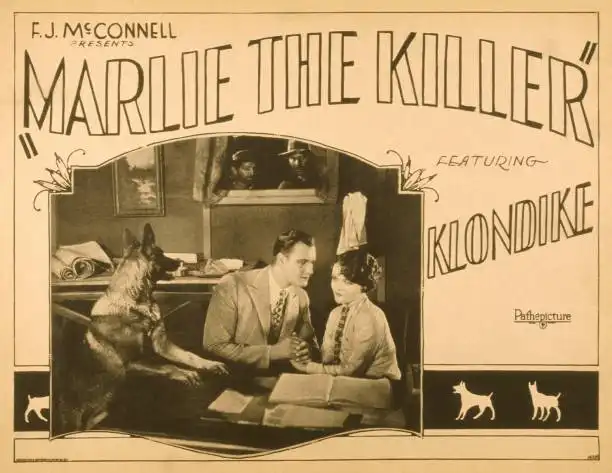
Alright, let’s talk about Marlie the Killer. Is this worth watching today? Honestly, yeah, for a very specific crowd. If you love old silent films, or you just have a soft spot for dog movies — especially *really* old dog movies — you might get a kick out of it. Anyone expecting snappy dialogue, fast pacing, or anything resembling modern cinema will probably be bored out of their mind. This one’s a curio, a gentle ripple from the past.
The whole thing hinges on Klondike the Dog, who plays Marlie. And look, Klondike is a good dog. He really is. You can tell they leaned on him heavily for emotional beats, and he delivers a surprisingly varied range of 'concerned,' 'guilty,' and 'heroic' looks. It's often through his eyes we get the most genuine reactions.
Blanche Mehaffey, as the leading lady, does a lot of _wide-eyed distress_ and _hand-to-chest emoting_. It’s exactly what you’d expect from the era. There’s a scene where she’s just staring off into the distance, worried, and it goes on for what feels like an eternity. You start to wonder if she just forgot her line, even though there are no lines!
The plot, such as it is, involves Marlie getting blamed for, well, being a 'killer.' He's a good boy, though. We know this. But the humans are very dramatic about it. There’s some intrigue with Francis X. Bushman Jr. who seems perpetually on the verge of doing something nefarious, often just standing there looking shifty. His villainy is less about action and more about _being intensely present_ in a room.
One particular moment sticks with me. Marlie, after being unjustly accused, slinks away with this really sad, almost defeated look. It’s hard to get a dog to act that out, and Klondike just *nails* it. You feel for him, even if the surrounding human drama is a bit much.
The intertitles are where a lot of the story gets told, sometimes a bit clumsily. They’ll just pop up and explain a whole character's motivation or a sudden plot twist, often right after a long shot of someone just standing there. It's a jarring shift in information delivery.
You can tell the budget wasn't huge. The sets are simple, often just a room with some furniture. And the outdoor scenes feel a bit staged, like they just found a quiet spot in a park and hoped no one walked into the shot. The crowd scenes have this oddly empty feeling, like half the extras wandered off for a snack.
Joseph W. Girard, as the older, wiser figure, tries to bring some gravitas. He mostly succeeds by just having a very serious face at all times. He's the voice of reason, or at least, the one who doesn't immediately assume the dog is evil.
The action sequences, when they happen, are charmingly quaint. A chase scene involves a lot of running in place and very quick cuts to make it seem like more is happening than actually is. Marlie does most of the heavy lifting here, bounding through fields and saving the day with sheer canine enthusiasm.
There's a scene near the end, where Marlie finally proves his innocence, and the human characters react with such exaggerated relief. It’s almost comical. You can almost feel the movie trying to convince you this moment matters, after all the build-up.
It’s a reminder of how much storytelling has changed. These films relied so much on visual cues and broad gestures. Sometimes it works, sometimes it just feels _slow_. But for a snapshot of 1928 filmmaking, and a glimpse into how they made 'dog stars' work, it’s not bad.
I found myself smiling more than anything. Not because it’s particularly funny, but because it’s so earnest. It’s a sweet little film, imperfect and a bit creaky, but with its heart in the right place. And Klondike? He’s a star. 🐾
IMDb —
1921
Community
Log in to comment.