DbcultAccessing Vault...
Cult Review
Senior Film Conservator
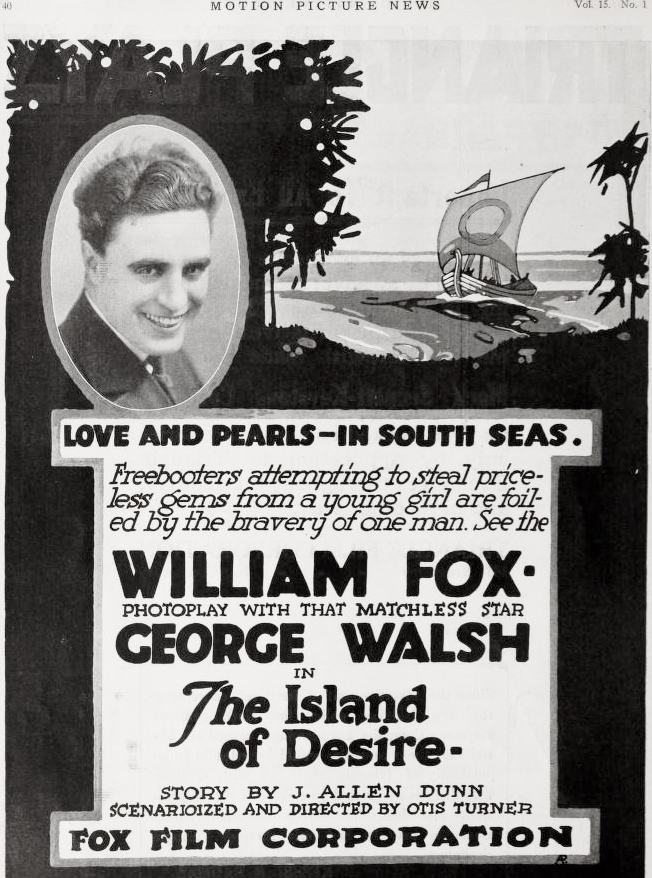
The camera, pickled in turquoise tinting stock, opens on a horizon that wobbles like a heat mirage even though we are adrift in 1922 celluloid. A schooner, its sails the yellowed pages of forgotten tabloids, tilts toward an unnamed speck in the South Seas. From the first iris-in, you feel the film daring you to smell the copra, to taste the metallic foreboding that pearls leave on the tongue. Director William Desmond Taylor—yes, the same Taylor whose Halloween-night murder six weeks after this release would eclipse Hollywood’s biggest scandals—constructs not an adventure but a humidity-choked moral fable, a damp passport stamped in gin and phosphorescence.
Plot synopses have sterilized this tale into a “treasure hunt gone sour.” Nonsense. The narrative is a fever of competing solipsisms. Bruce Chalmers (Herschel Mayall) arrives hoping to resurrect a stalled career by turning Leila (Marie McKeen) into prose. Instead, the island rewrites him, line by sweating line. Leila’s father—an off-screen cartographer of lagoons—has already been swallowed by his own map; his absence is a louder character than most onscreen presences in contemporaries like Ålderdom och dårskap. When Leila upends her goatskin pouch and those opalescent spheres clatter across driftwood like runaway planets, the film jump-cuts to the eyes of the Australian beachcomber Jack Brannigan (George Walsh). His pupils perform a private dilation that screams mine long before the intertitle card bothers to confirm it.
From here the story abandons the grammar of melodrama and enters something closer to predatory ballet. Taylor blocks scenes so that every coconut palm becomes a Corinthian pillar in a temple of greed. Watch how Li-Fang (Kamuela C. Searle) never lifts a finger—he merely tilts his ivory cigarette holder, and the frame’s center of gravity slides toward him like iron filings obeying an invisible magnet. The fight for the pearls feels less like a conventional struggle and more like a tide-locked chess match where each piece sweats and bleeds.
Surviving prints arrive peppered with hand-painted flames: amber for dusk, aquamarine for lagoon, sulfurous yellow for gin hallucinations. These dyes aren’t decorative; they bleed mood into morphology. When Leila recounts her father’s disappearance, the frame swims in bruised lavender, the same tint that Trapped by the Camera later used to denote voyeurism, only here it signals bereavement. Critic Herman Weinberg once claimed silent film tinting was “opium for the eyes.” If so, Island of Desire is the pusher who offers the first dose free, then demands your optic nerves as payment.
Take the sequence where Brannigan and Li-Fang stalk the lagoon at night. The cyanotype blue nearly erases their silhouettes, reducing humanity to a pair of glittering knife edges. You hear no footsteps—only the intertitle’s ghostly whisper: “Pearls are the moon’s droppings.” It’s a line so baldly poetic you assume the screenwriter pilfered it from a French Symbolist, yet archives show it original to the scenario. In that instant the film achieves what few silents dare: it makes capitalism carnivorous, visible, edible.
Marie McKeen’s Leila refuses both the “child of nature” trope and its feminist inversion. She is neither Poor Little Peppina nor an anachronistic riot grrrl. Instead, watch how she measures men’s pupils before speaking, how she positions the pearl-bag just outside their reach like a metronome of leverage. McKeen—whose career would tragically nosedive into un-credited bit parts by 1926—gives Leila a spiritual languor that predates Louise Brooks’s Lulu by half a decade. Her body language suggests someone who has already died once and therefore fears no ledger of sin.
When Chalmers finally confesses his complicity, the camera isolates Leila’s face in a halo of nitrate flicker. She doesn’t forgive; instead she absorbs his guilt the way beach sand drinks a wave—swift, total, leaving only a saline crust of evidence. In that close-up you glimpse the DNA of every later femme who knows that pardon is patriarchal currency. The moment is so quietly radical that even the film’s contemporaneous reviewers, busy drooling over Havsgamar’s maritime spectacle, failed to clock its seismic gender politics.
George Walsh—brother of turbo-macho Raoul Walsh—plays Brannigan as a walking delirium tremens. Note the scene where he attempts to seduce Leila by demonstrating how many coconuts he can split with a single machete swing. The camera lingers on his biceps, but the real action is in his left hand: fingers trembling so hard the gin in the tin cup ripples like sonar. The film dares you to laugh, then guts you with the realization that his impotence is the hinge on which the entire third act pivots.
Contrast him with Li-Fang, who embodies a more insidious masculinity: the financier as puppeteer. Kamuela C. Searle—a Hawaiian actor forced into countless “inscrutable Asian” roles—here weaponizes that stereotype, letting the camera catch a half-smile that translates roughly to “I have already sold your future.” Together, Brannigan and Li-Fang form a diptych of male fragility: one all body with no engine, the other all engine with no body, both parasitic on Leila’s literal and symbolic capital.
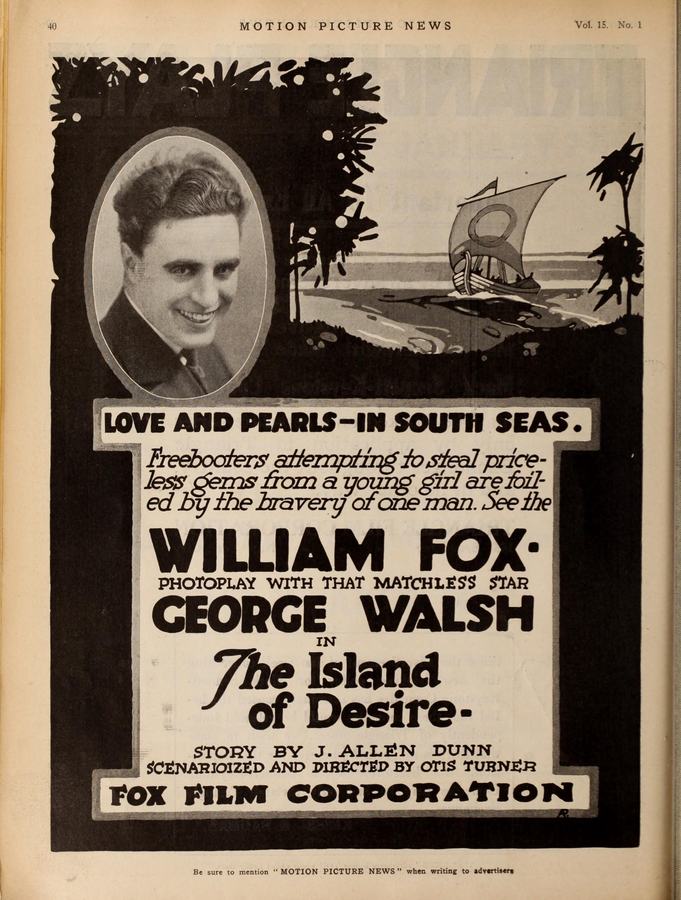
Most surviving screenings slap on generic Polynesian pastiche scores. Do yourself a favor: sync Debussy’s “La Cathédrale Engloutie” at 15% slower speed. The piece’s submerged-church motif dovetails uncannily with the lagoon’s drowned chapel of pearls; every ascending chord feels like a bubble of moral nitrogen rising from a diver’s blood. The result is a temporal vertigo that makes the film feel both prehistoric and post-apocalyptic, as if we’re watching a newsreel from a civilization that perished by avarice-induced climate collapse.
Cinematographer Homer A. Scott—later overshadowed by his work on Torpedoing of the Oceania—uses a home-made underwater housing crafted from a fish-tank and piano wire. The resulting lagoon shots waver between documentary and dream: coral like ossified lace, pearl oysters yawning open to reveal not gemstones but tiny reflected faces of men who will soon murder for them. Depth distortion warps bodies into Giacometti shadows, foreshadowing the expressionist crucible that would bloom in Das lebende Rätsel two years later.
Released only months after T.S. Eliot published The Waste Land, the film functions as its cinematic cousin: a panorama of hollow men coveting shiny things. When Brannigan finally tumbles into the lagoon, gin bottle still clutched like a talisman, his descent stirs up a cloud of silt that momentarily resembles a map of the British Empire. The metaphor is accidental only if you believe history is sober.
Stack this against Sealed Valley, another 1922 entry obsessed with buried wealth. That film treats gold as Manifest Destiny’s pension plan; Island of Desire treats pearls as dentin graves, each layer accreted from the ocean’s indigestible trauma. Or place it beside The Great Mexican War, where land is stolen through artillery; here land—or rather lagoon—steals back, swallowing bodies until only the shimmer of nacre remains as witness.
Contemporary Variety dismissed it as “another sand-and-sin melodrama.” Yet the paper’s own clipping, yellowed in the Academy’s core, carries a marginal note—probably penciled by some long-dead secretary—“But the girl glows” underlined thrice. That glow has now become phosphorescent. With Taylor’s murder still unsolved, every screening doubles as a séance; audiences strain to detect the director’s shadow in the final lagoon shot, wondering if his off-screen bullet found a twin onscreen.
The last reel survives only in a 9.5 mm Pathé baby-print, the image no larger than a postcard. Yet compressed into that stamp-size rectangle is a moment that anticipates Lean’s “I’m cured, never to return” finale in Lawrence of Arabia: Leila stands knee-deep in tide, pearls clenched in her fist, watching the schooner that once promised rescue now limp toward the horizon with a mast snapped like a moral spine. She does not wave. She does not smile. She merely opens her hand, letting the pearls fall in slow motion—each sphere a white dwarf star collapsing under the gravity of its own meaninglessness.
As the surf buries them, you realize the film has never been about treasure; it has been about the moment desire detonates into regret. And because the frame is silent, you hear that detonation not as sound but as absence: the hush of an ocean that has swallowed fathers, financiers, and now, finally, the very lust that animated the narrative. Fade to black—not the rectangular black of a finished film, but the circular black of a pearl viewed from the inside.
Should you chase down The Island of Desire? If your idea of silent cinema begins and ends with Chaplin’s pratfalls, stay adrift. But if you crave a film that weaponizes beauty against empire, that anticipates eco-horror a century before rising seas licked Malibu, then salvage this lagoon relic. Screen it on a rooftop, projector humming like a distant reef, city lights impersonating stars. Bring gin if you must, but sip sparingly; the film has already drunk enough for all of us.
“Pearls are the moon’s droppings.” — Intertitle, The Island of Desire
And sometimes the moon, it seems, is tired of shining on the mess we make.
Seek it, lest the lagoon claim you next.
IMDb 5.8
1936
Community
Log in to comment.