DbcultAccessing Vault...
Cult Review
Senior Film Conservator
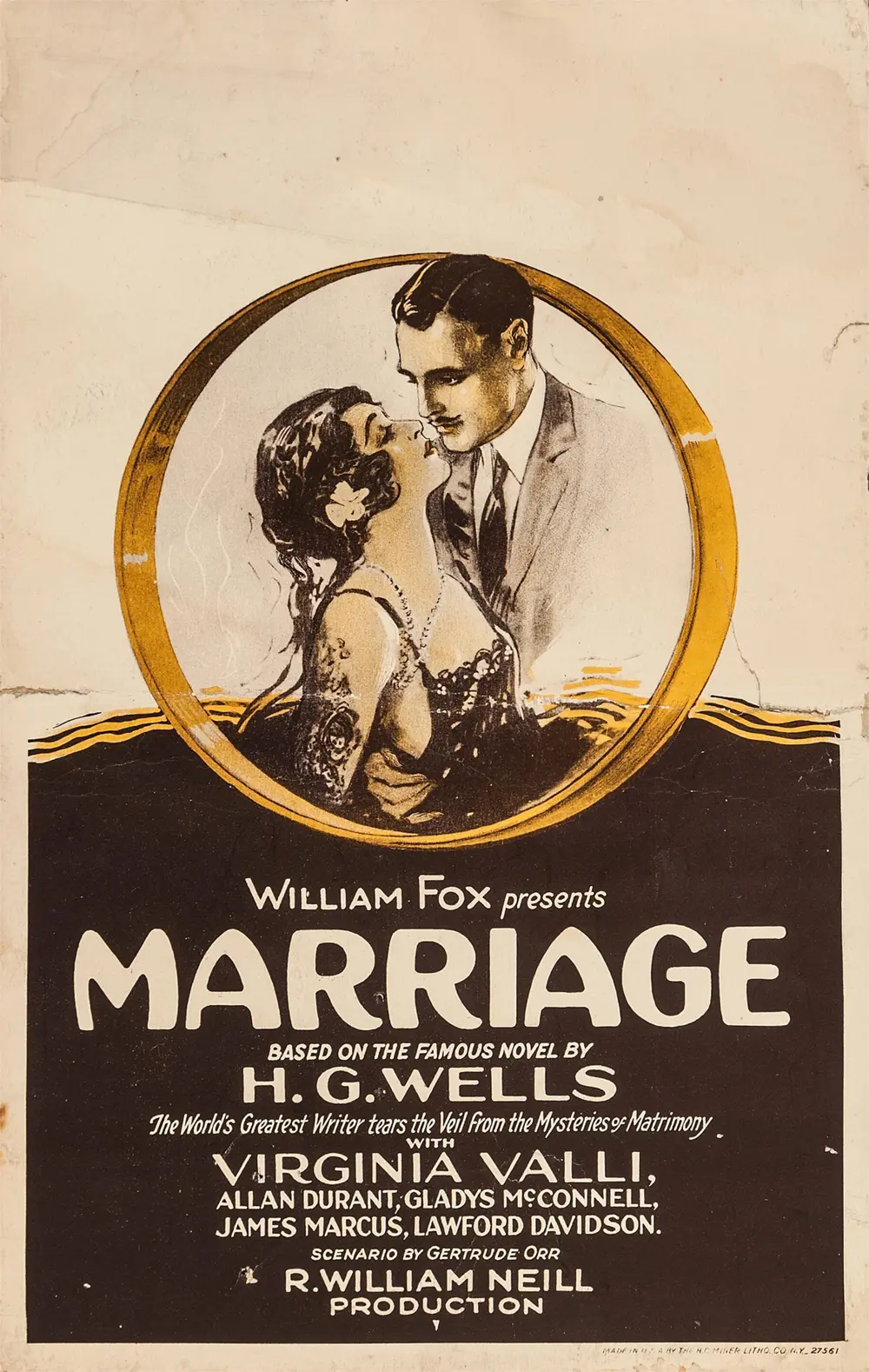
Is Marriage (1927) worth watching today? Short answer: yes, but with significant caveats. This silent drama, a curious adaptation of H.G. Wells' novel, offers a fascinating, if often frustrating, window into early 20th-century societal anxieties and the nascent art of cinema, making it a compelling watch for serious film historians and silent era aficionados, yet a likely patience-tester for casual viewers accustomed to modern narrative conventions.
Let's be direct:
Marriage, directed by Edwards Davis, attempts a grand narrative sweep, charting the turbulent relationship between Marjorie Pope and the idealistic inventor, Trafford. The film opens with Marjorie trapped in a joyless engagement to the wealthy Magnet, a familiar trope that quickly establishes her yearning for something more. Her salvation, or perhaps her undoing, arrives literally from the sky when Trafford's experimental airplane crashes onto her family estate. This dramatic entrance, while a classic silent film contrivance, effectively sets the stage for an impulsive elopement, fueled by a mixture of rebellious spirit and genuine, if fleeting, attraction.
The initial courtship and elopement sequences move with a spirited energy, characteristic of the era's romantic dramas. We see the spark between Marjorie and Trafford, a connection born of mutual defiance against societal norms. However, the film quickly pivots from burgeoning romance to the harsh realities of married life, particularly when confronted with Trafford's single-minded dedication to his inventions. Marjorie, portrayed as a woman of considerable vanity and a craving for luxury, finds herself increasingly isolated and bored by her husband's intellectual pursuits.
This shift in tone is jarring, deliberately so, but the pacing begins to falter here. The transition from free-spirited elopers to a couple at odds feels rushed, as if the screenplay, adapted from H.G. Wells' novel by Gertrude Orr and Elizabeth Pickett, is eager to reach its more dramatic conflicts. Marjorie's subtle manipulation of Trafford to commercialize his 'wonderful invention' – a move designed to fund her extravagant lifestyle – feels less like a gradual corruption and more like an abrupt character turn. This lack of organic development makes her subsequent affair with Sir Roderick feel less like an inevitable consequence of neglect and more a convenient plot device.
The narrative's geographical shifts, from rural England to a remote African outpost, are ambitious for a 1927 production, showcasing a desire for epic scope. Yet, these transitions are often more symbolic than substantive. The African setting, intended to highlight Marjorie's isolation and Trafford's unwavering dedication to his work, sometimes feels like a mere backdrop for melodramatic turns. The lion attack, while a visually striking moment for its time, serves as a rather blunt instrument for reconciliation, forcing Marjorie back into a caregiver role and setting up a resolution that feels less earned than imposed by the plot's need for closure.
In silent cinema, the burden of conveying emotion rests almost entirely on the actors' faces and physicality. Marriage is largely carried by Virginia Valli's portrayal of Marjorie Pope. Valli, a prominent actress of the silent screen, delivers a performance that is both captivating and frustrating, much like the character herself. She excels at embodying Marjorie's initial vivacity, her disdain for Magnet (played with suitable stuffiness by Lawford Davidson), and her impulsive attraction to Trafford. Her wide-eyed expressions of boredom and longing are particularly effective in the middle section, clearly communicating her character's internal strife without the aid of dialogue.
However, Valli's performance occasionally veers into the melodramatic, a common trait of the era. Her expressions of despair or anger can feel overwrought, especially to a modern audience. Yet, within the context of silent film acting, where emotions had to be projected across cavernous theaters, her choices are understandable. The scene where she first considers Sir Roderick's advances, her eyes darting between temptation and lingering guilt, is a masterclass in silent subtlety, showcasing her range beyond mere histrionics.
Donald Stuart, as Trafford, struggles to match Valli's intensity. His character is written as an idealist, a man consumed by his work, and Stuart conveys this dedication through a stoic demeanor. However, his performance often lacks the emotional nuance that would make Trafford a truly sympathetic figure. His indignation upon discovering Marjorie's infidelity is palpable, but his earlier detachment makes it difficult to fully invest in his pain. The chemistry between Valli and Stuart is present in their initial scenes, but it dissipates as the narrative progresses, mirroring the crumbling of their on-screen marriage.
The supporting cast, including Lawford Davidson as Sir Roderick, fulfills their archetypal roles competently. Davidson's Sir Roderick is suitably charming and predatory, a clear foil to Trafford's earnestness. Billie Bennett as Mrs. Pope offers a brief but memorable turn as the disapproving mother, her facial expressions providing comic relief and societal judgment in equal measure. These performances, while not groundbreaking, serve the story well, providing the necessary emotional beats and character dynamics.
Edwards Davis's direction in Marriage is competent, if not groundbreaking, for 1927. The film showcases a solid understanding of silent film grammar, utilizing intertitles effectively to convey dialogue and exposition without overwhelming the visual narrative. The cinematography, while not credited, makes good use of natural light in the exterior shots, particularly in the later African sequences, lending a sense of authenticity to the exotic locale. Close-ups are employed to highlight key emotional moments, drawing the audience into the characters' internal struggles, a technique that was becoming increasingly refined in the late silent era.
The film's tone shifts quite dramatically, from lighthearted romance to domestic drama, then to a more adventurous, almost colonial, setting. Davis attempts to manage these transitions, but the overall consistency suffers. The early scenes in England possess a charm and wit that give way to a heavier, more moralistic tone once Marjorie's infidelity becomes central. This tonal whiplash can be disorienting, making it hard to settle into a consistent emotional rhythm.
One particularly striking visual moment is Trafford's airplane crash. While rudimentary by today's standards, the sequence would have been thrilling for contemporary audiences, symbolizing the disruptive force Trafford brings into Marjorie's life. Similarly, the lion attack, achieved through a combination of stock footage and staged action, still manages to convey a sense of primal danger, even if the realism is imperfect. These moments demonstrate a director trying to push the boundaries of visual storytelling within the constraints of the period.
However, the film’s pacing is its weakest link. There are stretches, particularly after Marjorie and Trafford move to Africa, where the narrative meanders, focusing too heavily on Trafford’s scientific pursuits and Marjorie’s growing ennui without sufficient dramatic tension. A more judicious edit could have tightened these sequences, enhancing the overall impact of the story. The film occasionally relies too heavily on intertitles to explain character motivations rather than letting the visuals speak for themselves, a common pitfall of silent cinema that Marriage doesn't entirely escape.
The involvement of H.G. Wells in the writing credits for Marriage is perhaps its most intriguing aspect. Wells' novel, published in 1912, was a commentary on societal expectations, gender roles, and the clash between scientific idealism and material desire. The film attempts to translate these complex themes to the screen, but often struggles with the nuance required. Marjorie's character, in particular, feels simplified; her intellectual curiosity and potential for growth, hinted at in the novel, are largely overshadowed by her vanity and superficiality in the film adaptation.
The film’s greatest challenge lies in its portrayal of Trafford. Wells conceived him as a brilliant but socially awkward scientist, whose dedication to his work borders on obsessive. While Donald Stuart captures the obsession, the film doesn't fully explore the intellectual and emotional chasm this creates between him and Marjorie. The novel delves into their philosophical debates and the psychological toll of their incompatible desires, aspects that are difficult to convey through silent film's often broader strokes. The result is that Trafford often comes across as merely stubborn and insensitive, rather than a complex figure torn between his genius and his domestic life.
The ending, with Marjorie returning to nurse Trafford after the lion attack, feels like a dramatic capitulation rather than a genuine resolution. In Wells' novel, the reconciliation is more about mutual understanding and compromise, albeit fragile. The film, constrained by the conventions of its era, opts for a more overtly dramatic catalyst, suggesting a redemption arc for Marjorie that feels somewhat unearned. It’s a classic silent film move, designed for emotional impact, but it undercuts the more sophisticated psychological exploration present in the source material. This adaptation highlights the inherent difficulties of translating literary depth into a visually driven medium in its infancy.
Absolutely, but with a specific mindset. For film scholars, students of silent cinema, or anyone interested in the evolution of narrative storytelling, Marriage offers invaluable insights. It showcases the acting styles, directorial techniques, and thematic concerns prevalent in the late 1920s. It provides a tangible link to the literary adaptations of the era, particularly those from a writer as significant as H.G. Wells. The film is a historical document as much as it is entertainment.
However, for the casual viewer seeking a compelling, easily digestible narrative, Marriage might prove a test of patience. The pacing can be slow, the acting conventions dated, and some of the plot resolutions feel simplistic. It requires an appreciation for the medium's limitations and a willingness to engage with its historical context. If you can approach it as a piece of cinematic history, you will find value in its ambition and its earnest attempt to tell a complex human story.
Marriage (1927) is not a forgotten masterpiece, nor is it a cinematic failure. It exists in that fascinating middle ground of early cinema: a film brimming with ambition but constrained by the nascent art form's limitations. Virginia Valli's performance is the undeniable highlight, a testament to the power of silent acting, even when the script doesn't fully support her character's journey. The film works. But it’s flawed. Its narrative choices, particularly the abrupt character turns and the melodramatic ending, prevent it from achieving the profound impact of Wells' original work. Yet, as a historical document, a window into the societal anxieties of its time, and a showcase for the evolving craft of filmmaking, Marriage demands attention. It's a challenging watch, but one that rewards patience and a keen interest in the silent era. It reminds us that even nearly a century ago, filmmakers were grappling with the eternal complexities of human relationships, often with a raw earnestness that modern cinema sometimes lacks. For those willing to look past its imperfections, there's a valuable, if imperfect, story to be found.
IMDb 6.9
1923
Community
Log in to comment.