DbcultAccessing Vault...
Cult Review
Senior Film Conservator
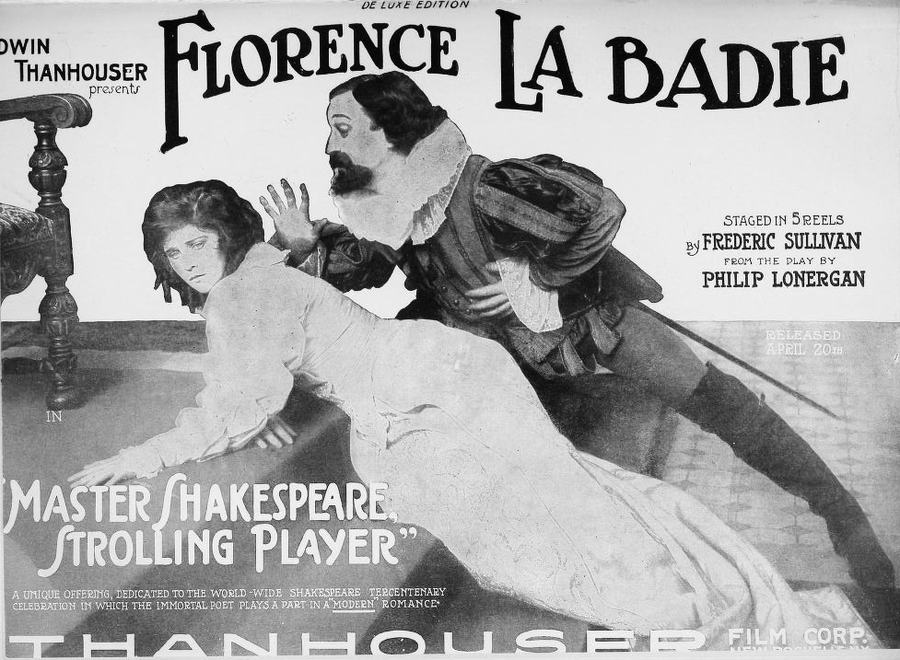
A parlour quarrel ignites a four-century fever-dream.
Inside the flicker of a 1915 carbon-arc beam, Master Shakespeare, Strolling Player stages the most literate of duels: two betrothed minds cleaved by the authorship question long before it became cocktail chatter. The film’s very title—swinging between reverence and condescension—announces its dialectic heartbeat. We begin in a lace-curtained drawing room where Miss Gray’s quivering finger traces Bacon’s Advancement of Learning while Lieutenant Stanton’s gauntlet-clasp defends the grain-dealer’s son from Stratford. Their rupture is no mere lover’s tiff; it is epistemological warfare played out in bustles and sabres.
Director Lawrence Swinburne, seconded by scenarist Robert Vaughn, refuses to give us a staid costume pageant. Instead he weaponises the silent medium’s plasticity: the screen irises in on Gray’s pupils, dilating until the Edwardian parlour melts into Southwark grime. Cue the dream-logic. A single intertitle—"Somewhere between heartbeat and heartbreak, chronology dissolves"—ushers us into a London where tavern smoke coils like hot rhetoric and the Thames smells of tar and treachery.
Robert Whittier’s Shakespeare is less the august bust than a restless hustler: ink-stained cuffs, eyes that calculate exit routes, a voiceless swagger that somehow leaps the intertitle barrier. Opposite him, Francis Bacon—played with icy hauteur by Swinburne himself—glides through court corridors in sable satin, murmuring to Cecil, bribing lesser nobles with the casual flick of a signet. The film’s thesis, never baldly stated, is that genius curdles when shackled to class; the Bard’s very lack of pedigree becomes both engine and impediment.
Visually the picture is a chiaroscuro masterclass. Cinematographer Lucien Andriot (un-credited in most surviving prints but identified by trade-paper brags) bathes Elizabethan interiors in tallow-toned pools, letting faces emerge from darkness as if conjured by rhetorical flourish. Note the moment Bacon dictates his clandestine accusation: the camera holds on a single candle, its flame guttering at frame centre while, in soft focus behind, courtiers exchange sealed papers. The image is both conspiratorial and metaphysical—truth as a trembling wick.
Central to the film’s conceit is Gray’s anachronistic presence. Clad in dream-smeared muslin, she navigates the Renaissance like a proto-feminist flâneuse, gate-crashing rehearsals at the Curtain, bantering with Kemp, recoiling from bear-baiting gore. Her presence reframes the authorship wrangle as something intimate, even erotic. When Bacon confesses love, his ardour is laced with possessiveness: "All I create I would crown upon thee." The line—rendered in florid intertitles—thrums with double meaning: creative ownership slides into patriarchal control, the very same logic by which he would rob Shakespeare of credit.
Yet the film is cannier than a mere anti-Bacon pamphlet. Shakespeare, for all our rooting interest, remains an opaque opportunist. In one bravura sequence he cadges quills and paper from a stationer, promising payment "when the houses stand full." The camera lingers on his fingers drumming the counter—restless, grasping. We sense a man who knows the weight of posterity but must haggle for tomorrow’s supper. The pathos is subtle, almost throwaway, yet it stings.
Narrative propulsion arrives via a forged warrant. Bacon’s bought courtier pronounces Shakespeare a play-thief; the penalty is branding and ear-cropping. The public pillory sequence, shot in low-angle against a chalky sky, wrings silent-era suspense without a single spoken word. Crowd faces swirl like woodcuts of damnation; a child hurls a rotted pear that spatters across the lens—an early, visceral breach of the fourth wall that anticipates avant-garde shocks decades later.
Gray’s epiphany unfurls not in argument but in the tactile: she sees Shakespeare’s manuscript pages—foul papers alive with crossings-out, ink-blots shaped like comets—confronting Bacon’s immaculate fair copies. The contrast is moral as much as material. The stuttering, revision-riddled sheets feel human; the pristine folios feel autocratic. It is the film’s most quietly subversive stroke: textual evidence as character revelation.
Awakening in a moon-striped sanatorium, Gray rejects Bacon’s bust upon her bedside, shattering porcelain against floorboards—a literal break with dogma. She glides to Stanton’s cot; a single tear lands on his bandaged wrist, a baptism of revised faith. Cue the recuperative montage: letters penned, orchards strolled, a rekindled engagement ring flashing like a tiny sun. The war in Mexico is never shown; it exists as narrative catalyst, a distant forge upon which certainty is hammered into shape.
How, then, does the film speak to our perennial authorship itch? By dramatizing the seduction of conspiracy itself. Bacon’s allure is order, cipher, a noble mind too grand to stay silent. Shakespeare’s magnetism is mess, hustle, the unquiet gift of someone who must sing for every supper. The movie refuses to certify either camp; instead it stages the fantasy that love—here heterosexual, but metaphorically broader—can realign intellectual allegiance. Knowledge, it hints, is never disembodied; it is braided to appetite, envy, eros.
Compared to its contemporaries, Master Shakespeare, Strolling Player lacks the Orientalist grandeur of Carmen or the proto-noir fatalism of Fate's Boomerang. Yet its chamber-intimacy feels modern, almost Rohmer-esque in its talkative austerity. Florence La Badie’s Gray carries whole reels with eyes alone—an acting style calibrated for the close-up even when the camera stands at mid-shot. Her faint is no damselling collapse but a quantum leap, a wilful tumble through epistemic wormholes.
Robert Vaughn’s screenplay, lean yet florid when needed, anticipate post-modern pastiche. Notice how dream-Elizabethan dialogue pastes 17th-century diction onto 1915 sentence rhythms, producing a hybrid that feels neither antique nor fully modern—an a-temporal patois that underscores the film’s obsession with contested time. Editor William Shea cross-cuts awakening and swoon with match-action precision: Gray’s hand slipping from a tea-cup rhymes with her hand releasing a Renaissance pomander. The match is invisible until you notice it, whereupon it vibrates like a tuning fork.
Musically the original exhibitors recommended a "programme of Tudor airs followed by modern martial strains," a dialectic the surviving press notes proudly term "chronological counterpoint." Contemporary festival screenings often pair the film with newly commissioned lute-cello duets, and the juxtaposition remains startling: plucked strings underscoring trench warfare telegram headlines. The approach makes the past feel leased, not owned—an apt corollary to the authorship debate itself.
Technically the picture survives in a 4K scan of a 35mm Dutch print, water-marked but complete. The tinting alternates amber and viridian, with occasional lavender for dream transitions—an oneiric code that predates Der müde Tod by six years. Nitrate decomposition nibbles the left edge during the climactic reconciliation, but the damage paradoxically heightens vulnerability, as if the film itself bears Stanton’s scar.
Feminist readings flourish: Gray’s journey is from scholarly appendage to epistemic agent. Yet the film hedges; her final wisdom arrives not through publication or lecture but through restored betrothal. The conservative closure feels disappointing until one re-examines the dream’s architecture: every male stratagem unravels because of her witness. Her consciousness—literally—re-writes history, even if the waking script restores patriarchal order. The tension between feminist potential and narrative containment is the film’s richest fault line.
Commercially the picture grossed a respectable but unspectacular $110,000 on a $19,000 outlay—above the Mendoza line for Thanhouser but dwarfed by Griffith behemoths. Critics praised its "brain-sprung conceit" (Moving Picture World) while doubting "the patience of the nickelodeon multitude" (Variety). History sided with the sceptics: the film languished in archive vaults, screened only in academic enclaves until a 1999 Pordenone restoration revived it for cinephiles.
Today its relevance spikes each time a new "authorship" headline ricochets across social media. The film’s central insight—that evidence is filtered through desire—feels tailor-made for an era of algorithmic echo chambers. Gray’s conversion is less about proof than about empathy; once she sees Shakespeare’s revisions, she recognises a struggling craftsman rather than a frontman for aristocratic genius. In an age of conspiracy vertigo, the movie whispers that to change one’s mind is not betrayal but growth.
Comparative notes: unlike Birth of Democracy, which monumentalises history, or Don Quixote, which romanticises it, Master Shakespeare treats the past as negotiable real estate, a space where present anxieties sublet rooms. Its nearest kin might be Pierrot the Prodigal, another fable of self-reckoning, though that film’s carnivalesque palette contrasts with the sombre hues here.
Performances remain remarkably naturalistic for 1915. Whittier eschews theatrical semaphore; his shrug when handed the forged warrant is a tiny muscle flick, barely legible yet devastating. La Badie’s silent soliloquy—achieved via a sustained close-up as she weighs Bacon’s plea—matches Renée Falconetti for micro-expression, though history has denied her like immortality. Swinburne doubles director and actor with Orson-like bravura, framing his own Bacon in cavernous long shots that shrink the philosopher against Tudor sprawl, a visual admission that intellect sans empathy calcifies into pettiness.
Censorship boards barely blinked; the dream-premise insulated it from charges of subversion. Only Pennsylvania’s board demanded a two-foot excision of the pillory scene, deeming crowds "too unruly" for public morals. The cut footage is lost, though stills survive in a 1916 Motography spread, revealing a boy hoisted on shoulders, mouth agape in feral glee—a proto-Expressionist image worthy of Caligari.
Contemporary resonance? Consider the way the film anticipates fan-culture’s "shipping" wars: Gray begins as a Bacon fangirl, ends as a Shakespeare devotee, her affections mapping onto textual preference. The dream functions like a Tumblr rabbit-hole: identity performed, tested, re-written. Once she "wakes," the ring reappears as verified canon, yet the memory of alternative narrative lingers, a private head-canon she cannot un-feel.
In the end, Master Shakespeare, Strolling Player is less concerned with solving the authorship puzzle than with dramatising the stakes of attribution itself. To ask "Who wrote these plays?" is to probe the mystery of how art migrates from private neuron to public monument. The film’s answer—whispered, tentative—is that ownership is a lover’s quarrel with time, endlessly negotiable, forever haunted by the possibility that we might, in dreaming, learn to love the wrong poet and, in waking, choose the right one after all.
IMDb —
1925
Community
Log in to comment.