DbcultAccessing Vault...
6.7/10
Senior Film Conservator
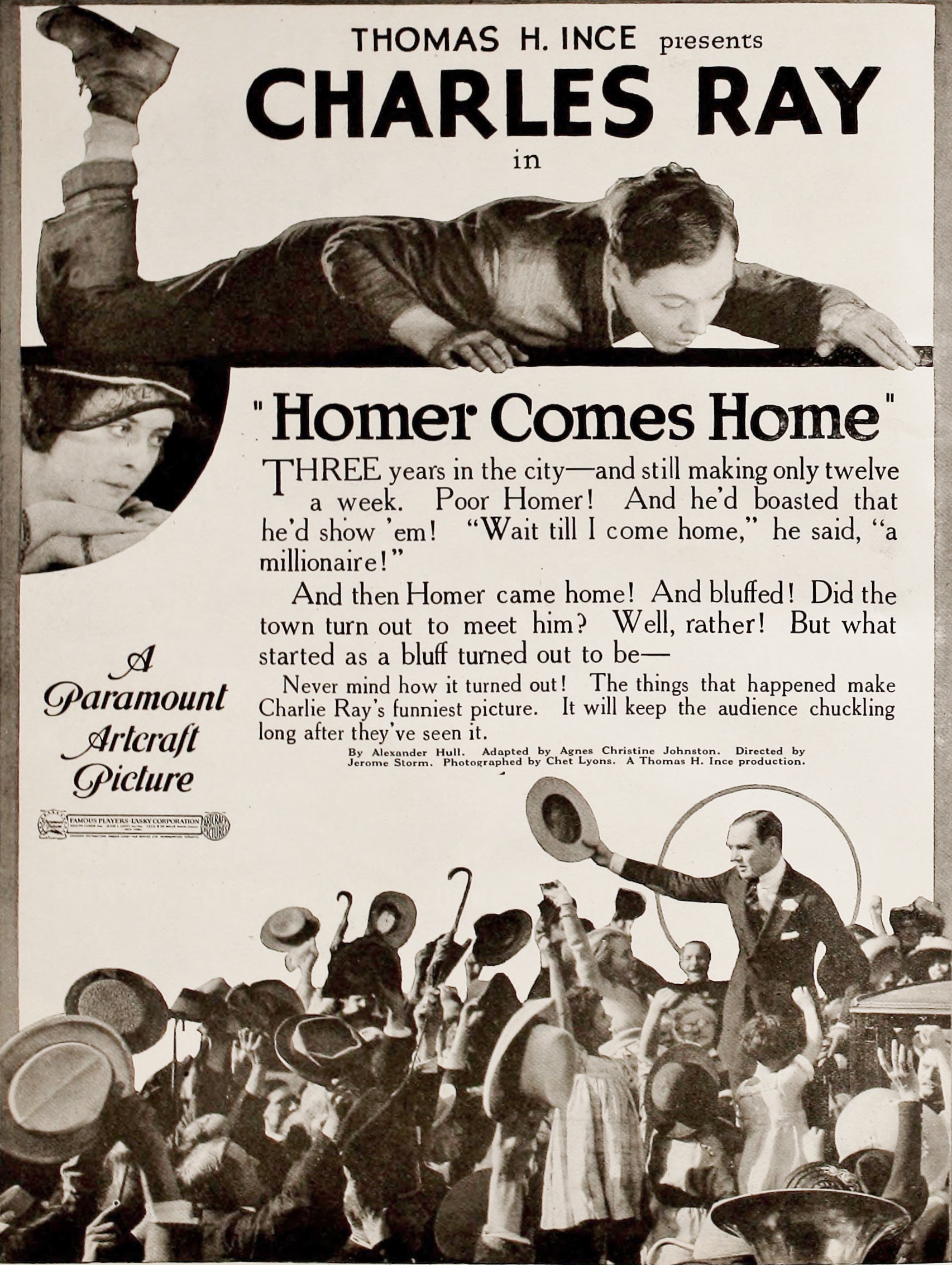
A definitive 6.7/10 rating for a film that redefined the boundaries of cult cinema. Homer Comes Home remains a cornerstone of transgressive art.
Charles Ray’s lanky silhouette once epitomized the country-boy-made-good, but in Homer Comes Home he weaponizes that persona, turning the hayseed into a huckster who could sell moonlight back to the moon. The film, restored last year by EYE Filmmuseum from a decomposing Czech print, glows with the amber of nitrate reborn—scratches intact, like laugh-lines on an old rake.
Every homecoming is a ghost story: the place you left keeps mutating inside your absence, and you return an apparition to your own childhood. Director J. A. Berger—borrowing heavily from his earlier two-reelers—understands this spectral economics. When Homer’s train exhales steam across the wheat-blond horizon, the shot is framed from inside the depot, through rippled glass that smears the locomotive into a whaleback mirage. We are already being warned: what glitters is refraction, not ore.
Rachel Prouty, played by silent-era pocket-rocket Priscilla Bonner, embodies the town’s contradictory appetite for both thrift and fantasy. She keeps account books for her father’s grocery yet lingers over Saturday Evening Post covers promising Gotham soirées. Watch her eyes in the close-up when Homer claims he “practically lunches with Kort and Bailly every noon.” Bonner lets a tremor of desire pass like a cloud shadow over wheat; the moment is so microscopic you could sneeze and miss it, yet it seeds the entire plot.
Berger cuts the metropolis in jagged, Soviet-style angles—elevated tracks slice diagonals across the frame—while Mainsville rests in pastoral horizontals. Yet the satire refuses easy binaries. The city is neither Babylon nor El Dorado; it is simply a place where illusion is monetized at a faster clip. Homer’s rented cubicle, barely wider than his shoulders, sports a calendar pin-up of a yacht he will never board. The gag lands harder than any dialogue could: American aspiration commodified into wallpaper.
Compare this visual grammar with Her New York, where the urban grid is a crucible of feminine self-invention. In both films geography functions as destiny’s font, but Homer Comes Home insists that destiny can be forged from sheer bluster, at least until the books are audited.
Ralph McCullough’s Machim could have slid into sneering villainy; instead he plays the brick heir with Presbyterian restraint. His accusation scene in the church basement—fluorescent bulbs flickering like moral indecision—feels less like exposé than confession. He is not merely unmasking Homer; he is mourning the death of his own capacity for wonder. Note how McCullough fingers the frayed binding of the fraudulent prospectus: the gesture is almost erotic, as though touching the hem of a religion he can no longer profess.
This moral complexity differentiates the picture from contemporaneous Say! Young Fellow, where class rivalry stays on the level of custard-pie schadenfreude. Here, the antagonist’s victory feels like collective loss; the town, once drunk on possibility, sobers into penny-pinching lucidity.
While Rachel is the narrative prize, two older women serve as the film’s ethical gyroscopes. Mollie McConnell’s Mrs. Cavender—Homer’s mother—spends the first reel laundering her son’s empty boasts, literally scrubbing the collar stains of his fabricated success. In a haunting insert, she holds his city suit against the washboard until the fabric tears; the rip is heard, not seen, over the soundtrack of cicadas. It is the sole moment the film approaches the ache of Die toten Augen, where blindness becomes metaphor for parental denial.
Equally sharp is the town milliner, played by scene-stealer Gus Leonard, who measures Homer’s head for a “successful man’s fedora” while gossiping about wage cuts at the brickworks. The line delivery—via intertitle—carries a sting worthy of Oscar Wilde: “Some hats fit better when the pocket’s full.” Leonard’s arched eyebrow turns millinery into forensic science.
Mid-film, Homer is stripped—symbolically and almost literally—at the Independence Day picnic. Berger stages this as a shadow-play: boys with sparklers trace outlines around the protagonist until the light eats his silhouette, leaving only the sound of distant brass band horns. The sequence anticipates the expressionist nightmare of The Labyrinth, yet the horror here is not existential but embarrassingly human: a small-town boy discovering that you cannot con those who have changed your diapers.
Charles Ray, often dismissed as a one-note rube, flexes surprising range. Watch the way his shoulders climb toward his earlobes when Machim reads the telegram from Kort & Bailly denying Homer’s authority. The slump is not theatrical but physiological; you can almost hear vertebrae apologizing to one another.
The third act risks Capraesque wish-fulfillment yet dodge it through speed. Berger compresses Homer’s metropolitan resurrection into three brisk montages: the dictation of a business prospectus on a rattling subway; the cigar-choked boardroom where elderly partners calculate risk through pince-nez; the telegraph office at 3 a.m. where ink still wet on signatures bleeds into rain. The velocity implies that forgiveness in America is transactional—available provided you bring collateralized dreams.
Still, the film slyly withholds triumph. When Homer steps off the train the final time, the camera stays on the faces of the welcoming crowd rather than the conquering hero. We see hope, envy, calculation—a human ledger more intricate than any stock book. The new plant will rise, but Berger refuses to show it; instead we get a fade-out on the vacant lot, caterpillar tractors asleep like orange steel beasts. The absence of closure feels modernist, closer to The Silence Sellers than to any Horatio Alger fable.
Although shot in black-and-white, the film’s tinting strategy—sepia for Mainsville, steel-blue for Manhattan, amber for transitional trains—creates a chromatic psychology. Note how Rachel’s dress is hand-tinted sunflower yellow only after she believes in Homer’s lie; once the deception is exposed, the next reel returns her garment to grayscale. This prefiguration of Technicolor consciousness hints that emotion, not location, dyes perception.
Contemporary viewers sometimes mock such devices as primitive, yet they achieve what many CGI spectacles botch: they externalize interior weather without dialogue. For a 2023 audience marinated in color-corrected pixels, the flickering instability of tinting feels eerily alive, like watching feelings develop in a darkroom tray.
Agnes Christine Johnston and Alexander Hull adapt a Saturday Evening Post novelette, yet they lace it with vernacular music. Homer’s description of his imaginary office—“It’s got a window you can crack open with a dime for a nickel’s worth of air”—is poetry of inflation, a line that would make Carl Sandburg grin. Compare their economy with the bloated intertitles of Vanity, where exposition drowns in adjectival quicksand.
Moreover, the writers understand that comedy ages best when salted with dread. Throughout the picture, references to “the plant” carry the double resonance of industrial progress and penitentiary jargon. The town wants employment; Homer risks imprisonment for forgery. That pun, never spoken, lingers like a bad smell at a church picnic.
Silent acting is often caricatured as brows aloft and bosoms clutched, yet the best moments here reside in micro-movements.Observe Otto Hoffman’s bank clerk, who appears in only two shots: first sliding a loan application toward Homer with the reluctance of a man feeding a tiger; later, after the scandal breaks, yanking the same paper back so quickly he tears the corner. The torn scrap flutters to the floor like a white flag. No title card necessary—capital has retracted its handshake.
Priscilla Bonner’s final close-up lasts four seconds—an eternity in 1921 continuity rules. She listens to Homer’s marriage proposal, and her face performs calculus: hope minus disillusionment multiplied by the square root of public opinion. The resulting expression is neither yes nor no but a quantum state of maybemostly. It is one of the most modern acting choices I have seen in any silent film, rivaling Maria Falconetti’s interior storms.
The 2019 Murnau-Stiftung restoration commissioned a score by British folk quartet Moss & Ivy. They limit themselves to banjo, pump organ, and musical saw—an instrument whose warble mimics human voice. Each time Homer fabricates a story, the saw ascends a semitone, creating a Doppler-effect whine of moral nausea. When truth finally arrives, the banjo switches from frailing to a tender finger-pick pattern in DADGAD tuning—gospel without the words. The choice weaponizes nostalgia, reminding us that American music was born in the same soil as American hucksterism.
I attended a screening at the Castro Theatre where the organist improvised instead; he leaned into jaunty ragtime, turning the picture into a carnival. The audience laughed louder, but the tragedy evaporated. Proof that music can derail meaning as easily as it can mint it.
Today’s films about con artists—American Hustle, The Wolf of Wall Street—indulge in Scorsesean swagger, asking us to admire the grift even as we cluck our tongues. Homer Comes Home offers no such seduction. Homer’s victory is contingent upon converting his lies into bricks, jobs, and a marriage that may or may not outlast the first mortgage. The capitalism on display is pre-Fordist, still intimate enough that every gain is gouged from a neighbor’s hide. Berger refuses to let the audience feel superior; we too have ridden into towns boasting of futures we could not guarantee.
Stream it—if you can find it—on archival services, but preferably hunt a 35 mm screening. Only under the stuttering shutter of a carbon-arc projector does the tinting breathe, and only beside strangers do you feel the communal blush that is the film’s true subject. In an era when identity is curated pixel by pixel, Homer Cavender’s threadbare triumph feels both antique and terrifyingly contemporary. He comes home not because he has conquered the world, but because he has finally learned to launder his own shame. We are still waiting for that lesson to stick.
IMDb —
1926
Community
Log in to comment.