DbcultAccessing Vault...
Cult Review
Senior Film Conservator
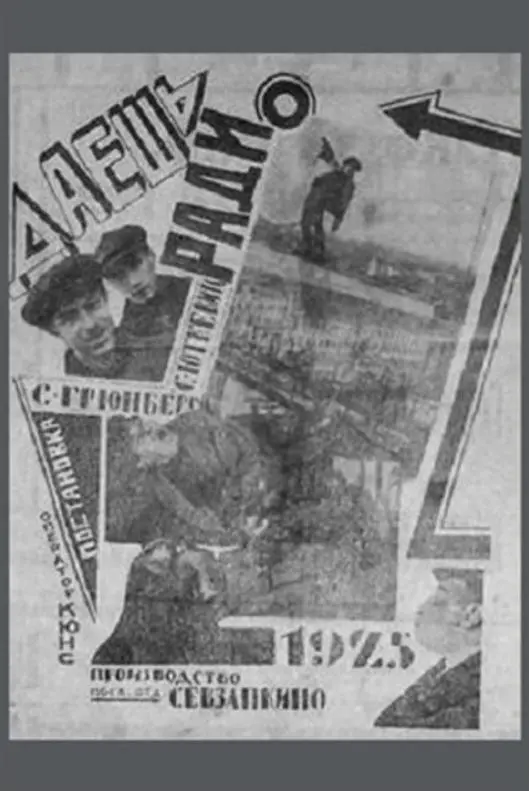
Should you spend your afternoon watching a 1925 Soviet propaganda short about radio waves? Short answer: yes, but only if you view it as a high-speed laboratory of film language rather than a narrative piece.
This film is for the cinephile who obsesses over the Soviet avant-garde and the 'Eccentric' movement of the 1920s. It is absolutely not for anyone seeking a relaxing, linear story or emotional character development.
1) This film works because its editing rhythm is so aggressive it feels modern even a century later.
2) This film fails because its thin plot is buried under a mountain of agitprop messaging.
3) You should watch it if you want to see the exact moment cinema stopped being theater and started being music.
Dayosh radio! is a frantic, twitchy beast of a film. Directed by Sergei Yutkevich and S. Gryunberg, it belongs to the era of 'Eccentricism,' where actors were trained to move like acrobats and the camera was treated like a weapon. Unlike the more somber Honor Among Men, this film rejects gravity.
The film captures a specific Soviet obsession: the radio as the great equalizer. In 1925, the idea that a voice could travel across the vast Russian steppes was nothing short of miraculous. Yutkevich captures this awe not through sweeping vistas, but through tight, jagged cuts of wires, towers, and sweating faces.
Consider the scene where the radio receiver is first assembled. It isn't filmed with reverence. It is filmed with a manic energy that borders on the absurd. The actors, Boris Poslavsky and Pyotr Repnin, don't just 'act'—they vibrate. Their movements are stylized, jerky, and profoundly anti-naturalistic.
Boris Poslavsky brings a unique physicality to the screen that feels distinct from the theatricality found in The Woman He Married. In Dayosh radio!, his body is an extension of the machinery. When he interacts with the radio equipment, his gestures are sharp and calculated, echoing the 'biomechanics' of Meyerhold.
Pyotr Repnin provides the necessary comedic friction. While the film is ostensibly a piece of state-sponsored promotion for technology, it functions as a slapstick comedy. Repnin’s ability to find the humor in the frustration of technical failure keeps the film from feeling like a dry lecture.
There is a specific moment where a character’s reaction to a radio broadcast is edited so tightly that it creates a visual stutter. This isn't a mistake; it’s a deliberate attempt to mimic the static of the airwaves. It is brilliant. It is also exhausting.
The cinematography in Dayosh radio! is obsessed with angles. Every shot seems designed to emphasize the diagonal, the sharp edge, and the industrial curve. It lacks the pastoral softness of The Darkening Trail, opting instead for a harsh, high-contrast look that screams 'modernity.'
The use of close-ups is particularly striking. Yutkevich focuses on the textures of the radio components—the glass of the valves, the coil of the wires. These objects are given more personality than the secondary characters. In this world, the machine is the protagonist, and the humans are merely its disciples.
The pacing is where most modern viewers will struggle. It moves at a breakneck speed that can feel disjointed. However, if you compare it to the more traditional pacing of The Square Deceiver, you can see how Yutkevich was trying to break the rules of time itself.
Yes, Dayosh radio! is worth watching for anyone interested in the evolution of visual storytelling. It is a vibrant example of how early filmmakers used propaganda as a playground for technical experimentation. While the message is dated, the method remains revolutionary.
If you are looking for a story with deep emotional resonance, look elsewhere. This is a film of the mind and the eye, not the heart. It is a historical document that still has the power to startle the viewer with its audacity.
Pros:
- Visually inventive and daring.
- Fascinating historical context regarding Soviet technology.
- Excellent physical performances from the lead duo.
- Short runtime makes it an easy watch for researchers.
Cons:
- Overtly propagandistic tone can be off-putting.
- The 'Eccentric' style may feel too 'cartoonish' for some.
- Narrative depth is non-existent.
One of my most debatable opinions on this film is that it’s actually a horror movie in disguise. Think about it. The way the radio is depicted—as an invisible force that penetrates walls and changes the way people think—is treated with a fervor that is almost frightening.
Unlike the romanticized struggle in Rob Roy, there is no room for the individual here. The individual is subsumed by the collective signal. It’s a cold, hard vision of the future. It works. But it’s flawed.
The film’s obsession with the 'new' often comes at the expense of the 'human.' In one scene, a group of workers gathers around a speaker, and their faces are framed so tightly they look like a single, multi-headed organism. It is a striking image, but one that strips away the very identity the film claims to be empowering.
When you place Dayosh radio! alongside contemporary American films like The Lure of New York, the difference in philosophy is jarring. While Western cinema was perfecting the art of the star-driven drama, the Soviets were busy deconstructing the frame itself.
Yutkevich wasn't interested in making you cry. He wanted to make you move. He wanted the audience to leave the theater feeling the same vibration that the radio wires felt. This is 'cinema as electricity.' It is far more experimental than Stolen Honor or The Spite Bride.
The film also lacks the slapstick innocence of Back to the Woods. Even its comedy has a sharp, ideological edge. Every fall, every spill, and every laugh is directed toward the ultimate goal of state progress. It is humor with a mission.
Dayosh radio! is a fascinating relic. It is a 1925 time capsule that manages to feel incredibly fast-paced. While its characters are thin and its message is heavy-handed, its visual language is a masterclass in the 'Eccentric' style. It is a jagged, electric, and ultimately essential piece of the Soviet cinematic puzzle. Watch it for the craft, stay for the chaos.

IMDb —
1915
Community
Log in to comment.