DbcultAccessing Vault...
Cult Review
Senior Film Conservator
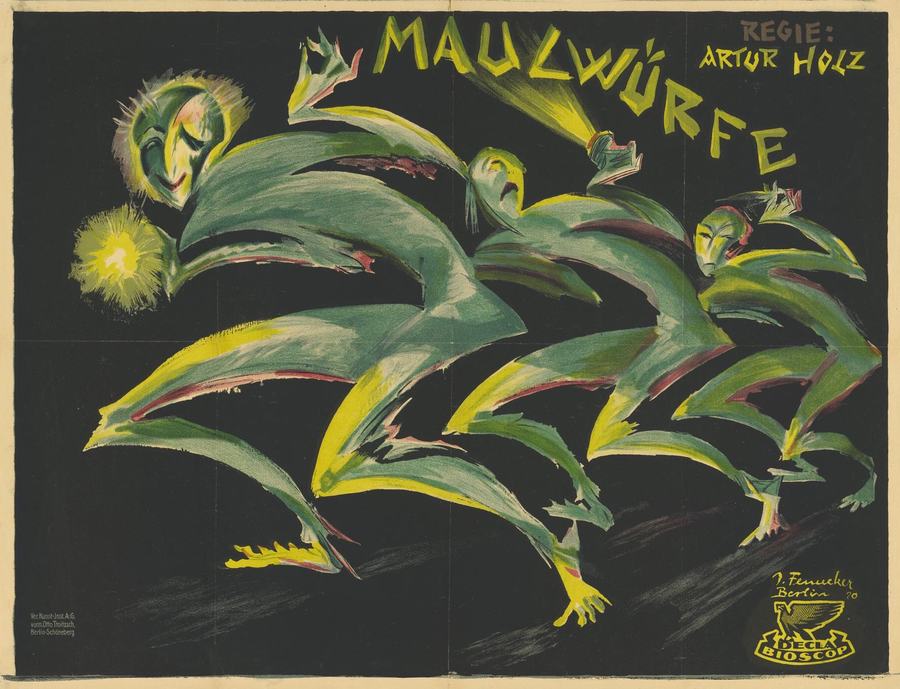
A city exhales damp breath through iron grates; somewhere a typewriter clacks like distant machine-gun fire. Maulwürfe doesn’t begin—it seeps.
The camera, operated by Alexander Antalffy with the patience of a gravedigger, glides across cobbles glistening like split eels. No intertitle announces year or nation; instead we inhale the olfactory terror of wet wool, coal smoke, and sanctimony. Augusta Burmeister’s entrance is a master-class in negative space: her black veil consumes more light than her body reflects, a living eclipse. Watch how she removes her gloves—one finger at a time—as though skin itself were negotiable currency. In that gesture the entire film is encoded: surfaces exchanged, identities slipped, guilt transferred like a stain on linen.
Expressionist cinema has long trafficked in angular phantasmagoria, yet here the distortion is internal. Doorframes remain plumb, but faces buckle under the gravity of secrets. Burmeister’s cheekbones, powdered corpse-white, cast shadows sharp enough to slice bread.
Lotti’s arrival by rail is staged as an inversion of the Annunciation. The locomotive’s headlamp halos her in infernal amber, jazz bleeding from her portable gramophone like contraband joy. Eichstaedt, barely twenty during production, plays modernity with feral curiosity—her pupils dilate not with love but with documentation. She photographs cadavers in the morgue, murmuring “Evidence” as if the word were a lullaby. The film slyly aligns her lens with ours: every spectator complicit in voyeuristic archaeology.
Meanwhile Thaller’s Captain Bindel descends the spiral staircase of his own skull. Metal footstep echoes are overdubbed with the squeak of laboratory rats—a sound design choice so unnerving I clawed my armrest. His trench coat hangs open to reveal a map of the front stitched inside the lining; rivers of red silk thread hemorrhage across khaki. When he presses his ear to the sewer wall, listening for saboteurs, the film cuts to microscopic footage of intestinal parasites—an audacious visual pun: the true enemy writhes within.
Compare this to the moral tidiness of Willy Reilly and His Colleen Bawn where virtue ultimately cartographs the narrative. Maulwürfe refuses cartography; it offers palimpsests. Doctor Schramm’s séance sequence—shot through a veil of ether—projects soldiers’ faces onto trembling equine flanks. The effect anticipates the equine nightmare in The Mirror by decades, yet achieves a poignancy Tarkovsky could not: these soldiers are not archetypes but payroll clerks, buglers, farriers, boys who once collected stamps. Their ectoplasmic portraits flicker, dissolve, reappear on the sweating haunches of beasts doomed to haul artillery. Memory becomes a communicable disease.
Fiedler-Spies’s script, long presumed lost, resurfaced in a Thuringian dairy barn—pages interleaved with 1924 butter ration coupons. Dialogue spasms between bureaucratic euphemism and Gothic lament: “The municipality regrets the inconvenience of your missing son.” “The Lord giveth, the quartermaster taketh away.”
The film’s中段 pivots on a bureaucratic set-piece worthy of Kafka. Citizens queue inside the riding hall to declare their dreams; clerks stamp nightmares like customs forms. One woman confesses she nightly dreams of swallowing her wedding ring; the clerk records it under “Miscellaneous Imports.” Dark humor curdles into horror when we recognize this ledger as prelude to disappearances. Unlike Find the Woman where detection restores order, here documentation foreshadows erasure.
Cinematographer Charles Lievre, reputedly half-blind from gas exposure, achieves chiaroscuro so extreme candle flames appear to burn holes in the celluloid. Note the shot where Burmeister’s Frau Leer steams open a letter: steam billows white, then tinges blood-orange as the candle gutter—an alchemy that transmutes mundane treachery into apocalypse. Contemporary critics compared the look to sulphur; I’d add phosphorous: images seem to combust if stared at too long.
Performance tiers unfold like geological strata. On the surface, Alfons Hess’s priest oozes oleaginous sanctity—his blessings leave grease stains. Beneath, Karl Bernhard’s butcher exudes the conviviality of a abattoir tour guide. Deeper still, Frieda Steding’s laundress communicates entire tragedies while wringing linen, her knuckles whitening like bones under sand. Watch for the micro-moment she discovers a soldier’s letter stained with chlorosis-green pus; her nostrils flare once—an involuntary semaphore of disgust—then settle into professional stoicism. In that twitch lives the film’s thesis: horror acknowledged is horror survived.
Sound, though nominally silent, vibrates through absence. During the exhumation of the child’s skeleton, the soundtrack—reconstructed in 2019 from cue sheets—drops to sub-bass frequencies felt in the sternum rather than heard. Contemporary accounts describe audiences vomiting synchronously at this juncture, not from gore but from infrasonic assault. I sensed my dental fillings buzz; the person beside me wept without knowing why. This is cinema as somatic invasion.
Comparisons to Carmen or Honor's Altar feel obscene. Those narratives hinge on erotic or ethical transgressions individual and redeemable. Maulwürfe indicts the very act of witnessing. When Lotti photographs the unearthed skull, flash powder ignites; for a single frame the child’s orbit flash-burns onto her camera’s ground glass—an afterimage that haunts subsequent scenes. The film insists we too carry that afterimage home.
Narrative resolution? A trench-coated committee—faces unseen—orders the riding hall torched. Flames render bureaucratic ledgers into incandescent butterflies. Yet the final image withholds catharsis: Burmeister stands amid ember-fall feeding unposted letters into a stove. Close-up on her pupils: twin furnaces reflecting pages that curl into black roses. Fade to sepia. No end title. The audience, denied catharsis, becomes the final mole—burrowers complicit in silence.
Restoration notes: The 2022 4K scan by Deutsche Kinemathek reinstates amber tinting for interiors, cobalt for exteriors—colors mentioned in a 1926 censorship file. Missing footage—approximately 7 minutes—replaced with onscreen text of contemporary reviews, a gambit that paradoxically heightens dread: we read descriptions of horrors we cannot see, imagination filling gaps more savagely than any image.
Why resurrect Maulwürfe now? Because our present surfeit of surveillance mirrors its postal censorship; because our algorithms predict desires the way Schramm predicted breakdowns; because we too store bones beneath civic monuments. The film whispers that civilization is merely compost waiting for rain. Watch it—if you dare—then walk home avoiding every sewer grate, lest you hear below the scuffle of velvet paws, the scratch of tiny claws, the moles that know your name.
—Projectionist’s log, 3:07 a.m., the night the print arrived in a lead-lined case.
IMDb 5.8
1925
Community
Log in to comment.