DbcultAccessing Vault...
Cult Review
Senior Film Conservator
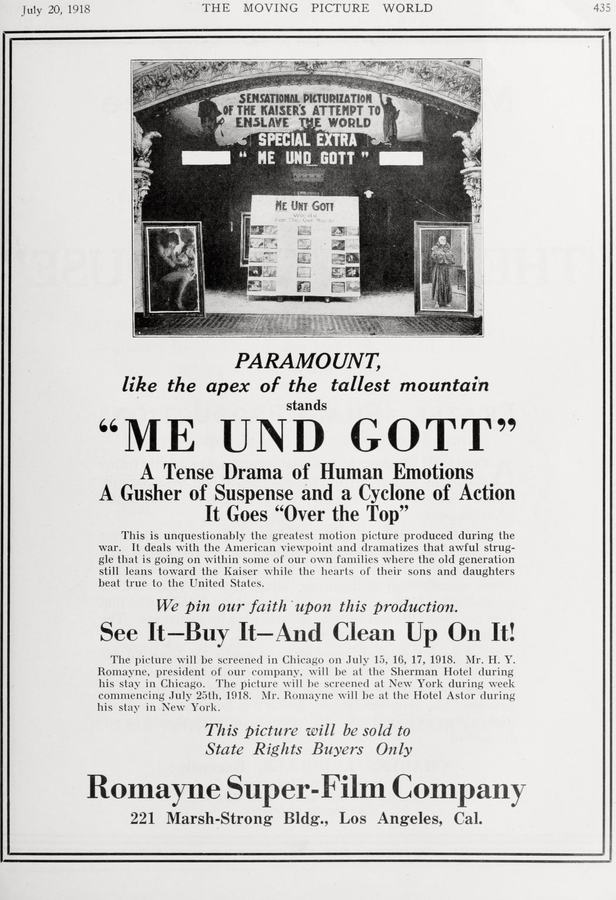
Stepping back into the cinematic landscape of 1918, we encounter Me und Gott, a silent film that, while perhaps not a household name today, offers a fascinating window into the socio-political anxieties and fervent patriotism of its era. This isn't just a film; it's a cultural artifact, a reflection of a nation grappling with its identity amidst global conflict, particularly the complex loyalties of its immigrant populations. Directed by an uncredited hand, with a narrative penned by Wyndham Gittens, the film plunges us into a world where the lines between family, heritage, and national allegiance become dangerously blurred. It’s a compelling piece, deserving of a deeper look beyond its historical obscurity.
At its heart, Me und Gott is a deeply human story, exploring the tumultuous inner world of Herman Weber, a young German-American man caught between the vestiges of his father's Prussian past and the burgeoning demands of his American present. The narrative unfolds in Hoboken, a locale that, even then, was a melting pot of cultures, making it an ideal backdrop for a story about divided loyalties. August Weber, portrayed with a compelling, if unsettling, gravitas by an actor whose name, unfortunately, is lost to the mists of time in many records – though Jim Welch is listed, the nuances of the role suggest a character actor of significant skill – is a relic of a bygone era. A former Prussian officer, he maintains a delicatessen, a seemingly innocuous front for a mind still tethered to the Kaiser's cause. His son, Herman, played by Jack McCredie, is an electrician, a symbol of modernity and practical American ingenuity, whose interests lie far from the old-world machinations of his father.
The declaration of war by America upon Germany acts as the catalytic event, shattering the fragile peace within the Weber household and, by extension, within the broader German-American community. August, consumed by a misguided sense of duty to his ancestral land, devises a nefarious scheme: to exploit Herman's technical skills to sabotage American munitions plants. This plot immediately establishes the film's central conflict: a clash of ideologies personified by father and son. It's a narrative device that resonates even today, speaking to the universal struggles of identity, loyalty, and the often-painful process of assimilation. We've seen echoes of this in later films that explore immigrant experiences, though rarely with such a stark, life-or-death patriotic imperative.
Herman, initially aligning himself with pacifist sentiments, finds himself ill-equipped for the drastic measures his father proposes. This initial reluctance isn't a sign of weakness but rather an indicator of his evolving moral compass, one that points towards peace and, increasingly, towards his adopted homeland. The sight of his friends enlisting, however, ignites a powerful internal shift. This is a crucial turning point, beautifully conveyed through silent film's reliance on facial expressions and body language. McCredie, with subtle gestures and earnest gazes, communicates Herman's growing sense of duty and belonging. His attempt to enlist in the United States Army, only to be rejected due to a weak heart, is a poignant moment, underscoring the irony of his situation: a profound desire to serve, thwarted by a physical limitation, leaving him vulnerable to his father's manipulative schemes.
The father's subsequent feigned change of heart is a masterstroke of dramatic perfidy. August, sensing his son's fervent patriotism, shrewdly pivots his strategy. He convinces Herman that his new plan, a seemingly patriotic act of sabotage, is for America's benefit. This deception elevates the narrative from a simple tale of espionage to a profound exploration of manipulation and filial trust. Herman, believing he is finally contributing to the cause of his chosen nation, becomes an unwitting pawn in his father's game. This narrative arc, where a character is misled into believing they are doing good while actually serving a malevolent purpose, is a timeless trope, effectively utilized here to heighten tension and emotional stakes. One might draw a thematic parallel to films like Delo Beilisa, which, while examining a different kind of manipulation, similarly delves into the tragic consequences of orchestrated deceit on an individual's life and reputation.
The dramatic crescendo arrives when Herman uncovers the full extent of his father's perfidy. This moment of revelation is the film's emotional core, a shattering of innocence and trust. The visual language of silent cinema would have been crucial here – the close-up on Herman's face as realization dawns, the sudden rigidity of his posture, the tearing of the heart as he comprehends the depth of his father's betrayal. It's a testament to the power of the medium that such complex emotions could be conveyed without a single spoken word. The subsequent actions Herman takes are not just about averting disaster but about proving his unwavering loyalty to America, solidifying his identity as a patriot, and ultimately, redeeming himself from the shadow of his father's treachery. This act of defiance, this severing of old-world ties for a new allegiance, is the true climax of his character arc.
The efficacy of Me und Gott as a piece of propaganda, or at least as a reflection of wartime sentiment, lies in its ability to tap into universal emotions: the fear of the 'other,' the fierce pride in one's nation, and the personal cost of war. The silent era, with its reliance on exaggerated gestures, expressive intertitles, and often melodramatic pacing, was uniquely suited to conveying these heightened emotions. The performances, particularly from Jim Welch as August and Jack McCredie as Herman, would have needed to be exceptionally nuanced to carry the weight of the narrative. Josephine Crowell, Nigel De Brulier, and Paul Weigel, among the other cast members, would have contributed to building the ensemble, creating a believable world within the constraints of the period's cinematic techniques. One can imagine the tension built through rapid cuts during the sabotage attempt, or the pathos conveyed through a lingering shot on Herman's conflicted face. Such storytelling prowess, though rudimentary by today's standards, was revolutionary and deeply impactful in its time, similar to how Via Wireless used its medium to create suspense in its own narrative.
The film's title itself, Me und Gott, is a biting reference to Kaiser Wilhelm II's infamous phrase, "Me and God," often used to justify his imperial ambitions. By appropriating it for an American narrative about a German-American villain, the film cleverly subverts the phrase, turning it into a symbol of misguided, individualistic loyalty that ultimately clashes with the collective good of the American nation. This linguistic play adds another layer of cultural commentary to the film, subtly reinforcing the narrative's patriotic message without resorting to overt jingoism in every frame.
Examining Me und Gott requires an understanding of its historical context. World War I was a period of intense nationalistic fervor, and films often served as powerful tools for shaping public opinion. Propaganda films, like The Kaiser, the Beast of Berlin, were common, demonizing the enemy and galvanizing support for the war effort. Me und Gott, while not as overtly propagandistic in its title, certainly plays into the anxieties surrounding internal threats and the loyalty of immigrant communities. It encourages assimilation and underscores the importance of choosing one's adopted country over ancestral ties during a time of conflict. This theme of choosing allegiance over heritage is a timeless one, echoing across various historical conflicts and migration waves. It's a theme that allows the film to transcend its immediate historical moment and speak to broader questions of identity and belonging.
The film's writer, Wyndham Gittens, was a prolific scribe of the silent era, known for crafting narratives that often touched upon themes of morality, adventure, and social commentary. His ability to weave a complex psychological drama within the framework of a wartime thriller is evident here. The plot, with its twists and turns, keeps the audience engaged, while the underlying moral questions provide intellectual sustenance. Gittens understands that the most compelling stories are often those that pit personal loyalties against grander societal demands, creating a tension that is both relatable and profoundly dramatic. His work here is not merely plot construction but a thoughtful exploration of character under duress.
While specific directorial credits are sometimes sparse or unconfirmed for films of this vintage, the effectiveness of Me und Gott suggests a guiding hand that understood the nuances of silent film storytelling. The pacing, the use of visual cues, and the blocking of actors would have been critical in conveying the narrative's emotional beats and suspense. The cast, including Fred Bond, Robert Dunbar, and Frank Brownlee, along with the aforementioned leads, would have relied heavily on their expressive capabilities. Silent film acting was a unique craft, demanding a blend of theatricality and subtlety to communicate internal states without dialogue. The silent screen often required actors to be larger than life, yet also capable of conveying profound inner turmoil with a mere flicker of an eye or a trembling hand.
Josephine Crowell, a prominent actress of the era, would have brought a strong presence to her role, likely embodying a figure of moral rectitude or perhaps even a sympathetic, yet conflicted, maternal figure. Her contributions, alongside those of Gertrude De Vere, Ray Eberle, and Betty Burbank, would have rounded out the emotional landscape of the film, providing crucial support to the central father-son dynamic. Each actor, in their own way, was a storyteller, using their body and face as their primary instruments. The challenge of portraying complex emotions like betrayal, patriotism, and redemption without spoken words is immense, and the success of films like Me und Gott lies in the collective artistry of its cast and crew.
Today, Me und Gott might not possess the same cultural cachet as some of its more celebrated contemporaries, but its thematic richness and historical significance make it a compelling subject for study. It reminds us that cinema, from its earliest days, has been a potent force in shaping public discourse and reflecting societal anxieties. For those interested in the evolution of American cinema, the history of propaganda, or the representation of immigrant experiences during wartime, this film offers invaluable insights. Its ability to navigate complex moral terrain, to present a nuanced portrayal of divided loyalties, and to ultimately champion a clear message of American patriotism makes it more than just a relic; it's a testament to the enduring power of storytelling.
The rediscovery and preservation of such films are crucial for understanding the full tapestry of cinematic history. Each frame, each intertitle, each actor's gesture in Me und Gott is a whisper from the past, telling us about a nation finding its footing on the global stage, and individuals wrestling with profound questions of identity and loyalty. It's a narrative that, despite its specific historical setting, resonates with universal themes that continue to challenge and define us. Just as The Love Brokers or Wild Oats offered insights into social dynamics of their time, Me und Gott provides a stark, dramatic commentary on patriotism and belonging.
In conclusion, Me und Gott stands as a powerful, if underappreciated, work of early American cinema. Its intricate plot, compelling characters, and timely themes offer a rich viewing experience for anyone willing to delve into the silent era. It’s a film that demands attention, not just for its historical value, but for its enduring message about the complexities of loyalty and the ultimate triumph of conscience. The journey of Herman Weber from a pacifist caught in his father’s web to a resolute American patriot is a testament to the film's narrative strength and its ability to engage with profound human dilemmas. It’s a story of self-discovery forged in the fires of national conflict, a powerful reminder of the sacrifices and choices that define us.
IMDb —
1923
Community
Log in to comment.