DbcultAccessing Vault...
Cult Review
Senior Film Conservator
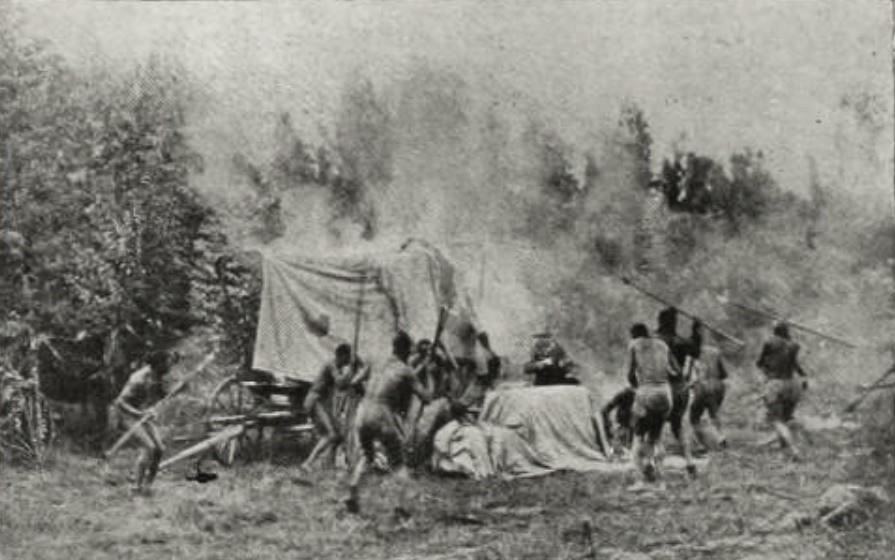
To witness Vengeance of the Wilds is to step into a time capsule where the grammar of cinema was still being forged in the crucible of the American frontier. This 1915 relic, directed with a surprisingly modern sense of spatial awareness, transcends the simplistic 'Northwoods' tropes of its era. It is a film that breathes through its environment, utilizing the sprawling, unmanicured landscapes not merely as a stage, but as a primary character that dictates the rhythm of the soul. In the same vein as the psychological depth found in Blodets röst, this production seeks to unearth the primal motivations that drive a man to the brink of his own humanity.
The screenplay, credited to the enigmatic Big Otto, displays a sophisticated understanding of tension and release. Unlike the more theatrical plotting of David Copperfield, which relied heavily on established literary structures, Vengeance of the Wilds feels born from the soil itself. The pacing is deliberate, almost agonizingly so, mirroring the slow crawl of a predator through the underbrush. Otto understands that in the silence of the 1915 screen, the visual cadence is everything. There is a palpable sense of dread that permeates the early scenes, a foreshadowing that rivals the atmospheric density of Fantasma.
The narrative doesn't merely present a conflict; it interrogates the very concept of justice in a lawless land. We see echoes of the moral ambiguity found in Tainted Money, where the acquisition of wealth or survival often demands a sacrifice of the spirit. The dialogue intertitles are sparse, allowing the physical performances of the ensemble cast to carry the weight of the subtext. This is a film that trusts its audience to interpret the flicker of doubt in a character's eye or the hesitation in their stride.
Charles Le Moyne delivers a performance of remarkable restraint. In an era often criticized for its histrionic acting styles—seen in some of the more melodramatic sequences of A Fool There Was—Le Moyne opts for a grounded, internal approach. His face is a map of weathered experience, every line telling a story of previous battles with both nature and man. He occupies the frame with a heavy, gravitational presence that anchors the film's more kinetic moments.
Opposite him, Lorraine Otto provides a nuanced portrayal of resilience. She is not the typical damsel in distress; rather, she represents the civilizing force that is constantly under threat by the masculine ego and the wild's indifference. Her chemistry with Le Moyne is subtle, built on shared glances and the mundane rituals of frontier life, making the eventual disruption of their peace all the more devastating. It is a dynamic that feels more grounded than the heightened romanticism found in The Battle of Love.
Harry De Vere, as the antagonist, is a revelation of understated villainy. He doesn't twirl a mustache or engage in overt theatrics. Instead, he embodies a cold, bureaucratic cruelty—a man who views the wilderness not as a home, but as a resource to be plundered. His interactions with Charles Wheelock create a secondary layer of conflict that elevates the film from a simple revenge story to a broader critique of industrial encroachment on the natural world, similar to the thematic undercurrents in On Dangerous Paths.
The visual language of Vengeance of the Wilds is startlingly evocative. The use of natural light creates a chiaroscuro effect that highlights the isolation of the characters. The camera often lingers on the vastness of the horizon, making the human figures appear small and inconsequential. This technique reminds one of the scale used in The Typhoon, where the environment serves to dwarf human ambition. The composition of the shots, particularly during the climactic pursuit, utilizes deep focus to keep the looming threat of the forest ever-present.
There is a specific sequence involving a river crossing that stands out as a triumph of early practical effects and stunt work. The visceral reality of the rushing water and the genuine peril faced by the actors provides a level of immersion that modern CGI frequently fails to replicate. It captures the same sense of mechanical and physical urgency found in the suspenseful Time Lock No. 776. The editing, while rudimentary by today's standards, exhibits a keen sense of rhythm, particularly in how it cuts between the hunter and the hunted, building a palpable sense of kinesis.
Released in 1915, the film arrived at a crossroads of American identity. As the urban sprawl began to dominate the cultural consciousness, the 'Wilds' became a mythological space for testing one's character. Vengeance of the Wilds taps into this zeitgeist, presenting the frontier as a purgatory where sins are purged and true natures are revealed. It shares this ontological curiosity with Dämon und Mensch, exploring the duality of the human condition when stripped of societal guardrails.
Furthermore, the film’s exploration of vengeance is surprisingly cynical. It does not offer the easy catharsis one might expect. Instead, it suggests that the act of revenge is a transformative process that leaves the seeker as scarred as the victim. This complexity is often missing from contemporary works like The Perfect '36' or the more lighthearted A Continental Girl. Here, the 'vengeance' of the title is a double-edged sword, cutting through the protagonist's morality as much as it does the antagonist's flesh.
When comparing this film to its contemporaries, its unique texture becomes even more apparent. While Das Geheimschloss relies on the claustrophobia of its gothic setting to generate thrills, Vengeance of the Wilds uses the infinite openness of the woods to create a different kind of entrapment—the entrapment of one's own choices. There is no castle to hide in, no locked doors to provide sanctuary; there is only the vast, indifferent expanse of the trees.
In terms of character development, the film mirrors the tragic trajectories found in Trompe-la-Mort, where fate seems to conspire against the individual's desire for a quiet life. The characters in Big Otto's world are often at the mercy of 'At the Cross Roads' moments—pivotal decisions that irrevocably alter their destiny, much like the thematic core of At the Cross Roads. However, the resolution here is far more somber, lacking the melodramatic redemption arcs common in mid-1910s cinema.
Ultimately, Vengeance of the Wilds is a haunting reminder of the power of visual storytelling before it became reliant on the crutch of synchronized sound. It demands much from its viewers—patience, observation, and an appreciation for the subtle shifts in atmospheric pressure. The collaboration between Big Otto and the cast resulted in a work that feels remarkably cohesive, a singular vision of a world where the only law is the one you carry within yourself.
For the modern cinephile, this film offers more than just historical curiosity. It provides a blueprint for the survivalist dramas that would follow decades later. It understands that the greatest conflict is not between man and nature, but between the civilized man and the primitive shadow he carries within. It is a stark, beautiful, and ultimately harrowing journey into the heart of the American wilderness, standing tall among the giants of the silent era. Whether you are drawn to it for Le Moyne's commanding presence or the evocative cinematography, Vengeance of the Wilds remains an essential chapter in the evolution of narrative film, a testament to the enduring power of the wild to reflect our darkest and most noble impulses.
Critic's Note:
The restoration of this film (where available) highlights the incredible detail in the costume design and the rugged textures of the location shooting. It is a masterclass in using limited resources to achieve maximum emotional impact. If you have enjoyed the psychological depth of Blodets röst, this is a mandatory addition to your viewing list.
IMDb —
1926
Community
Log in to comment.