DbcultAccessing Vault...
Cult Review
Senior Film Conservator
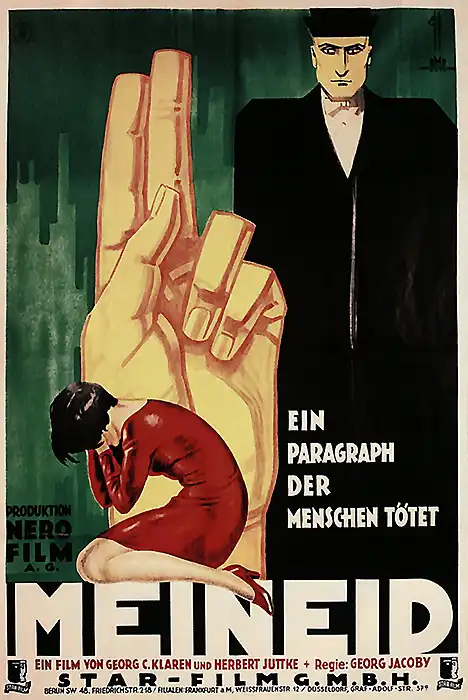
So, Meineid – Ein Paragraph, der Menschen tötet. Yeah, it’s a title that tells you exactly what you’re in for. No subtlety there. For anyone diving into silent German cinema, this one lands somewhere in the middle. It’s not a masterpiece you absolutely must see, but it’s definitely got its moments, especially if you can get past the really deliberate pace.
The film opens with this kind of stark feeling, almost immediately. You’re dropped into a courtroom, which, honestly, feels less like a place of justice and more like a stage for inevitable doom. The stakes are clear from the get-go: someone’s life is on the line because of a lie. Francis Lederer plays the central figure, a fellow whose testimony—or rather, his false testimony—kicks off this whole chain of woe. His face, even in those early frames, carries a certain kind of anxiety. You can just feel the weight of what he’s about to do, or what he’s already done. It’s not a huge, dramatic moment, but the camera just sort of sits there with him for a beat too long, letting that tension sink in. 😬
What struck me was how much the film relies on these quiet, almost mundane, details. There’s a scene where Lederer’s character, I think his name is Robert, walks through a very grey, ordinary street. The buildings feel heavy. The people passing by are just… going about their lives, oblivious to the massive internal storm brewing in him. It makes his personal tragedy feel even more isolating. You know? Like the world just keeps turning, uncaring.
The whole "paragraph that kills" idea, it's pretty literal here. We see the consequences unfold, slowly, like water dripping. It’s not a sudden, violent death, but more of a slow suffocation of a man’s spirit. There’s a particular shot of him later, in a much bleaker setting, just staring out a window. It’s a long take. Really long. You almost start to wonder if the projectionist fell asleep. But then, you realize, it’s supposed to be like that. It’s meant to make you uncomfortable, to feel the boredom and despair alongside him. It kinda works, but also, I definitely checked my watch. 🕰️
Inge Landgut is in this too, though her screen time felt a bit sparse for my taste. She brings a certain fragile intensity to her role, a sort of quiet suffering that contrasts sharply with Lederer's increasingly tormented expressions. There's this one scene where she just looks at him, no words, just a *look*. And you get everything. It’s a powerful, understated moment that really stuck with me.
The film isn't trying to be subtle about its message. Perjury is bad. Very bad. It destroys lives. Got it. But it doesn't just preach; it *shows* the decay. The legal system itself almost becomes a character, a kind of indifferent monster. There’s a part where the court clerks are just shuffling papers, looking utterly bored, while someone's entire future is being decided. It's a small detail, but it makes you think about how impersonal justice can feel sometimes.
And the way they show flashbacks? Very cool for its time. Not fancy dissolves, just sudden cuts back to the moment of the lie, almost jarring. Like a recurring nightmare for Robert. It really drives home that feeling of being trapped by a past mistake.
One thing that was a little odd: there's this character, played by Maria Forescu, who has a very small, almost cameo role. She's just this old woman, observing things, almost a Greek chorus without the speaking part. Her eyes follow Robert sometimes, and it’s unsettling. You wonder what she knows, or what she represents. They don't explain her, and that's okay. Some things just... are.
The pacing, oh boy, the pacing. If you’re used to modern films, this will feel like molasses. But it's not without purpose. The slow unfolding really lets the dread build. You see the cracks forming in Robert’s life, one by one. His relationships, his standing in the community, everything just crumbles. It’s a very deliberate kind of despair.
Comparing it to something like Das törichte Herz, which has its own slow emotional beat, *Meineid* feels a lot heavier, less about internal romance and more about external consequence. And it's definitely a far cry from, say, the more fantastical elements of Alraune und der Golem. This is firmly grounded in a grim reality, even if it's a very stylized, silent film reality.
The ending, without giving anything away, really hits you. It's not a tidy wrap-up. It leaves you with a certain hollowness. The "paragraph" truly does its work. It makes you think about how easily a life can be derailed by one bad choice, and how unforgiving the system can be. Is it a fun watch? Absolutely not. Is it thought-provoking? Yeah, in its own somber way. If you have a rainy afternoon and a curious mind for older films, give it a shot. Just be ready to settle in. And maybe have some snacks. 🍿
Community
Log in to comment.