DbcultAccessing Vault...
Cult Review
Senior Film Conservator
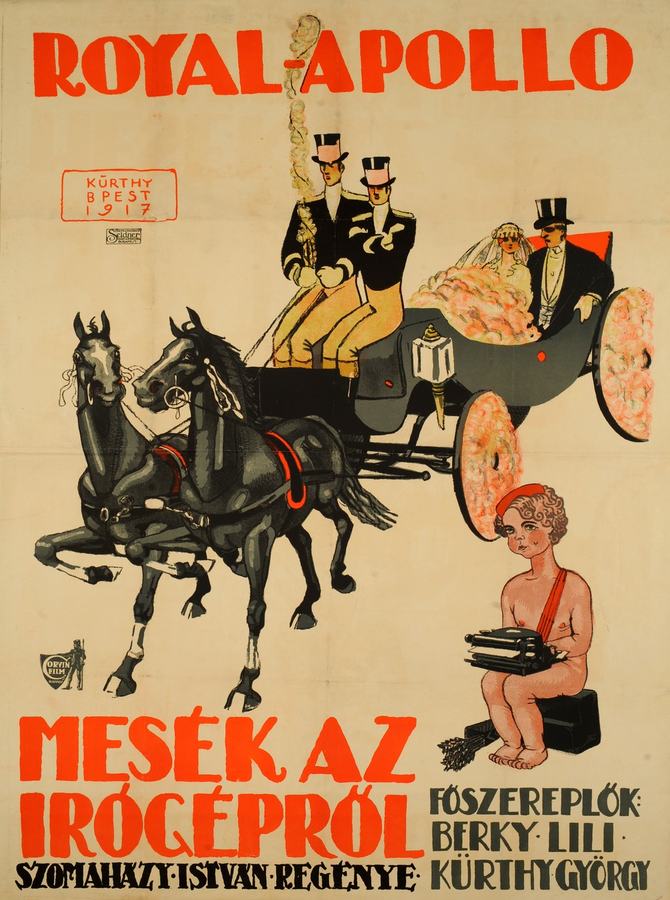
There's a peculiar magic to unearthing a forgotten cinematic artifact, especially one that hails from the nascent days of a legendary director's career. Alexander Korda, a name synonymous with grand British productions and Hollywood ambition, began his illustrious journey in the vibrant, if often turbulent, landscape of early Hungarian cinema. 'Mesék az írógépröl' (Tales of the Typewriter), a film whose very title evokes a sense of quiet intrigue and untold stories, stands as a testament to Korda's nascent genius and the rich narrative potential of the silent era. For too long overshadowed by his later, more internationally acclaimed works, this picture, if one is fortunate enough to experience it, offers a rare glimpse into the intellectual and artistic currents that shaped a cinematic titan.
The film, a fascinating exploration of modernity, communication, and the shifting role of women in society, places a seemingly inanimate object – the typewriter – at the very heart of its narrative universe. In an age rapidly transitioning from handwritten missives to the efficient clatter of keys, the typewriter wasn't just a machine; it was a symbol, a harbinger of change, a democratizer of information, and, in Korda's hands, a silent observer of human drama. This isn't merely a tale; it's a series of vignettes, a mosaic of lives touched and transformed by the rhythmic tap-tap-tapping that permeated offices and homes across the globe. It's a film that asks us to consider the power inherent in the transcription of words, the subtle influence wielded by those who merely record history, and the profound impact of technology on the human condition.
At the core of 'Mesék az írógépröl' is the remarkable performance of Ilona Jakabffy as Eszter, a character who embodies the spirit of a new generation of women. Eszter is not merely a background fixture; she is the central nervous system of the narrative, her journey from a wide-eyed provincial arriving in the bustling Hungarian capital to a discerning participant in its intricate social tapestry forming the emotional spine of the film. Jakabffy, with an expressiveness that transcends the limitations of silent cinema, imbues Eszter with a quiet strength and an evolving awareness. Her subtle gestures, the nuanced shifts in her gaze, and her restrained yet potent reactions convey a depth of character that many of her contemporaries struggled to achieve. She is the quintessential 'modern woman' of the era, navigating a world of increasing complexity, seeking independence, and finding her voice not through grand pronouncements but through the meticulous work of her hands.
The narrative, crafted by Alexander Korda himself alongside István Szomaházy, is surprisingly intricate for its time. It eschews simplistic melodrama for a more layered exploration of character and consequence. Eszter, as a typist in a prominent legal firm, becomes an unwitting confidante to the city's secrets. The documents she processes – legal briefs, scandalous letters, business contracts – are not just words on a page; they are fragments of lives, clues to mysteries, and catalysts for drama. Korda masterfully uses these documents as narrative devices, allowing the audience to piece together the larger picture alongside Eszter. This technique, while seemingly straightforward, effectively pulls the viewer into the protagonist's perspective, making us feel her growing understanding and her moral dilemmas.
The supporting cast, a veritable who's who of early Hungarian cinema, lends significant weight to the unfolding drama. Jenö Janovics, a prominent figure in the industry, delivers a compelling turn as a charismatic barrister whose motivations remain tantalizingly ambiguous. His interactions with Eszter are charged with an unspoken tension, a dance between professional decorum and burgeoning personal feeling. Mihály Bérczy, as the wrongfully accused, evokes a profound sense of pathos, his silent suffering a powerful counterpoint to the bureaucratic machinations surrounding him. The ensemble, including Ilonka Székely, László Betegh, and Lili Berky, each contribute to the film's rich texture, portraying a cross-section of Budapest society – from the morally upright to the subtly corrupt – all caught in the inexorable march of progress.
Korda's direction in 'Mesék az írógépröl' is remarkably sophisticated for a film of its vintage. He demonstrates a keen understanding of visual storytelling, utilizing close-ups to emphasize emotional states and wider shots to establish the urban grandeur of Budapest. The pacing is deliberate, allowing the audience to absorb the nuances of the plot and the subtleties of the performances, yet it never drags. There's a palpable sense of tension that builds as Eszter delves deeper into the legal case, a tension masterfully orchestrated through Korda's judicious use of intertitles and his dynamic editing. One can discern the nascent stylistic flourishes that would later define his more famous works, a nascent mastery of mise-en-scène that elevates the film beyond mere historical curiosity.
The film's thematic resonance extends far beyond its historical context. It's a meditation on the power of information and the ethical responsibilities that come with its handling. In an age where digital communication inundates our lives, Korda's exploration of the typewriter's impact feels remarkably prescient. It reminds us that technology, while a tool for progress, can also be a weapon, a means of manipulation, or a conduit for truth, depending on the hands that wield it. Eszter's journey is, in many ways, a universal one: the individual confronting systemic injustice, the search for personal agency in a world that often seeks to define and limit us.
Comparing 'Mesék az írógépröl' to its contemporaries reveals its unique strengths. While films like `/movies/les-miserables-part-1-jean-valjean` delved into grand narratives of social injustice and individual struggle, Korda's film offers a more intimate, yet equally profound, exploration through the lens of a single, unassuming character. The intrigue, while not as overtly sensational as in something like `/movies/fantomas-the-false-magistrate`, is deeply rooted in human motivations and the intricacies of the legal system, making it perhaps more psychologically compelling. Furthermore, in its depiction of a woman finding her voice and purpose through intellectual work, it subtly echoes the burgeoning feminist sentiments explored more directly in films like `/movies/what-80-million-women-want`, showcasing a similar undercurrent of female empowerment, albeit through a distinctly European lens.
The film's portrayal of Budapest itself is another character, a vibrant, evolving backdrop to Eszter's personal and professional awakening. Korda captures the city's energy, its architectural grandeur, and its social stratification with an eye for detail that transports the audience back in time. The film is a visual document of a bygone era, a snapshot of a city on the cusp of significant change, mirroring the transformation within Eszter herself. The contrast between the old-world charm and the stark modernity of the office environment is subtly highlighted, adding another layer to the film's rich thematic tapestry.
One cannot discuss 'Mesék az írógépröl' without acknowledging its place within Alexander Korda's extraordinary career. This early work provides crucial insight into the director's evolving craftsmanship. Here, we see the foundation of his later ability to orchestrate complex narratives and elicit powerful performances. It's a film that, despite its age and relative obscurity, possesses a vitality and intelligence that belies its simple premise. It serves as a reminder that even in the earliest days of cinema, filmmakers were grappling with sophisticated themes and pushing the boundaries of visual storytelling. While perhaps not as overtly dramatic as a film like `/movies/tosca`, its quiet intensity and psychological depth leave a lasting impression.
The meticulous attention to detail in the set design and costuming further immerses the viewer in the period. The offices, with their imposing wooden furniture and rows of typewriters, feel authentic, lived-in spaces. Eszter's evolving wardrobe, from her modest provincial attire to her more sophisticated urban ensembles, subtly mirrors her personal growth and increasing confidence. These elements, though seemingly minor, contribute significantly to the film's overall authenticity and its ability to transport the audience into its world. The visual aesthetic of the film, with its stark black and white contrasts, is used to great effect, emphasizing the moral ambiguities and the clear-cut decisions Eszter is forced to confront.
In conclusion, 'Mesék az írógépröl' is far more than just a historical curiosity or a footnote in a famous director's biography. It is a compelling, emotionally resonant film that stands on its own merits. It is a profound exploration of technology's impact on human lives, the burgeoning independence of women, and the quiet power of the written word. If you ever have the opportunity to witness this rarely screened gem, seize it. It offers not only a window into the early genius of Alexander Korda but also a timeless reflection on themes that continue to resonate today. This film, with its intricate plot, stellar performances, and thoughtful direction, solidifies its place as an important, albeit underappreciated, piece of cinematic history. It's a testament to the fact that even the most unassuming tools can become instruments of profound change, and that the 'tales of the typewriter' are, in essence, the tales of humanity itself. The journey of Eszter, illuminated by the flicker of the projector and the rhythmic clatter of keys, remains an enduring testament to the enduring power of silent cinema to speak volumes.
IMDb —
1921
Community
Log in to comment.