DbcultAccessing Vault...
Cult Review
Senior Film Conservator
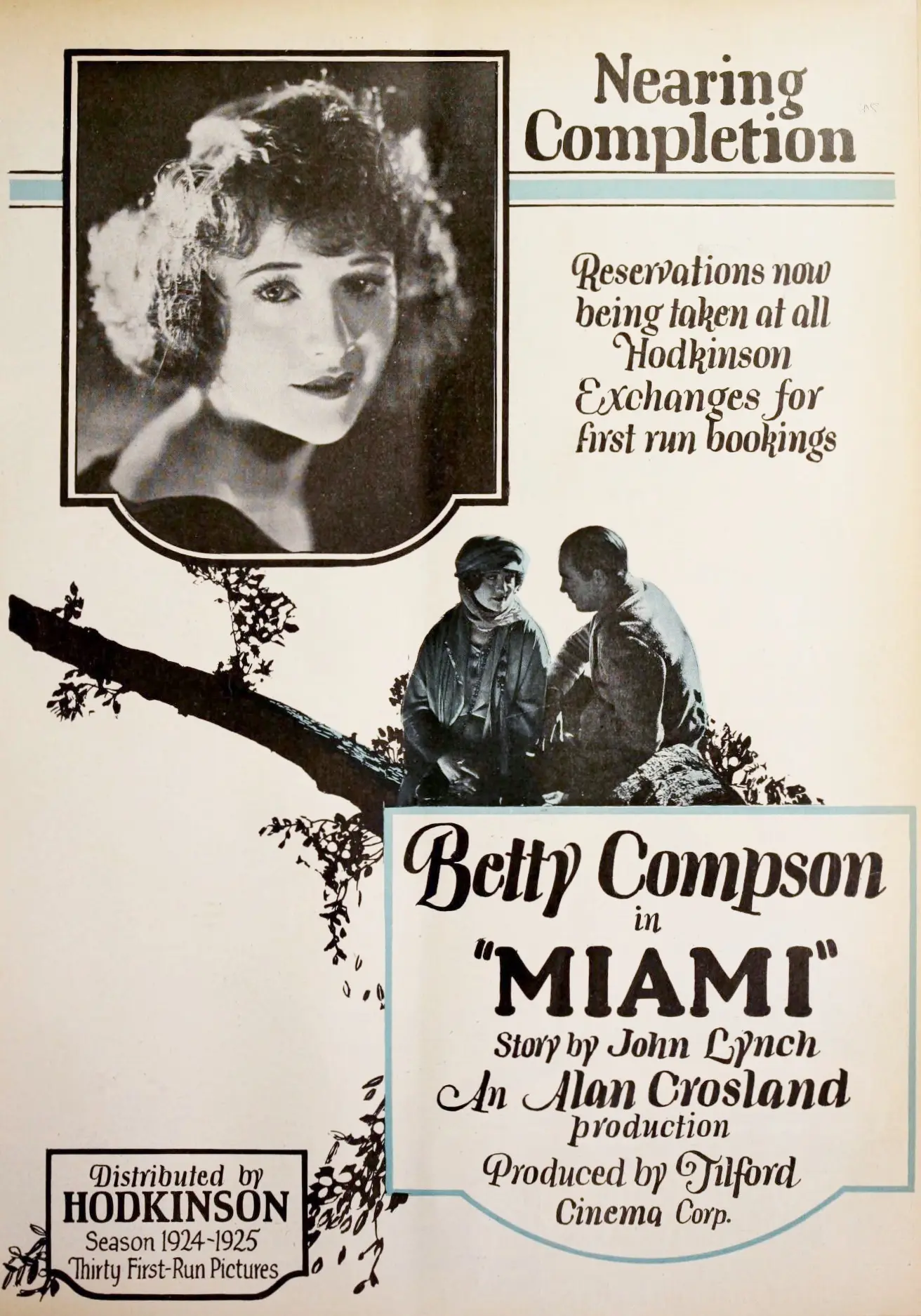
Step into the shimmering, often tumultuous, world of the 1920s, where the silver screen was just beginning to truly capture the zeitgeist of a rapidly changing America. Among the myriad of silent dramas that sought to reflect and refract the era's anxieties and aspirations, 'Miami' (1924) emerges as a fascinating, if perhaps overlooked, artifact. This film, starring the luminous Betty Compson, offers a window into the societal pressures and romantic entanglements that defined the Jazz Age, presenting a narrative that, while ostensibly straightforward, hints at deeper currents of morality, reputation, and the precarious position of women in a world both liberated and restrictive.
At its heart, 'Miami' is a tale of a woman caught between two strikingly different men, a classic cinematic trope that nevertheless finds fresh resonance within its specific historical context. Joan Bruce, portrayed with a compelling blend of vivacity and vulnerability by Compson, is established as a central figure in Miami’s burgeoning jazz scene. The very phrase 'leader of the jazz set' immediately paints a vivid picture: a woman of charisma, perhaps a flapper, certainly someone who embodies the new freedoms and social dynamism of the era. She is not merely a passive object of affection but an active participant in her social world, a magnet for attention, particularly from the male gaze.
The narrative pivots around the dual courtship of Joan by Ranson Tate and Grant North. Tate, brought to life by Lawford Davidson, is the quintessential unscrupulous villain. The plot's description of him as having 'deserted his wife on becoming wealthy' is a potent detail, immediately establishing his character as morally bankrupt and driven by self-interest. In the 1920s, a time when divorce was still a significant social taboo and marital fidelity held considerable weight, such a character would have been instantly recognizable as a cad, a danger not just to individuals but to the very fabric of societal norms. His wealth, rather than being a sign of virtue, is tainted by the means of its acquisition and his subsequent abandonment of spousal duty. This makes his pursuit of Joan not an act of genuine affection, but rather an extension of his acquisitive nature, a conquest to add to his material possessions, further underscoring his predatory essence.
In stark contrast stands Grant North, played by Benjamin F. Finney Jr. He is introduced as a 'young man who ignores her advances until he saves her from drowning.' This dynamic is particularly intriguing. Why does North initially ignore Joan's advances? Is it a sign of his own aloofness, a disinterest in the superficiality of the jazz set, or perhaps a subtle commentary on male perceptions of assertive women during the period? His eventual heroism, saving her from drowning, serves as a catalyst, transforming his indifference into a protective instinct, and presumably, affection. This moment of crisis and rescue is a powerful narrative device, often used in silent cinema to forge an undeniable bond between characters, stripping away societal pretense and revealing deeper, more primal connections.
The 'compromise' of Joan by Tate is the narrative's central crisis, a plot point laden with social implications. In the 1920s, a woman's reputation was her most valuable asset, and being 'compromised' could have devastating consequences, ranging from social ostracization to a complete ruin of her prospects. The very vagueness of 'compromised' allows for a range of interpretations, from a scandalous public incident to something far more insidious and personal. This element of the plot taps into the anxieties surrounding female vulnerability and the power dynamics inherent in male-female relationships of the era. It highlights the precarious balance between the newfound freedoms women were experiencing and the lingering societal judgments that could swiftly undermine their standing.
The ultimate rescue by North, therefore, is not merely a romantic resolution but a restoration of Joan's honor and future. It signifies the triumph of virtue over villainy, of genuine care over cynical exploitation. The film, in this regard, adheres to a classic moral framework, reassuring audiences that despite the allure of the 'unscrupulous' and the dangers of 'compromise,' a righteous path and a heroic rescuer will ultimately prevail. This narrative arc, while seemingly simple, would have resonated deeply with audiences grappling with the rapid societal shifts of the 1920s, offering a comforting reaffirmation of traditional values even amidst the perceived moral looseness of the Jazz Age.
Lawford Davidson, as Ranson Tate, would have had the challenging task of making his villain both alluring and repulsive. The success of such a character often lies in the actor's ability to project a surface charm that masks a deeper depravity. His 'unscrupulous' nature and the detail about his deserted wife would have provided ample material for Davidson to create a character that embodies the dark underbelly of ambition and wealth. One can envision him using subtle sneers, calculating glances, and an air of entitled arrogance to convey Tate's villainy, making his eventual comeuppance all the more satisfying for the audience. The menace of Tate isn't just in his actions, but in the casual cruelty he exhibits, a stark contrast to the emerging idealism of the Jazz Age youth.
Benjamin F. Finney Jr.'s portrayal of Grant North, the reluctant hero, would have required a different kind of subtlety. His initial indifference to Joan's advances could be played as a quiet strength, a man who isn't easily swayed by superficial charm. His eventual transformation into her rescuer would then feel earned, stemming from a genuine connection forged in a moment of shared peril. The shift from aloofness to heroic devotion is a classic character arc that, when handled well, can make a hero deeply sympathetic and admirable. The sincerity of his actions, especially against the backdrop of Tate's duplicity, would have cemented his role as the moral compass of the film.
The setting of Miami itself, even if primarily evoked through intertitles and perhaps some establishing shots, plays a crucial role. In the 1920s, Miami was rapidly developing, becoming a symbol of American expansion, new money, and a certain exotic allure. It was a place where fortunes were made and lost, where societal rules could feel a little looser, and where the 'jazz set' could truly thrive. This backdrop enhances the drama, providing a vibrant, yet potentially dangerous, stage for Joan's story to unfold. The city's reputation for both glamour and moral ambiguity perfectly mirrors the internal conflicts and external threats faced by Joan.
While 'Miami' may not be as widely remembered as some of its contemporaries, its thematic concerns were certainly prevalent in early 20th-century cinema. The plight of a woman navigating treacherous social waters, often caught between competing male interests, was a recurring motif. One might draw a thematic parallel to films like Wedlock, which also explores the complexities and often dire consequences of marital bonds and societal expectations, albeit from a different angle. The idea of a woman's reputation being 'compromised' and the need for a 'rescue' also echoes narratives found in films dealing with moral dilemmas or dangerous situations, though perhaps less directly than a film like Kiss or Kill, which suggests a more direct threat. The 'unscrupulous villain' character, particularly one with a hidden past, is a staple that can be seen in the shadowy figures of mysteries like Cornered or even the moralistic underpinnings of something like The Eternal Law, where questions of justice and consequence are paramount.
The film's exploration of the Jazz Age goes beyond mere setting; it delves into the very spirit of the time. The 'jazz set' represents a new generation pushing against Victorian constraints, embracing new forms of music, dance, and social interaction. Joan Bruce, as its leader, is a symbol of this modernity. However, the film also serves as a cautionary tale, demonstrating that even in an era of supposed liberation, old dangers and societal judgments still lurked. The 'compromise' she faces is a reminder that while women were gaining more freedom, their reputations remained fragile, often dependent on male protection or societal approval. This tension between liberation and lingering conservatism is a hallmark of the 1920s and a central theme that 'Miami' appears to effectively capture.
The directorial choices, even in a silent film of this vintage, would have been critical in conveying the emotional intensity and narrative progression. The use of close-ups to capture Betty Compson's nuanced expressions, the framing of dramatic confrontations between Joan, Tate, and North, and the pacing of the rescue sequence would all have contributed to the film's impact. Silent films often relied heavily on visual storytelling, and a skilled director could use lighting, set design, and camera angles to evoke mood and emphasize character motivations. One can imagine the director employing stark contrasts between the vibrant, perhaps chaotic, scenes of the jazz set and the more intimate, tense moments of Joan's 'compromise' or North's heroic act.
The film's resolution, with North rescuing Joan, reinforces a particular societal ideal of the time: the virtuous hero saving the imperiled woman. While modern audiences might view this trope with a more critical eye, questioning the agency of the female protagonist, in the 1920s, it was a deeply satisfying conclusion. It offered a sense of order and justice, affirming that even when faced with moral decay and personal peril, there was hope for redemption and a happy ending, often facilitated by a strong, principled male figure. This kind of resolution provided a comforting closure for audiences who were navigating a world of rapid change, offering a sense of stability in an otherwise turbulent era.
The supporting cast, including J. Barney Sherry, Hedda Hopper, and Lucy Fox, would have added further layers to the film's social tapestry. Hedda Hopper, later famed as a gossip columnist, began her career as an actress, and her presence would have brought a certain gravitas or sophistication to the proceedings, depending on her role. These peripheral characters often served to flesh out the world of the film, providing context for the main characters' actions and reactions, whether as gossipy socialites, concerned friends, or additional figures within the jazz set. Their performances, even in smaller roles, would have contributed to the overall authenticity and atmosphere of the film, painting a more complete picture of Miami's social landscape.
Ultimately, 'Miami' (1924) stands as a testament to the enduring power of classic storytelling, even with a relatively simple plot. It uses archetypal characters to explore complex themes relevant to its time: the allure and dangers of wealth, the fragility of reputation, the nature of heroism, and the evolving roles of men and women in society. For those interested in the cinematic output of the Jazz Age, or the career of Betty Compson, 'Miami' offers a compelling glimpse into a bygone era, reminding us that while the societal norms may have shifted, the fundamental human dramas of love, betrayal, and rescue remain timeless. It's a film that, despite its age, continues to invite reflection on the moral compasses that guide us, then as now, through the vibrant, often perilous, dance of life.
IMDb 6.8
1934
Community
Log in to comment.